


(ANNOUNCED DATE 01/09/2013)
In John 2: 5 -10 it is said like this:
“His mother saith unto the servants, Whatsoever he saith unto you, do it.
And there were set there six waterpots of stone, after the manner of the purifying of the Jews, containing two or three firkins apiece.
Jesus saith unto them, Fill the waterpots with water. And they filled them up to the brim.
And he saith unto them, Draw out now, and bear unto the governor of the feast. And they bare it.
When the ruler of the feast had tasted the water that was made wine, and knew not whence it was: (but the servants which drew the water knew;) the governor of the feast called the bridegroom,
And saith unto him, Every man at the beginning doth set forth good wine; and when men have well drunk, then that which is worse: but thou hast kept the good wine until now.”
Generally, in all the Christian marriage houses, when people speak and bless the bridegroom and the bride, we see them speak about the miracle the Lord performed in the marriage of Cana. There was a shortage in that marriage house. As we give sweets in our marriage houses, the Jews used to give wine in the functions of their houses. When there was shortage of wine, it means that, that family (or house hold) did not organise that event properly. In the marriage of Cana that was held that day, they ran out of wine. So, there was a situation that they should make it ready immediately. The want of wine in that place turned into a blessing as the Lord came there. All had eaten and were satisfied and so even today we see people talk about this matter in all the marriage functions. Because this is the first miracle which Jesus performed.
When they ran out of wine, mother of Jesus Christ told the servants,” whatsoever he saith unto you, do it.”He told His mother in reply, “Mine hour is not yet come.” Only after that His mother told the servants “whatsoever He saith unto you, do it.”
Water is poured full into water pots of stone. After that, He told the servants, “Draw out the water you had filled in the water pots of stone and give it to the master of the feast.” At once the servants drew it out and gave it to the master of the feast. When the master of the feast served it, it was turned into wine. They who tasted it asked Him, why He had given such a great tasty wine at last without giving it earlier. Just think about the deeds of those servants. They are the real servants of the Lord.
In each time, the Lord has performed different kinds of deeds. Could we make wine there only by pouring water into the waterpots of stone? He could bring wine even without water. Without anything He could make wine in those water pots of stone.
The Bible says that one cannot get anything from the Lord without faith. Mary told the servants, “Whatsoever He says unto you, do it.” This is the order that was given to them.
The servants never thought of any other thing. They did not ask Him why he poured water into waterpots of stone kept there for the manner of purification. They poured water forthwith when it was said, “Pour water into it.” As soon as it was said, “Draw it out and give it to the master. Without speaking anything they drew it and gave it to the master of the feast”. Only they are the faithful and honest servants.
The bride is readying herself for the marriage of the Lamb. The Lord wishes to do some works for the marriage of the Lamb. He requires some faithful servants for that. He did not turn the water into wine, before He did this miracle in the marriage of Cana. He had not resurrected Lazarus at that time. He had not opened the eyes of the blind man. He did not do any miracle before that. In this state, they knew only that Jesus was the son of a carpenter. However, those servants did not ask Jesus anything in reply.
WATER - THE WORD. An order will be birthed to carry that Word and pour in the marriage house of the Lamb. When the Word that is poured as water turns into wine, it will give life. Only that life gives eternal life to the soul. Water namely the Word which is poured spiritually is changed into a carnal thing (pertaining to flesh). In that state, water does not turn into wine.
The Bible meant for spiritual body is being turned into fleshy things (carnal things). After the end of the time of grace, the Bible written for the spirituality will out and out change into carnality. Reason - then there will be no spiritual intervention. Only the spiritual intervention separates things for life and for death. To segregate it the Law is witnessed as the Word.
The servants will pour water if they are asked to pour water in empty water pots of stone. Bur when we say, “Go and give it to the master of the feast”, how will it be seen to them? Just think over. Water is poured by the order, “Pour water into the water pots of stone.” How will that servant act if we say, “Go and give it to the master of the feast?” That which was poured was water. Those servants knew it well. What will be the state of those servants if they go and give that water to the master of the feast instead of wine? He had never performed such a miracle before that. Those servants did not know that there was a power of doing miracle in Him. However, without saying any reply, the servants gave the water filled in the water pots to the master of the feast as He said.
The Lord gives an order in each and every time to pour a Word as water. The servants must take it and pour to the people. The servants of the Lord will preach the Word of gospel as water ordered for that day. He is the faithful servant who carries the word ordered for that day and preaches as the gospel.
Water is poured in water pots. The Lord gives life to the water poured full. The water that has received life turns into wine. This is a change for life. Wine changes them into one who belongs to life.
They are faithful who obey and do according to the order of the Lord in its respective time. The Bible says they who fight against the beast with the Lamb are faithful.
When generations change, faith in spiritual occurrences is abating. Even now, 90% of Christians do not believe in devil. It is said among the learned people that devil is a psychological impact. It is a result of eating the fruit of the knowledge of good and evil. The fruit of the knowledge of good and evil gives the mind of this world. Fruit of the living tree shall not be given to them who eat the fruit of this tree.
They, who are mindful of the things of this world will not be allowed to see the eternal life namely, life after death. The Lord said, “Pour the water into the water pots.” The servants who had poured the water knew, that the water filled in the water pots was not as wine. When it was ordered to draw it and give to the master of the feast, they did not give any reply.
Today, in the marriage houses, they sing,
Marriage, yes! O marriage!
Marriage of Cana!
Lord Jesus with love
Partook of the marriage
As soon as marriage invitation is printed, at first, they take and place it to the altar in the church in the presence of the Lord. It is because of the idea, that only after giving the first invitation to the Lord, it must be given to others. When they ran out of wine in the marriage house of Cana, the Lord ordered the fullness there. Likewise, the same mind is seen when there is a shortage of anything, the Lord must order fullness in their house. The Lord performed miracle in the marriage of Cana. So it is natural to be of the mind, to expect a miracle happening in them. But, the Bible was not written with the motive of fleshy mind (or carnality). Of course, we need things of the flesh (or carnality). When we believe the truth, other things of the flesh will be added unto us. When we accept and believe the truth, other worldly things (or fleshy things) will be given to us without our asking. When the Lord gives blessing to him who withers like grass, it is greatly sure that He gives these things to His children who belong to eternal life. But the Bible witnesses that one who seeks Lord only for the things of this world alone is Esau.
In Genesis 21: 14 it is said like this:
“And Abraham rose up early in the morning, and took bread, and a bottle of water, and gave it unto Hagar, putting it on her shoulder, and the child, and sent her away: and she departed, and wandered in the wilderness of Beersheba.”
As the water was poured in the water pots of the marriage house of Cana, so too a bottle of water was given to Hagar. That water was given for Ishmael. It was God's plan that a dynasty must be formed from Hagar also.
Ishmael, the son of Hagar, scoffed at Isaac, the son of Sarah who had received the Lord's promise. Therefore, a situation arose that Hagar and Hagar's son were cast out. Ishmael had no share in the heirship. Hence the Lord acknowledged the words announced by Sarah that he should cast out that bond woman and her son. And so, a bottle of water was sent by Abraham. Abraham gave a bottle (or a skin) of water to Hagar as ordered by the Lord. Abraham gave Hagar a bottle of water, for her son which she could drink.
'Water' means 'Word'. In the bottle, which Abraham gave, there was water. That water was Word, the Promise. That water was given by Abraham who was chosen for eternal life. Abraham belongs to eternal life. The water given in that bottle was the water belonging to eternal life. Abraham gave Ishmael the water that belonged to eternal life. He did not like his son to enter into condemnation. So he poured water in that bottle and gave her. It was delivered to Hagar that she must give it to that child.
Hagar carried that water and went away. When she wandered in the wilderness, that water ran out. The given word led them until then. After that, that word was not belonging to them. Because, it ran out. The Word is such as that.
Ishmael drank water. Isaac too drank water. Isaac was with his father. Isaac drank the same water which his father drank until he died. But that grace was not given to Ishmael. That which was given to Ishmael was only a bottle of water. It ran out. Therefore, his seed did not have the work meant for eternal life.
The blessing which the Lord had ordered to Ishmael was the blessing of the world. But the blessing given to Isaac was also the blessing of the next world. Eternal life is a blessing after death. Blessing of this world was given to Ishmael, whereas the blessing after death was given to Isaac. That blessing was given to Isaac through Sarah. This blessing given to Ishmael was the blessing ordered by Hagar. That is a blessing of this world which cannot acquire the heirship in the life after death.
Two women - of these Sarah and Hagar, - only the water given by Sarah, was the water pertaining to eternal life. The water given by Hagar was the water that could give only a blessing of this world. Only by Abraham, water was given to both Sarah and Hagar. Because, only the Lord had given this blessing to Abraham - Abraham divided it to Sarah and Hagar who were seen as his own (physical) fleshy body.
In Genesis 21: 19 it is said like this:
“And God opened her eyes, and she saw a well of water; and she went, and filled the bottle with water, and gave the lad drink.”
Abraham gave a bottle of water to Hagar, for Ishmael. When the water ran out, she turned aside saying that she would not see the death of her child. Here, another different well of water was shown to her. She drew water from the well of water and filled her bottle. That water was not like the water which Abraham drew from his well of water. Reason, that water was not the water given by Abraham who had received the promise.
There was life in the water which Abraham gave. When it was drunk, there was an occurrence of eternal life. When the water of that bottle was over, another water was poured into that bottle. No works meant for eternal life were ordered in that water. Hagar was carrying the promise in the bottle given to Abraham. But it ran out on the way. Therefore, that blessing meant for life came to an end with Ishmael. The water given after that was the water ordered for Ishmael's fleshy body. That is a carnal blessing or blessing of flesh. That is a blessing of this world. That is a fleshy blessing given to the seed of Ishmael. That blessing was given to Abraham. The blessing which the Lord gave Abraham, that I would make your descendants (seed) a big nation must be fulfilled through Ishmael and through Isaac. An angel is bringing that word of promise.
Two angels were sent to Abraham. Those two angels came with the Lord. The water, which those angels gave, was given to Isaac. But that water was poured into a bottle and was given to Ishmael. That water ran out in certain time. That blessing was ordered by the Lord only for a fixed time.
Ishmael got it. After it ran out, no one in Ishmael's seed drank it. When that water ran out there, another kind of water was needed. That water brought a word. That word led them only for their fleshy needs. Only for that an angel came there.
In Genesis 21: 17,18 it is said like this:
“And God heard the voice of the lad; and the angel of God called to Hagar out of heaven, and said unto her, Whataileth thee, Hagar? fear not; for God hath heard the voice of the lad where he is.
Arise, lift up the lad, and hold him in thine hand; for I will make him a great nation.”
The promise that was given to the lad was “I will make Ishmael a great nation. That was a blessing given in flesh. That angel was sent for that. Hagar must go holding the child in her hand. Hagar was also the body of Abraham. Here, an angel came. He showed a well of water. That angel ordered, “Go and draw water from that well.” That is water which Abraham did not use to drink. The water given to Abraham was water belonging to life. Here, the water shown by the angel to Hagar was the water that gave blessing of the flesh. This blessing came to Ishmael because of Abraham.
An angel called Ishmael. That angel was one who came leading Ishmael. After Jesus Christ, until five centuries that angel led the Ishmaelites. That was a blessing of flesh (a blessing of this world), given to the descendants of Ishmael. After Mohammed Nabi was born, that blessing was given to his followers by faith. That water was the teaching of Mohammed Nabi. From that time, the blessing of the descendants of Ishmael was given to the natural men. The natural men became Islamites. They who became the descendants of Ishmael, inheriting the promise of Abraham, began to possess the blessings of this world.
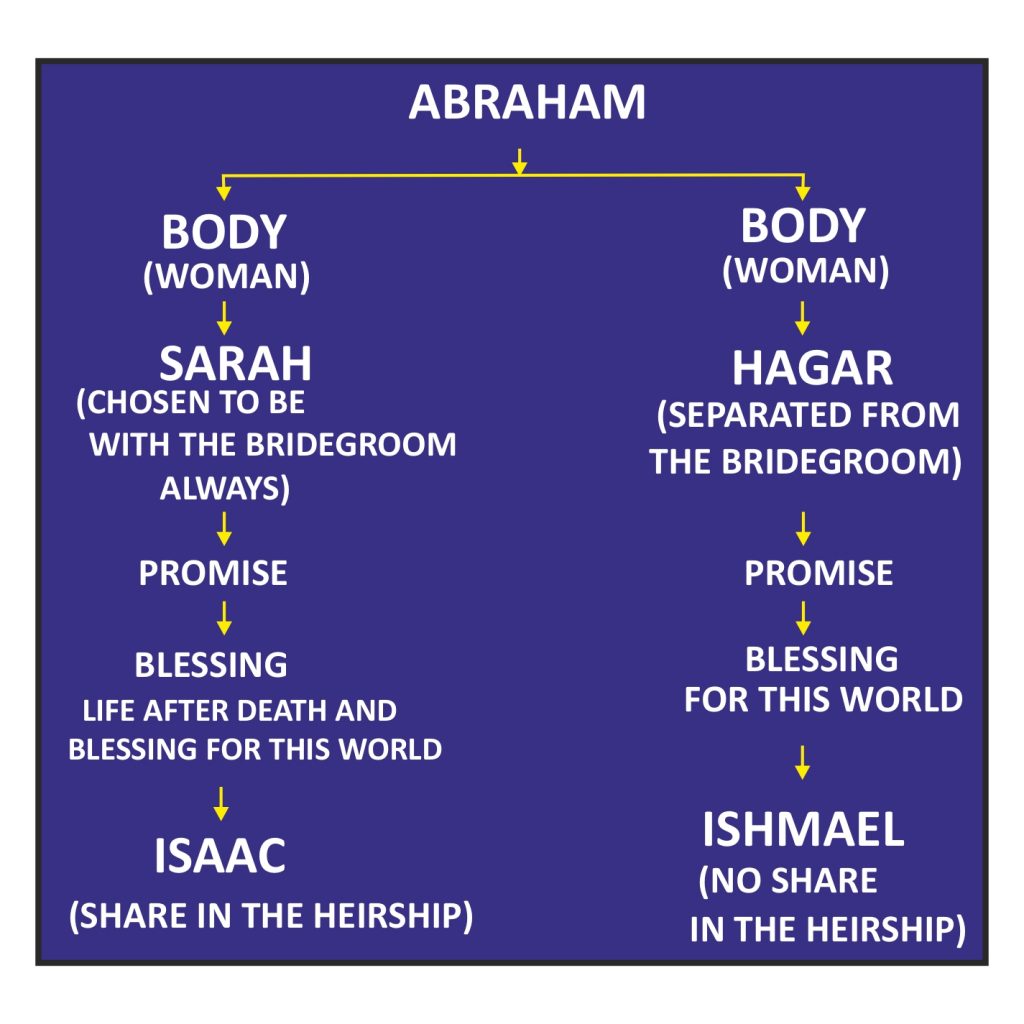
Water is Word. It was given to Abraham. Since the water given by Abraham ran out, the angel showed another well there. The water taken from that well shown by the angel was the promised word ordered to give the blessings of this world. Hagar gave that water to her child. He grew and became older. According to the promise, “I will make you a great nation”, he has become a great nation today. We read in the Bible that he who had received the blessings of the flesh lived in wilderness.
In Genesis 21: 20 it is said like this:
“Wherefore she said unto Abraham, Cast out this bondwoman and her son: for the son of this bondwoman shall not be heir with my son, even with Isaac.”
The water which Abraham drank was in the bottle and fed Ishmael for some time. That Word belonging to eternal life which Abraham had eaten came to an end (or was fulfilled) with the fleshy body of Ishmael.
The fleshy body chosen to give birth to Ishmael was that of Hagar (Hagar's). Body refers to the woman. The woman means the church. Here, two churches are mentioned.
1.Sarah who had received the promise.
2.Hagar who gave birth to Ishmael.
Two divisions of people originated from Abraham. They multiplied through the bodies of two women. One body is Sarah. The other body is Hagar. Both bodies gave birth to sons who had received promise. One promise belongs to this world. The other had got within itself both this world and the world after.
On one side, the promise, given to Abraham through Sarah, who had got grace, comes to Isaac as water. On another side, the promise of Abraham comes to Ishmael as water through Hagar. Hagar was one who separated herself from the bridegroom. She was severed from the bridegroom. Hagar was not with Abraham continuously; because, that grace was not given to her. She gave birth. That is, she got the power to form a dynasty. She received the grace to become a mother of nations. But she did not receive the grace to be in harmony with the bridegroom. Sarah was with her Lord. But Hagar was not like that. Hagar was one who separated herself from the bridegroom.
The water of well which Abraham drank was drunk by Isaac through Sarah. It was ordered to him continuously. But that grace was given to the child of Hagar only for certain time. That grace was not given to him continuously.
After the death of Abraham, Isaac drank the water from the wells that were digged in his father's days.
In Genesis 26:18 it is said like this:
“And Isaac digged again the wells of water, which they had digged in the days of Abraham his father; for the Philistines had stopped them after the death of Abraham: and he called their names after the names by which his father had called them.”
He repaired the stopped wells which were digged by his father and drank that water. That grace was given to him. That grace was perfectly ordered to Isaac from Abraham.
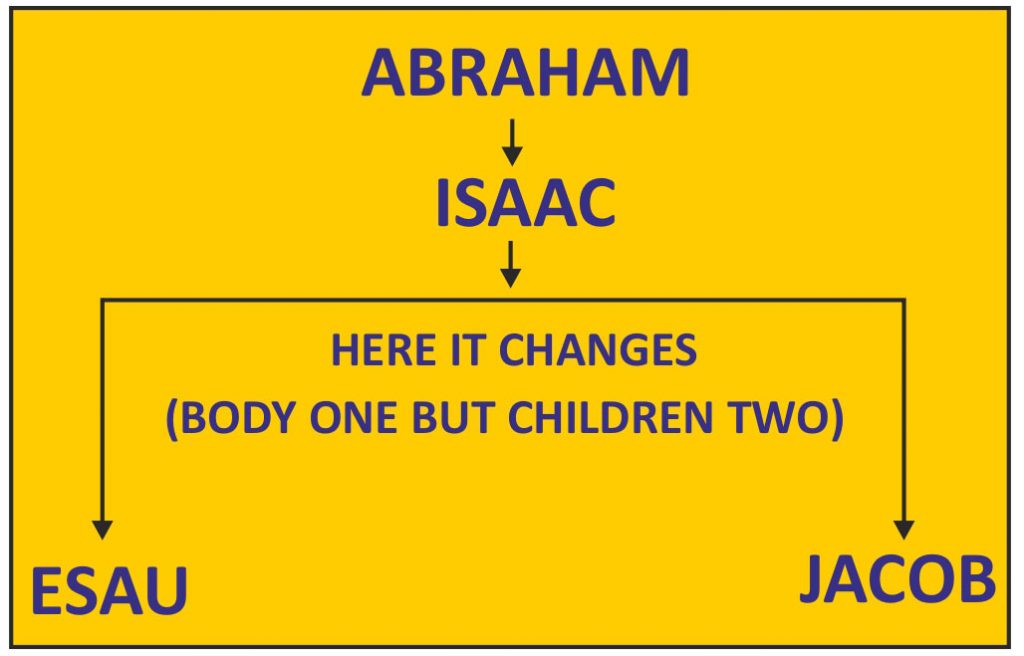
That body divided into two from Isaac. They are
1.Esau
2. Jacob
“Thuravu” in Tamil means “well”. “WELL” is a blessing given where there were a few people. Those people were few at that time. Abraham, Abraham's sons - Isaac and Ishmael - When there were few people like Esau and Jacob, water of well was given. When people multiplied (increased), that water of well was not sufficient, so that water became river water. When the water in the well was insufficient, river water was ordered there.
Isaac drank water from the well digged by his father. He imbibed that word continuously. Even after Abraham's death, Isaac was unswerving in the Word. Even after Abraham's death Isaac was steadfast in the Word ordered to his father, by the Lord. That steadfastness became a blessing to him. Because, he was chosen to bless.
It was a small crowd until Abraham, Isaac and Jacob. Therefore, well of water was ordered. After that, when Israelites became a large crowd, river water was commanded there, because well of water was insufficient.
In Genesis 2:10-14 it is said like this:
“And a river went out of Eden to water the garden; and from thence it was parted, and became into four heads.
The name of the first is Pison: that is it which compasseth the whole land of Havilah, where there is gold;
And the gold of that land is good: there is bdellium and the onyx stone.
And the name of the second river is Gihon: the same is it that compasseth the whole land of Ethiopia.
And the name of the third river is Hiddekel: that is it which goeth toward the east of Assyria. And the fourth river is Euphrates.”
Water taken from the well is for a few people. Water from the river is ordered for a large number of people. Here, a river originates. That originates in a place which the Lord has chosen.
Blessing for the Islamaites was ordered by God's angel. Only by the angel blessing of water was given to Hagar's child. An angel was sent to order a blessing by the Word to the child of Hagar. Only that angel showed the well and said, “Draw the water from the well and give your child”.
Both that promise and the blessing were given through the fleshy body of Hagar because of Abraham. That was ordered to Ishmael and his descendants.
If we view from another side, that blessing was given to Isaac through Sarah. Sarah was chosen to be with the bridegroom always. Observe the differences between Sarah and Hagar carefully. Sarah was chosen to be with the bridegroom always. Hagar was united with the bridegroom to inherit a particular promise. She was seated only to form a seed through her. Here, the works of Hagar were good works. After Ishmael, she did not give birth to any other children. After that, she never married any other husband. She was faithful to her husband. But the purpose of her being chosen is not that she must be a perfect bride.
Sarah's womb was blocked and so Hagar was united in order to form a seed through her. After that matter was fulfilled she was sent away alone. But the blessing given to Ishmael was not given to his descendants. Blessing after this life was not given to his descendants.
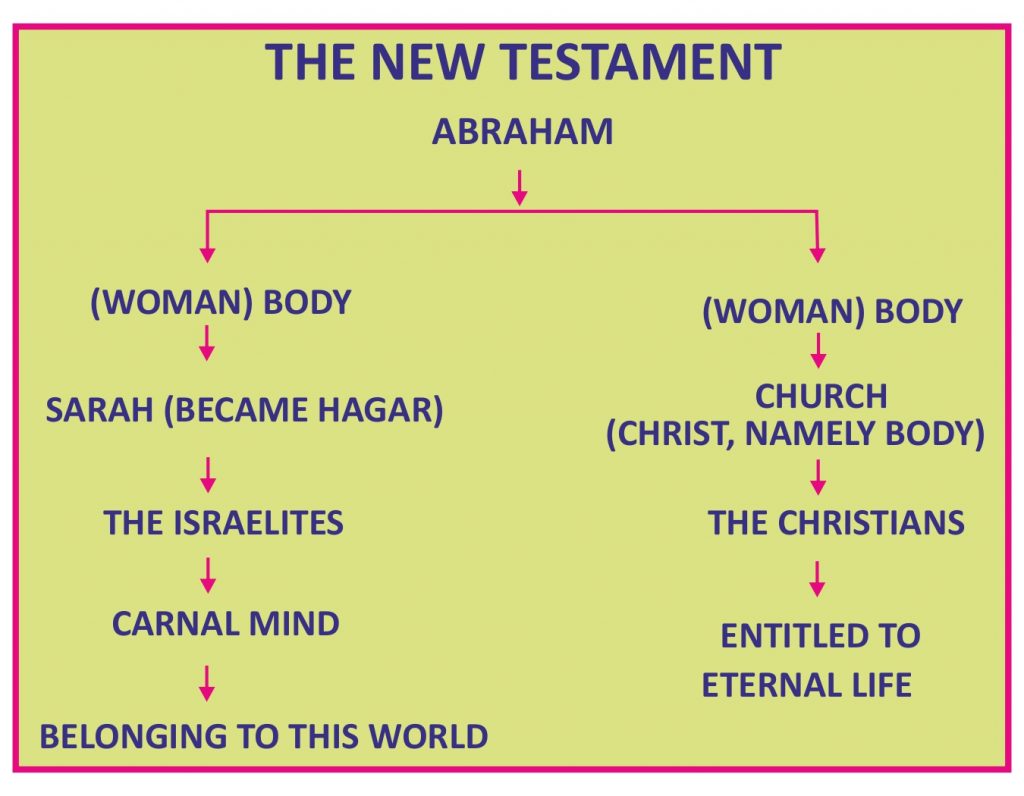
Apostle Paul also says this division of Sarah and Hagar into two categories. Sarah is the mother of Isaac; Hagar of Ishmael. When he speaks of these two women, he says 'Hagar' means 'Sinai' - that is slavery. 'Sarah' means 'New Jerusalem'.
Similarly, among Christians there is a situation of two groups of women who have got promises.
Fleshy bodies of Abraham -1.Sarah 2. Hagar. The angel who came to lead Hagar led the seed of Hagar. So Hagar's dynasty was blessed. Isaac the son of Sarah, seated himself beside the well of Abraham, and inherited all that belonged to his father. Because he was the son of Sarah who was sealed as the bride of Abraham. He is an heir born of the bride. And so he received all the blessings of it. The Israelites began to increase from Isaac as the seed of Sarah. The Israelites received the blessings. This is Old Testament.
When the New Testament began, Paul the angel of the first church witnessed thus:
In Galatians 4:22 - 26 it is said like this:
“For it is written, that Abraham had two sons, the one by a bondmaid, the other by a freewoman.
But he who was of the bondwoman was born after the flesh; but he of the freewoman was by promise.
Which things are an allegory: for these are the two covenants; the one from the mount Sinai, which gendereth to bondage, which is Agar.
For this Agar is mount Sinai in Arabia, and answereth to Jerusalem which now is, and is in bondage with her children.
But Jerusalem which is above is free, which is the mother of us all.”
Apostle Paul has witnessed here that Sarah had become Hagar. The Israelites are the children of Sarah who had received the promise. But they had lost their promise. They were changed into those who were fleshy minded. Therefore, they are witnessed as descendants of Hagar. When the church times began, there were descendants of Sarah in the first church. The Bible says that church is 'woman'. Christ is the head of this church. Blessings came to the Gentiles only through that body, namely, Christ. Just as blessing came to Isaac through the body, namely, Sarah, likewise, through the body, namely church of Christ, the bridegroom's bride, blessings and the word of eternal life are given to the Christians.
In the Old Testament times, a river flowed among the Israelites. That river was known as Jordan. When the ark of God was taken through Jordan, waters rolled back in the opposite direction. The Jordan that had seen such kind of miracles changed in to the water used for cleansing the sins. The river which did the works of witness, changed into the water used for cleansing the sins. It was John the Baptist who changed that water as such. This is New Testament.
In Old Testament times the Jordan was a witness. The Jordan that was a witness became a factor of cleansing the sins.
Now we come into the Last Testament:
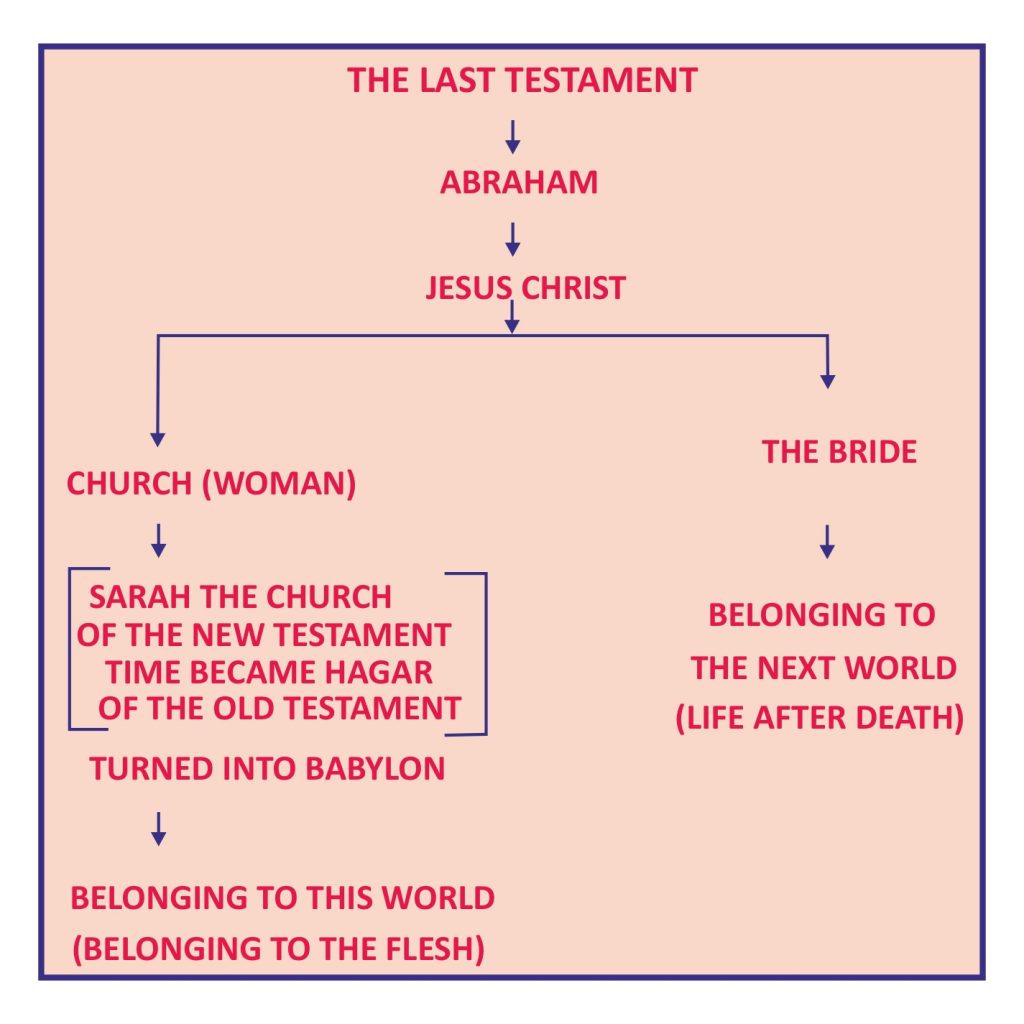
Grace and promise have been ordered to us through the father of Abraham. We have become the children of Abraham through Jesus Christ.
As said before, two fleshy bodies (united) coupled with 'Abraham”
1. The Bride - Sarah
2. Hagar - coupled with Abraham in order to receive one particular thing that is the blessing of this world.
An angel was sent to give Hagar, the blessing of this world. All people who obeyed the word of that angel received the blessing. That angel led the descendants of Ishmael till 5th century AD. After fifth century AD another angel was sent. That angel not only led the fleshy descendants of Ishmael, but all whosoever put their faith on the God of Ishmael, he led them to receive that blessings. Till the end of this earth, there will be the descendants of both Sarah and Hagar on this earth. This is a blessing which the Lord has given to Abraham. It will definitely be fulfilled.
In the given promise, the matter, belonging to eternal life is given to one sect of people. Blessing of eternal life was given to Abraham. The blessing which Abraham received was given to Isaac through Sarah. The blessing which Isaac received comes to Jacob through Rebekah. Jacob received it. Jacob's brother Esau lost it, because there came a situation in which he despised or neglected the works of his hand. Therefore only the seed of Jacob was chosen. The descendants of Jacob are the Israelites. The Clan of Judah was separated from the Israelites. After that, Jesus Christ was sent. Apostle Paul also has witnessed that Sarah and Hagar are divided as two categories.
Esau was separated as one pertaining to flesh. The fleshy people (people who are carnal minded) are descendants of Hagar.
When the time of New Testament began, the descendants of Sarah by flesh, who were Israelites, changed into the descendants of Hagar within spiritual bodies. All these happenings have occurred, keeping the woman as cynosure. In the time of New Testament, the name of the church, namely that woman was Sarah. Sarah who had received the promise was the mother of all Christians. All the Christians became Sarah's descendants. The blessing pertaining to eternal life was with the Christians and only the carnal blessing (the blessing pertaining to the flesh) was ordered to the Israelites who are witnessed as the descendants of Hagar who had lost the eternal life. This is New Testament. These happenings will be changed at the end of the time of the fulfilment of the New Testament. In this manner, the nature of Sarah and the nature of Hagar were seen in each time. Similar state will be formed in the end of the New Testament. The Gentiles, who have become Christians by receiving grace through Jesus Christ, are divided into two categories. One is the seed of (or the descendants of) Sarah. The other is of Hagar. This woman, who is witnessed as Babylon, will be witnessed as having the nature of Hagar the bond woman, in the time of the Last Testament.
As the Hagar of the Old Testament time, the church of the New Testament - the woman in the nature of Sarah, will turn to be fleshy minded. Such a situation will be formed. The woman, namely the church, appeared as the promised one will also change from her status. We have seen that Christ is the head of the church. In the Last Testament, the 'woman' namely, 'the church' will change into Babylon having the nature of Hagar. This Babylon means bondage. The enslaved was Hagar. At the end of the New Testament the woman marked as the mother for Christians (Sarah) and as the free woman, also changes into the nature of Hagar. When we come into the Last Testament, all the churches will be enslaved.
Hagar was the one who had received only the blessing of this world. She has no share in the liberty. That share is the inheritance of heaven. As she cannot get it, she becomes one belonging to the flesh. Sarah who gave liberty (freedom) to the Israelites in the time of the Old Testament would change into the nature of Hagar in the time of the New Testament. This woman rose up as churches in the time of the New Testament. She is a free woman. So she was witnessed as Sarah. In the time of the Last Testament this woman, namely, the church will also lose her freedom. She also becomes a bondwoman with the nature of Hagar.
In every time of the testament, it happens as such. In the Old Testament time Hagar, the mother of Ishmael. In the time of the New Testament, Hagar is the church of Israelites. In the Last Testament time, it will become the churches of the Christians. As it gets into mere fleshy goodness (carnal benefits) it becomes Hagar. In the time of the Last Testament churches will change into carnality. It will be like the nature of Hagar who cannot give birth to inheritors.
In the Last Testament, churches change carnally, and become the descendants of Hagar. The woman, namely, the church will act merely as a carnal woman. So she will stand against the bride.
The nature of the bride is the nature of being linked always with the husband. Sarah was united with Abraham till the end. But Hagar is separated from the bridegroom and is sent away. The bride 'Sarah' belongs to eternal life. The works of the bride are the works acknowledged by God.
At first we saw that the water drawn from the well had two natures.
1. First is “of this world”.
2. Second is “of the next world (Life after death)”.
Similarly, river is also divided as having two natures.
1. One is“of this world”.
2. The other is “of the next world (Life after death)”.
This life after death means 'eternal life'. Of this world means 'death'. We saw that Hagar is of this world. Sarah is of eternal life. She is the bride having the inheritors who have eternal life.
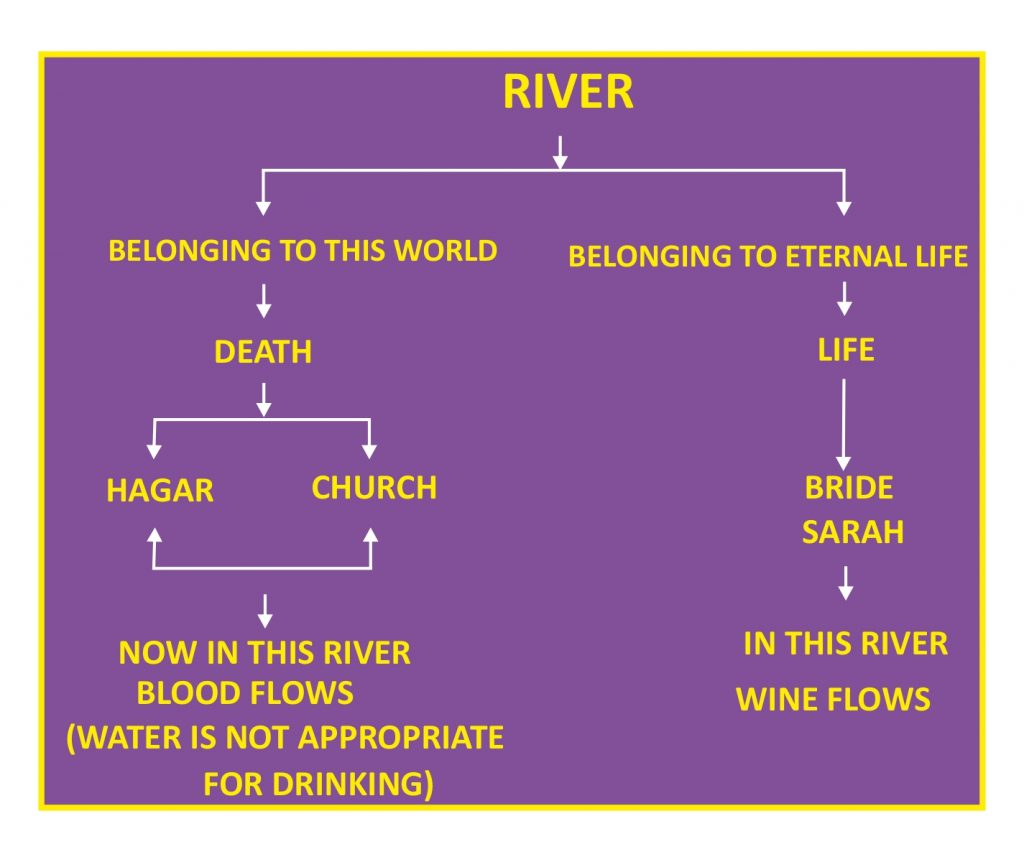
This river is witnessed as divided into two categories originating from Eden, where Adam pertaining to life, was settled to live.
It is coming with two divisions - one is of this world; the other is of the next world (life after death). Only the river of this world will flow into the churches that are in a state of having lost their life. In the Last Testament, people of this world who drink the water of this river will flow with blood. In this river, where those who were predestined to drink wine, will be flowing. The descendants of carnal Hagar drink the water of river which will turn into blood. This water is not suitable for life.
In the time of the Last Testament, a situation, where a ram will stand by this river, will be witnessed.
In Daniel 8: 3 - 7 it is said like this:
“Then I lifted up mine eyes, and saw, and, behold, there stood before the river a ram which had two horns: and the two horns were high; but one was higher than the other, and the higher came up last.
I saw the ram pushing westward, and northward, and southward; so that no beasts might stand before him, neither was there any that could deliver out of his hand; but he did according to his will, and became great.
And as I was considering, behold, an he goat came from the west on the face of the whole earth, and touched not the ground: and the goat had a notable horn between his eyes.
And he came to the ram that had two horns, which I had seen standing before the river, and ran unto him in the fury of his power.
And I saw him come close unto the ram, and he was moved with choler against him, and smote the ram, and brake his two horns: and there was no power in the ram to stand before him, but he cast him down to the ground, and stamped upon him: and there was none that could deliver the ram out of his hand.”
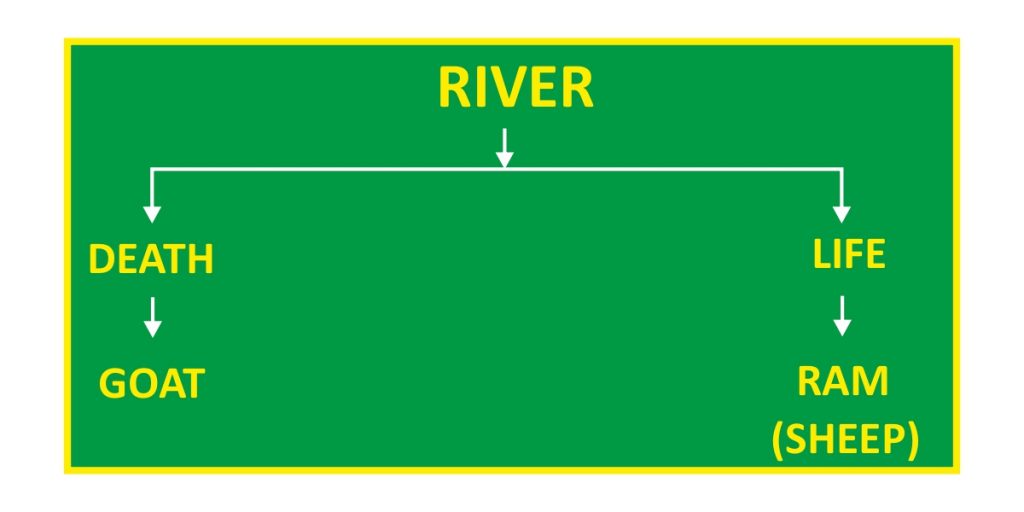
This river is divided into two categories. It is divided in such a way that its water has two kinds of nature. One is Life. The other is Death. In front of this river, a ram stood. It had two horns. It is witnessed that the sheep that stood there was Sarah and the ram that stood there was Hagar.
In Daniel 8:8-12 it is said like this:
“Therefore the he goat waxed very great: and when he was strong, the great horn was broken; and for it came up four notable ones toward the four winds of heaven.
And out of one of them came forth a little horn, which waxed exceeding great, toward the south, and toward the east, and toward the pleasant land.
And it waxed great, even to the host of heaven; and it cast down some of the host and of the stars to the ground, and stamped upon them.
Yea, he magnified himself even to the prince of the host, and by him the daily sacrifice was taken away, and the place of his sanctuary was cast down.
And an host was given him against the daily sacrifice by reason of transgression, and it cast down the truth to the ground; and it practised, and prospered.”
Four notable horns came up for this he-goat. This he-goat removed the daily sacrifice. It cast down the truth and stamped upon the ram. Further its kingdom became stronger. It casts down the truth on the ground; the ground means “earthly thing”. It is, knowing the truth with the carnal and the earthly mind. It means that the spiritual happenings will be delivered to the earthly things.
We the Christians offer all the supplications to be kept in the presence of God and pray only for our carnal needs (fleshy needs). That is a state of forgetting the will of God. That is the state of Hagar. Hagar belongs to this earth. She belongs to this world. Sarah belongs to the life after death. She belongs to eternal life. The children she bore belong to eternal life. Only they will inherit the promise. The promise He has given to us is, “I will give eternal life”. This is the new covenant.
The Israelites who were belonging to eternal life in the time of the Old Testament became they who were belonging to this world. They began to seek the Lord only for the things of this world. Therefore, the church, namely the body of Christ began to rise up. They, who were united with it, drank the water namely the Word of Christ. They, who drank the water of that river belonging to eternal life, became those who are entitled to eternal life. In the time of the Last Testament, the woman, namely the church will change into one as having the nature of Hagar. The he-goat cast down the spiritual mind, by possessing the carnal (fleshy) things.
It is the prophecy that all the churches must become the tents of harlots. The Bible witnesses in Revelation 18:4 that Babylon is the great whore that sits upon many waters.
In the time of the Last Testament the bride must come out of the tent of that whore. These will be announced as gospel. The Word calls, “you come out so that you be not partakers of her plagues”. His bride will pay heed to His Word.
The sheep of His flock will come out of her. The he-goat will not come out of her. The he-goat will not obey His truth. The sheep will obey His truth. The he-goat will gather in the flock on the left side. The sheep will gather in the flock on the right side.
Both are flocks. Both Esau and Jacob are the children of Isaac. Ishmael born in the dynasty of Hagar and Isaac born in the womb of Sarah are the children of Abraham. All the Christians become the children of Abraham in the dominion. But among them, one who belongs to eternal life on the right side and the other, who belongs to death on the left side, are divided into two. The one who belongs to eternal life is the bride chosen to be with the bridegroom always. The bride comes running to wilderness. Reason - the Word will come out from the wilderness.
The heirs will come out of her and come to wilderness. Hagar was not an whore by body. She was faithful to Abraham. Likewise the churches that rise up as Babylon are not fornicators by flesh. But they will be spiritually witnessed as whores.
In Revelation 12:6 it is said like this:
“And the woman fled into the wilderness, where she hath a place prepared of God, that they should feed her there a thousand two hundred and threescore days.”
1260 days - 3 ½ years -3 ½ generations. Sarah must be in the wilderness. Because, it is the decision. The promised woman is in the wilderness in order to birth her child. The children, whom she gives birth to be in the wilderness, are the children who are going to inherit the promise. The children who are borne within the organisations, the churches, and within the glory of the tent will be seen as the inheritors of only the fleshy promise.
May the Lord grant us His grace, so that we will be doers of His Word and be inheritors of the promise of eternal life.
Amen! Amen!! Amen!!!
(அறிவிக்கப்பட்ட நாள்: 01.09.2013)
யோவா. 2: 5 - 10-ல் இவ்விதமாகக் கூறப்பட்டுள்ளது:
"அவருடைய தாய் வேலைக்காரரை நோக்கி: அவர் உங்களுக்கு என்ன சொல்லுகிறாரோ, அதன்படி செய்யுங்கள் என்றாள்.
யூதர்கள் தங்களைச் சுத்திகரிக்கும் முறைமையின்படியே, ஒவ்வொன்று இரண்டு மூன்று குடம் தண்ணீர் கொள்ளத்தக்க ஆறு கற்சாடிகள் அங்கே வைத்திருந்தது.
இயேசு வேலைக்காரை நோக்கி: ஜாடிகளிலே தண்ணீர் நிரப்புங்கள் என்றார்; அவர்கள் அவைகளை நிறைய நிரப்பினார்கள்.
அவர் அவர்களை நோக்கி: நீங்கள் இப்பொழுது மொண்டு, பந்திவிசாரிப்புக்காரனிடத்தில் கொண்டுபோங்கள் என்றார்; அவர்கள் கொண்டுபோனார்கள்.
அந்தத் திராட்சரசம் எங்கேயிருந்து வந்ததென்று தண்ணீரை மொண்ட வேலைக்காரருக்குத் தெரிந்ததேயன்றி பந்திவிசாரிப்புக்காரனுக்குத் தெரியாததினால், அவன் திராட்சரசமாய் மாறின தண்ணீரை ருசிபார்த்தபோது, மணவாளனை அழைத்து:
எந்த மனுஷனும் முன்பு நல்ல திராட்சரசத்தைக் கொடுத்து, ஜனங்கள் திருப்தியடைந்தபின்பு, ருசிகுறைந்ததைக் கொடுப்பான், நீரோ நல்ல ரசத்தை இதுவரைக்கும் வைத்திருந்தீரே என்றான்."
பொதுவாக எல்லா கிறிஸ்தவ திருமண வீடுகளிலும் மணமகனையும், மணமகளையும் ஆசீர்வதித்துப் பேசும்போது, இந்தக் கானாவூர் கலியாண வீட்டில் கர்த்தர் செய்த அற்புதத்தினைக் குறித்துப் பேசுவதை நாம் பார்க்க முடியும். அந்தத் திருமணவீட்டில் ஒரு குறைவு ஏற்பட்டது. நமது இல்லத் திருமணங்களில் நாம் இனிப்பு வழங்குவதுபோல, யூதர்கள் தங்கள் வீட்டு விசேஷங்களில் திராட்சரசம் பரிமாறுவது வழக்கம். திராட்சரசம் குறைவுபட்டால், அந்த நிகழ்ச்சியினை அந்த வீட்டார் சரியாக நடத்தவில்லை என்று அர்த்தம். இந்த திராட்சரசம் அன்று நடந்த கானாவூர் திருமண வீட்டில் காலியாகி விட்டது. எனவே அதனை உடனடியாக ஆயத்தம்பண்ண வேண்டும் என்ற நிலை வந்தது. அந்த இடத்தில் இருந்த குறைவு கர்த்தர் வந்ததினால் ஆசீர்வாதமாக மாறியது. அனைவரும் சாப்பிட்டுத் திருப்தியடைந்தார்கள் என்பதால், இன்று எல்லாத் திருமண வைபவங்களிலும் இந்தக் காரியத்தினைக் குறித்துப் பேசுவதைப் பார்க்கின்றோம். ஏனென்றால், இது இயேசுகிறிஸ்து செய்த முதலாம் அற்புதம்.
திராட்சரசம் தீர்ந்துவிட்டது என்றவுடன், வேலைக்காரர்களைப் பார்த்து இயேசுகிறிஸ்துவின் தாயார் கூறுகின்றார்: அவர் உங்களுக்கு என்ன கூறுகின்றாரோ, அதின்படி செய்யுங்கள் என்று. அவருடைய தாயிடம் அவர்: என் வேளை இன்னும் வரவில்லை என்று பதில் கூறினார். அதன்பின்னரே வேலைக்காரர்களை நோக்கி அவருடைய தாய்: இவர் உங்களுக்கு என்ன கூறுகின்றாரோ, அதின்படி செய்யுங்கள் என்றார்.
கற்சாடிகளில் வெறும் தண்ணீர் நிரப்பப்படுகின்றது. அதன்பின்னர் அவர் வேலைக்காரரைப் பார்த்து, இந்தக் கற்சாடிகளில் நீங்கள் நிரப்பிய தண்ணீரை மொண்டு கொண்டுபோய் பந்திவிசாரிப்புக்காரர்களிடம் கொடுங்கள் என்றார். உடனே வேலைக்காரர்கள் அதை எடுத்து பந்திவிசாரிப்புக்காரனிடம் கொடுக்கின்றார்கள். பந்திவிசாரிப்புக்காரன் அதனைப் பந்தியில் பரிமாறும்போது அது திராட்சரசமாக மாறியிருந்தது. அதைப் பருகியவர்கள், இத்தனை ருசியுள்ள திராட்சரசத்தினை முன்னர் கொடுக்காமல் கடைசியில் கொடுக்கின்றீரே என்று கேட்கின்றார்கள். அந்த வேலைக்காரருடைய செயல்களை எண்ணிப் பாருங்கள். அவர்கள்தான் உண்மையான கர்த்தருடைய ஊழியக்காரர்கள்.
ஒவ்வொரு காலத்திலும் கர்த்தர் ஒவ்வொருவிதமான கிரியைகளை நடப்பித்துள்ளார். அந்தக் கற்சாடிக்குள் தண்ணீரை ஊற்றினால்தான் அங்கே திராட்சரசத்தினை உருவாக்க முடியுமா? தண்ணீரே இல்லாமல் அவரால் திராட்சரசத்தினைக் கொண்டுவர முடியும். எதுவுமே இல்லாமல் அந்தக் கற்சாடிகளுக்குள் அவரால் திராட்சரசத்தினை உருவாக்கமுடியும்.
வேதம் கூறுகின்றது, விசுவாசமில்லாமல் தேவனிடத்திலிருந்து ஒன்றையும் பெற்றுக்கொள்ள முடியாது என்று. வேலைக்காரர்களிடம் மரியாள், அவர் எவைகளைச் செய்யக் கட்டளையிடுகின்றாரோ, அவைகளைச் செய்யுங்கள் என்றார். இதுதான் அவர்களுக்குக் கொடுக்கப்பட்ட கட்டளை.
வேலைக்காரர்கள் வேறு எந்தக் காரியத்தினைக் குறித்தும் சிந்திக்கவில்லை. சுத்திகரிப்பின் முறைமைக்காக வைக்கப்பட்டிருந்த கற்சாடிகளில் தண்ணீரை இப்போது ஏன் ஊற்றக் கூறுகின்றீர் என்று கேட்கவில்லை. அதில் தண்ணீரை ஊற்று என்றவுடன் தண்ணீரை ஊற்றினார்கள். அதனை மொண்டு கொண்டுபோய் பந்திவிசாரணைக்காரர்களிடம் கொடுங்கள் என்றவுடன், வேறு எதுவும் பேசாமல் பந்திவிசாரிப்புக்காரர்களிடத்தில் கொண்டுபோய்க் கொடுத்தார்கள். இவர்கள்தான் உண்மையும் உத்தமமும் உள்ள வேலைக்காரர்கள்.
ஆட்டுக்குட்டியானவருடைய திருமணத்திற்காக மணவாட்டி ஆயத்தமாகி கொண்டிருக்கின்றாள். ஆட்டுக்குட்டியானவருடைய திருமணத்திற்காகக் கர்த்தர் ஒரு சில கிரியைகளைச் செய்யவேண்டுமென்று விரும்புகின்றார். அதற்காக அவருக்கு உண்மையுள்ள வேலைக்காரர்கள் தேவைப்படுகின்றார்கள். கானாவூர் திருமணத்தில் இந்த அற்புதத்தினை செய்வதற்கு முன்பாக அவர் தண்ணீரைத் திராட்சரசமாக மாற்றவில்லை; மரித்த லாசருவை அப்போது அவர் உயிரோடு எழுப்பியிருக்கவில்லை; குருடனுடைய கண்களைத் திறந்திருக்கவில்லை. எந்தவிதமான அற்புதங்களையும் அதற்கு முன்னர் அவர் செய்யவில்லை. இந்த நிலையில், இயேசு ஒரு தச்சன் மகன் என்பதுதான் அவர்களுக்குத் தெரியும். ஆனாலும், அந்த வேலைக்காரர்கள் மறுமொழியாக ஒன்றும் கேட்கவில்லை.
தண்ணீர் - வார்த்தை. அந்த வார்த்தையினைக் கொண்டுபோய் ஆட்டுக்குட்டியானவரின் கல்யாணவீட்டில் ஊற்றுங்கள் என்று ஒரு கட்டளை பிறப்பிக்கப்படும். ஊற்றப்படும் தண்ணீராகிய வார்த்தை ரசமாகும்போது அது ஜீவனைக் கொடுக்கும். அந்த ஜீவன்தான் ஆத்துமாவிற்கு நித்திய ஜீவனைக் கொடுக்கின்றது. ஆவிக்குரியதாய் ஊற்றப்படும் தண்ணீராகிய வார்த்தை மாற்றி அமைக்கப்பட்டு மாமிசத்திற்குரிய காரியமாகிவிடும். அப்படிப்பட்ட நிலையில் தண்ணீர் திராட்சரசமாக மாறாது.
ஆவிக்குரிய சரீரத்திற்குரியதான வேதாகமம் மாமிசத்திற்குரிய காரியத்திற்காகத் திருப்பப்பட்டுக் கொண்டிருக்கின்றது. கிருபையின் காலம் நிறைவுபெற்ற பின்னர் ஆவிக்குரியதாக எழுதப்பட்டுள்ள வேதாகமம் முழுவதுமாக மாமிசத்திற்குரியதாக மாறிவிடும். காரணம், ஆவிக்குரிய இடைபாடு அப்போது இருக்காது. ஆவிக்குரிய இடைபாடுதான் ஜீவனுக்கென்றும் மரணத்திற்கென்றும் வேறுபிரிக்கின்றது. அப்படி வேறுபிரிக்கவே பிரமாணம் வார்த்தையாய் சாட்சியிடப்படுகின்றது.
வெறும் கற்சாடியில் தண்ணீரை நிரப்பு என்று கூறினால், ஊழியர்கள் தண்ணீரை நிரப்பிவிடுவார்கள். ஆனால் அதனைக் கொண்டுபோய் பந்திவிசாரிப்புக்காரர்களிடம் கொடு என்றால் எப்படியான நிலையில் இது அவர்களுக்குக் காணப்படும்? சற்று சிந்திப்பீர்! கற்சாடியில் தண்ணீரை ஊற்று என்ற கட்டளையின் பேரில் தண்ணீரை ஊற்றியாயிற்று. இப்போது அதனை பந்திவிசாரிப்புக்காரர்களிடம் கொண்டுபோய் கொடு என்றால் அந்த வேலைக்காரன் எப்படியாக செயல்படுவான்? ஊற்றப்பட்டது தண்ணீர்; அதனை அந்தப் பணியாளர்கள் அறிவார்கள். திராட்சரசத்திற்குப் பதிலாக அந்தத் தண்ணீரைக் கொண்டுபோய் பந்திவிசாரிப்புக்காரரிடத்தில் ஒப்படைக்கும்போது, அவர்களின் நிலை எப்படி இருக்கும்? அதற்கு முன்னர் அவர் அத்தகைய அற்புதங்களைச் செய்யவில்லை. அப்படியாக அற்புதம் செய்யக்கூடிய வல்லமை அவரிடத்தில் இருந்தது என்பது அந்த வேலைக்காரருக்குத் தெரியாது. ஆனாலும் அவர்கள் மாறுத்தரமாக எதுவும் கூறாமல், கற்சாடியில் நிரப்பப்பட்ட தண்ணீரை அவர் கூறியதின்படி பந்திவிசாரிப்புக்காரரிடத்தில் கொடுத்தார்கள்.
கர்த்தர் ஒவ்வொரு காலத்திலும் ஒரு வார்த்தையினைத் தண்ணீராய் ஊற்றக் கட்டளையிடுகின்றார். அதனை ஊழியக்காரர்கள் எடுத்துச்சென்று ஜனங்களண்டையில் ஊற்றவேண்டும். கர்த்தருடைய ஊழியக்காரர்கள் அந்த நாளுக்கென்று கட்டளையிடப்பட்ட தண்ணீராகிய வார்த்தையினைக் கொண்டுவந்து சுவிசேஷமாய் அறிவிப்பார்கள். அன்றைக்கென்று கட்டளையிடப்பட்ட வார்த்தையைக் கொண்டுவந்து சுவிசேஷமாய் அறிவிப்பவன் உண்மையுள்ள ஊழியக்காரன்.
கற்சாடிகளில் தண்ணீர் நிரப்பப்படுகின்றது. நிரப்பப்பட்ட தண்ணீரான வார்த்தைக்குக் கர்த்தர் ஜீவனைக் கொடுக்கின்றார். ஜீவனைப் பெற்றுக்கொண்ட அந்தத் தண்ணீர் ரசமாக மாறுகின்றது. இது ஜீவனுக்குரிய மாறுதல்; இரசம் ஜீவனுக்குரியவர்களாக மாற்றுகின்றது.
அதினதின் காலத்தில் கர்த்தர் கட்டளையிட்டபடி செய்பவர்கள் அவருக்கு உண்மையுள்ளவர்கள். ஆட்டுக்குட்டியானவரோடு இருந்து, மிருகத்திற்கு எதிரான யுத்தத்தினைச் செய்பவர்கள் உண்மையுள்ளவர்கள் என்று வேதம் கூறுகின்றது.
தலைமுறைகள் மாறி வரும்போது ஆவிக்குரிய நிகழ்வுகளில் இருக்கக்கூடிய விசுவாசமும் குறைந்துகொண்டே வருகின்றது. இப்போதே பிசாசு என்றால் 90% கிறிஸ்தவர்கள் நம்புவது இல்லை. பிசாசு என்பது ஒரு மனோதத்துவ ரீதியான பாதிப்பு என்றுதான் கற்றறிந்தவர்கள் மத்தியில் கூறப்படுகின்றது. இது நன்மைதீமை அறியத்தக்க விருட்சத்தின் கனியினைப் புசிப்பதால் வரும் விளைவு ஆகும். நன்மைதீமை அறியத்தக்க விருட்சத்தின் கனி கொடுப்பது இந்தப் பூமிக்குரிய சிந்தையாகும். இந்த விருட்சத்தின் கனியினைப் புசிப்பவர்களுக்கு ஜீவ விருட்சத்தின் கனி கொடுக்கப்படுவதில்லை.
இம்மைக்குரிய காரியங்களை மாத்திரம் சிந்திப்பவர்கள் மறுமை என்ற நித்திய ஜீவனைக் காண அனுமதிக்கப்படுவதில்லை. கர்த்தர் கூறினார்: கற்சாடியில் தண்ணீரை நிரப்புங்கள் என்று. தண்ணீர் நிரப்பப்பட்டபோது, நிரப்பப்பட்ட அந்தத் தண்ணீர் திராட்சரசமாக இல்லை என்பது தண்ணீர் ஊற்றிய வேலைக்காரர்களுக்குத் தெரியும். அதனை மொண்டுசென்று பந்திவிசாரிப்புக்காரர்களிடம் கொடு என்று கட்டளையிடப்பட்டபோது, மாறுத்தரமாக அவர்கள் எதுவும் கூறவில்லை.
இன்று திருமண வீடுகளில்,
"கலியாணமாம் கலியாணம்
கானாவூர் கலியாணம்
கர்த்தர் இயேசு கனிவுடனே
கலந்துகொண்ட கலியாணம்" - என்று பாடல் பாடுகின்றார்கள். அதுபோல திருமண அழைப்பிதழ் அச்சடித்தவுடன் முதலில் ஆலயத்தில் கர்த்தருடைய சந்நிதியில் (altar) கொண்டுபோய் வைப்பதுண்டு. அது ஏன் என்றால், முதல் பத்திரிக்கையினைக் கர்த்தருக்குக் கொடுத்துவிட்டுத்தான் மற்றவர்களுக்குக் கொடுக்க வேண்டும் என்ற சிந்தையாகும். கானாவூர் கலியாண வீட்டினில் திராட்சரசம் குறைந்தபோது கர்த்தர் நிறைவைக் கட்டளையிட்டதுபோல, தங்களுடைய வீட்டினில் ஏதாவது குறைவுபட்டால், அவைகளை நிறைவுபடுத்த வேண்டும் என்ற எண்ணம் காணப்படுகின்றது. கானாவூர் கலியாணவீட்டில் கர்த்தர் அற்புதம் செய்தார். அப்படியான அற்புதம் தங்களிடமும் நிகழவேண்டும் என்ற எண்ணம் இயல்பானதே. ஆனால், வேதாகமம் மாமிசத்திற்குரிய சிந்தையோடு எழுதப்படவில்லை. மாமிசத்திற்குரியவைகள் நமக்குத் தேவைதான். சத்தியத்தினை விசுவாசித்தால், மாமிசத்திற்குரியவைகள் நமக்குக் கூடக் கொடுக்கப்படும். சத்தியத்தினை ஏற்று விசுவாசிக்கும்போது, மாமிசத்திற்குரியவைகள் நாம் கேட்காமலேயே நமக்குக் கொடுக்கப்படும். அழிந்துபோகின்ற புல்லுக்கு ஒப்பாயிருக்கின்றவனுக்குக் கர்த்தர் இந்த ஆசீர்வாதங்களைக் கொடுக்கும்போது, அழியாத ஜீவனுக்குரிய தன்னுடைய பிள்ளைகளுக்கு இவைகளைக் கொடுப்பது அதிக நிச்சயமான ஒன்றே. ஆனால், இம்மைக்குரிய காரியங்களுக்காக மாத்திரம் கர்த்தரை நாடுபவன் ஏசா என்றே வேதம் சாட்சியிடுகின்றது.
ஆதி. 21: 14-ல் இவ்விதமாகக் கூறப்பட்டுள்ளது:
"ஆபிரகாம் அதிகாலையில் எழுந்து, அப்பத்தையும் ஒரு துருத்தி தண்ணீரையும் எடுத்து, ஆகாருடைய தோளின்மேல் வைத்துப் பிள்ளையையும் ஒப்புக்கொடுத்து, அவளை அனுப்பிவிட்டான்; அவள் புறப்பட்டுப்போய், பெயர்செபாவின் வனாந்தரத்திலே அலைந்து திரிந்தாள்."
கானாவூர் கல்யாண வீட்டினில் கற்சாடிகளில் தண்ணீர் நிரப்பப்பட்டதுபோன்று, ஆகாரிடமும் ஒரு துருத்தியில் தண்ணீர் கொடுக்கப்பட்டது. அந்தத் தண்ணீர் இஸ்மவேலுக்காகக் கொடுக்கப்பட்டது. ஆகார் மூலமாகவும் ஒரு சந்ததி உருவாகவேண்டும் என்பது தேவதிட்டம்.
ஆகாரின் குமாரனான இஸ்மவேல் வாக்குத்தத்தம் பெற்ற சாராளுடைய பிள்ளையான ஈசாக்கினைப் பரியாசம் செய்தான். அதனால், ஆகாரையும் ஆகாருடைய பிள்ளையினையும் புறம்பே தள்ளவேண்டும் என்ற ஒரு சூழல் உருவானது. இஸ்மவேலுக்குச் சுதந்திரத்தில் பங்கு கிடையாது. எனவே அந்த அடிமையையும், அவள் பிள்ளையையும் புறம்பே தள்ளு என்று அறிவிக்கப்பட்ட சாராளுடைய வார்த்தையை கர்த்தர் அங்கீகரித்தார். எனவே துருத்தியின் தண்ணீர் ஆபிரகாம் மூலம் கொடுத்து அனுப்பப்பட்டது. கர்த்தர் கட்டளையிட்டபடி ஆகாரிடம் ஒரு துருத்தியில் தண்ணீரைக் கொடுக்கின்றார். தனது பிள்ளைக்குக் கொடுப்பதற்காக, தான் பருகக்கூடிய அந்தத் தண்ணீரை ஒரு துருத்தியில் எடுத்துக் கொடுக்கின்றார்.
தண்ணீர் என்பது வார்த்தை. ஆபிரகாம் கொடுத்த துருத்தியில் தண்ணீர் இருந்தது. அந்தத் தண்ணீரானது வார்த்தை, வாக்குத்தத்தம். அந்தத் தண்ணீர் ஜீவனுக்கென்று பிரிக்கப்பட்ட ஆபிரகாம் மூலம் கொடுக்கப்பட்ட தண்ணீர். ஆபிரகாம் ஜீவனுக்குரியவன். அந்தத் துருத்தியில் கொடுக்கப்பட்ட தண்ணீர் ஜீவனுக்குரிய தண்ணீர். ஆபிரகாம் ஜீவனுக்குரிய தண்ணீரைத்தான் இஸ்மவேலுக்குக் கொடுத்தான். தன் பிள்ளை ஆக்கினைக்குள் பிரவேசிக்கப் போவதை அவன் விரும்பவில்லை. அதனால் அவன் அந்தத் துருத்தியில் தண்ணீரை வைத்துக் கொடுத்தான்; நீ இந்தப் பிள்ளைக்குக் கொடு என்று அது ஆகாரிடம் ஒப்படைக்கப்பட்டது.
அந்தத் தண்ணீரை ஆகார் எடுத்துக்கொண்டு போகின்றாள். அவள் வனாந்திரத்தில் அலைந்து திரிந்தபோது, அந்தத் தண்ணீர் தீர்ந்துபோயிற்று. கொடுக்கப்பட்ட வார்த்தை அதுவரையிலும் அவர்களை நடத்திற்று. அதற்குப்பின்னர் அந்த வார்த்தை அவர்களுக்கு உரியதாக இல்லை. ஏனென்றால், அது தீர்ந்துவிட்டது. வார்த்தை அப்படித்தான் இருக்கின்றது.
இஸ்மவேலும் தண்ணீர் பருகினான். ஈசாக்கும் தண்ணீர் பருகினான். ஈசாக்கு தன் தகப்பனோடு இருந்தான். தகப்பன் மரிக்கின்றவரையிலும் எந்தத் தண்ணீரைக் குடித்தாரோ, அந்தத் தண்ணீரையே ஈசாக்கும் குடித்தான். ஆனால், அந்தக் கிருபை இஸ்மவேலுக்குக் கொடுக்கப்படவில்லை. இஸ்மவேலுக்குக் கொடுக்கப்பட்டது துருத்தியின் தண்ணீர், அது தீர்ந்துவிட்டது. அதனால் ஜீவனுக்குரிய கிரியை அவன் சந்ததிக்கு இல்லை.
இஸ்மவேலுக்கு கர்த்தர் கட்டளையிட்ட ஆசீர்வாதம், அது இம்மைக்குரிய ஆசீர்வாதமாகும். ஆனால், ஈசாக்கிற்குக் கொடுக்கப்பட்ட ஆசீர்வாதமோ மறுமைக்கும் உரிய ஆசீர்வாதமாகும். ஜீவன் என்பது மறுமைக்குரிய ஆசீர்வாதமாகும். இம்மைக்குரிய ஆசீர்வாதம் இஸ்மவேலுக்கும், மறுமைக்குரிய ஆசீர்வாதம் ஈசாக்கிற்கும் கொடுக்கப்பட்டது. ஈசாக்கிற்கு அந்த ஆசீர்வாதம் சாராள் மூலம் கட்டளையிட்டப்பட்டது. இஸ்மவேலுக்குக் கொடுக்கப்பட்ட இந்த ஆசீர்வாதம் ஆகார் மூலம் கட்டளையிடப்பட்ட ஆசீர்வாதமாகும். அது சுதந்திரத்தினை மறுமையில் பெற இயலாத இம்மைக்குரிய ஆசீர்வாதம் மாத்திரமே.
சாராள், ஆகார் என்ற இரண்டு ஸ்திரிகளில், சாராள் மூலமாகக் கொடுக்கப்பட்ட தண்ணீர் மாத்திரமே ஜீவனுக்குரிய தண்ணீராகும்; ஆகார் மூலமாகக் கொடுக்கப்பட்ட தண்ணீர் இம்மைக்காக மாத்திரம் ஆசீர்வாதத்தினைக் கொடுக்கக்கூடிய தண்ணீராகும். சாராளுக்கும், ஆகாருக்கும் ஆபிரகாம் மூலமாகத்தான் தண்ணீர் கிடைத்தது. ஏனென்றால், இந்த ஆசீர்வாதத்தினைக் கர்த்தர் ஆபிரகாமிற்குக் கொடுத்திருந்தார். ஆபிரகாம் தன்னுடைய மாமிச சரீரமாகக் காணப்பட்ட சாராளுக்கும், ஆகாருக்கும் அதனைப் பிரித்துக் கொடுத்தார்.
ஆதி. 21: 19-ல் இவ்விதமாகக் கூறப்பட்டுள்ளது:
"தேவன் அவளுடைய கண்களைத் திறந்தார். அப்பொழுது அவள் ஒரு தண்ணீர்த் துரவைக் கண்டு, போய், துருத்தியிலே தண்ணீர் நிரப்பி, பிள்ளைக்குக் குடிக்கக் கொடுத்தாள்."
ஆபிரகாம் ஒரு துருத்தி தண்ணீரை இஸ்மவேலுக்காக ஆகாரின் கையில் கொடுத்தார். தண்ணீர் தீர்ந்துபோனபோது, தனது பிள்ளை சாகப்போவதை தான் பார்க்கமாட்டேன் என்று திரும்பிக்கொள்கின்றாள். இங்கே வேறொரு தண்ணீர் துரவு காட்டப்படுகின்றது. அந்தத் துரவிலிருந்து மொண்டு துருத்தியில் நிரப்புகின்றாள். அது ஆபிரகாம் மொண்டு கொடுத்த துரவின் தண்ணீரைப் போல் அல்ல. காரணம், அந்தத் தண்ணீர் வாக்குத்தத்தம் பெற்ற ஆபிரகாம் கொடுத்த தண்ணீர் அல்ல.
ஆபிரகாம் கொடுத்த தண்ணீரில் ஜீவன் இருந்தது. அதனைப் பருகும்போது ஜீவனுக்குரிய நிகழ்வு. அந்தத் துருத்தியின் தண்ணீர் தீர்ந்தபோது, அங்கே வேறொரு தண்ணீர் துருத்தியில் ஊற்றப்பட்டது. அந்தத் தண்ணீரில் ஜீவனுக்குரிய கிரியைகள் கட்டளையிடப்படவில்லை.
ஆபிரகாமிற்குக் கொடுக்கப்பட்ட வாக்குத்தத்தத்தினைத் துருத்தியில் எடுத்துக்கொண்டு வருகின்றாள் ஆகார். ஆனால், வழியில் அது தீர்ந்துவிட்டது. எனவே, ஜீவனுக்குரிய அந்த ஆசீர்வாதம் இஸ்மவேலோடே நிறைவடைந்தது. அதன்பின்னர் கொடுக்கப்பட்ட தண்ணீர் அவனது மாமிச சரீரத்திற்காகக் கட்டளையிடப்பட்ட தண்ணீர். அது மாமிசத்திற்குரிய ஆசீர்வாதம், அது இம்மைக்குரிய ஆசீர்வாதம். அது இஸ்மவேலின் சந்ததிக்குக் கொடுக்கப்பட்ட மாமிசத்தின் ஆசீர்வாதம். அது ஆபிரகாமிற்குக் கொடுக்கப்பட்ட ஆசீர்வாதம். உன் சந்ததியினை பெரிய ஜாதியாக்குவேன் என்று கர்த்தர் கொடுத்த வாக்குத்தத்தம் இஸ்மவேலின் மூலமாகவும், ஈசாக்கின் மூலமாகவும் நிறைவேற வேண்டும். வாக்குத்தத்தமான அந்த வார்த்தையினை ஒரு தூதன் கொண்டுவருகின்றான்.
ஆபிரகாமிடம் இரண்டு தூதர்கள் அனுப்பப்பட்டார்கள். கர்த்தரோடு அந்த இரண்டு தூதர்களும் வந்தார்கள். அந்த தூதர்கள் கொடுத்த தண்ணீர் ஈசாக்கிற்கு கொடுக்கப்பட்டது. ஆனால் அந்தத் தண்ணீர் துருத்தியில் ஊற்றப்பட்டு இஸ்மவேலுக்குக் கொடுக்கப்பட்டது. அது குறிப்பிட்ட காலத்தில் தீர்ந்துபோயிற்று. அது குறிப்பிட்ட ஒரு காலம் வரையிலும் கர்த்தர் கட்டளையிட்டிருந்த ஆசீர்வாதம். அதனை இஸ்மவேல் பெற்றுக்கொண்டான். அது தீர்ந்துபோனபடியினால், இஸ்மவேலுக்குப் பின்னர் அவன் சந்ததியில் ஒருவரும் அதனைப் பருகவில்லை.
அங்கே தண்ணீர் தீர்ந்துபோனபோது, வேறொரு தண்ணீர் தேவைப்படுகின்றது. அந்தத் தண்ணீர் ஒரு வார்த்தையினைக் கொண்டுவருகின்றது. அந்த வார்த்தை அவர்களை மாமிச நன்மைகளுக்குள்ளாக மாத்திரமே வழிநடத்துகின்றது. அதற்காகத்தான் அங்கே ஒரு தூதன் வருகின்றான்.
ஆதி. 21: 17, 18-ல் இவ்விதமாகக் கூறப்பட்டுள்ளது:
"தேவன் பிள்ளையின் சத்தத்தைக் கேட்டார். தேவதூதன் வானத்திலிருந்து ஆகாரைக் கூப்பிட்டு: ஆகாரே, உனக்கு என்ன சம்பவித்தது, பயப்படாதே, பிள்ளையிருக்கும் இடத்திலே தேவன் அவன் சத்தத்தைக் கேட்டார்.
நீ எழுந்து பிள்ளையை எடுத்து அவனை உன் கையினால் பிடித்துக் கொண்டுபோ, அவனைப் பெரிய ஜாதியாக்குவேன் என்றார்."
நான் இஸ்மவேலைப் பெரிய ஜாதியாக்குவேன் என்பது அந்தக் குழந்தையினுக்குக் கொடுக்கப்பட்ட வாக்குத்தத்தம். அது மாமிசத்தில் கொடுக்கப்பட்ட ஆசீர்வாதம். அதற்காக அந்தத் தூதன் அனுப்பப்பட்டான். ஆகார் தனது கையில் குழந்தையினைப் பிடித்துக்கொண்டு செல்லவேண்டும். ஆகாரும் ஆபிரகாமின் சரீரம். இங்கே ஒரு தூதன் வருகின்றார். அந்தத் தூதன் ஒரு தண்ணீர்த் துரவினைக் காட்டுகின்றார்; அந்தத் துரவில் போய் நீ தண்ணீர் எடுத்துக்கொள் என்று கட்டளையிடப்பட்டது. இது ஆபிரகாம் பானம் செய்யப் பயன்படுத்தாத துரவின் தண்ணீர். ஆபிரகாமிற்குக் கொடுக்கப்பட்ட தண்ணீர் ஜீவனுக்குரிய தண்ணீர். இங்கே தூதன் மூலமாக ஆகாருக்குக் காண்பிக்கப்பட்ட தண்ணீர் மாமிசத்தின் ஆசீர்வாதத்தினைக் கொடுக்கும் தண்ணீர். இந்த ஆசீர்வாதம் ஆபிரகாமின் பொருட்டு இஸ்மவேலுக்குக் கிடைத்தது.
ஒரு தூதன் இஸ்மவேலைக் கூப்பிட்டார். அந்தத் தூதன் இஸ்மவேலை வழிநடத்தி வந்தவர். இஸ்மவேலர்களை இயேசுகிறிஸ்துவுக்குப் பின்னர், 5-ம் நூற்றாண்டு வரையிலும் அந்தத் தூதன் வழிநடத்தி வந்தார். அது இஸ்மவேல் சந்ததியாருக்குக் கொடுக்கப்பட்ட மாமிசத்திற்குரிய ஆசீர்வாதம். முகம்மது நபி தோன்றிய பின்னர் அந்த ஆசீர்வாதமானது விசுவாசத்தின் மூலம் அவரைப் பின்பற்றுபவர்களுக்குக் கொடுக்கப்பட்டது. அந்தத் தண்ணீர் முகம்மது நபி அவர்களின் போதனையாயிருந்தது. அதுமுதல் இஸ்மவேல் சந்ததிக்கான ஆசீர்வாதமானது ஜென்மசுபாவத்தாருக்குக் கொடுக்கப்பட்டது. ஜென்மசுபாவத்தார்கள் இஸ்லாமியர்களாக மாறினார்கள். இஸ்மவேலுடைய சந்ததிகளாக மாறியவர்கள் ஆபிரகாமிற்குக் கொடுக்கப்பட்ட வாக்குத்தத்தத்திற்குள்ளாகி இம்மைக்குரிய ஆசீர்வாதங்களை சுதந்தரிக்க ஆரம்பித்தார்கள்.
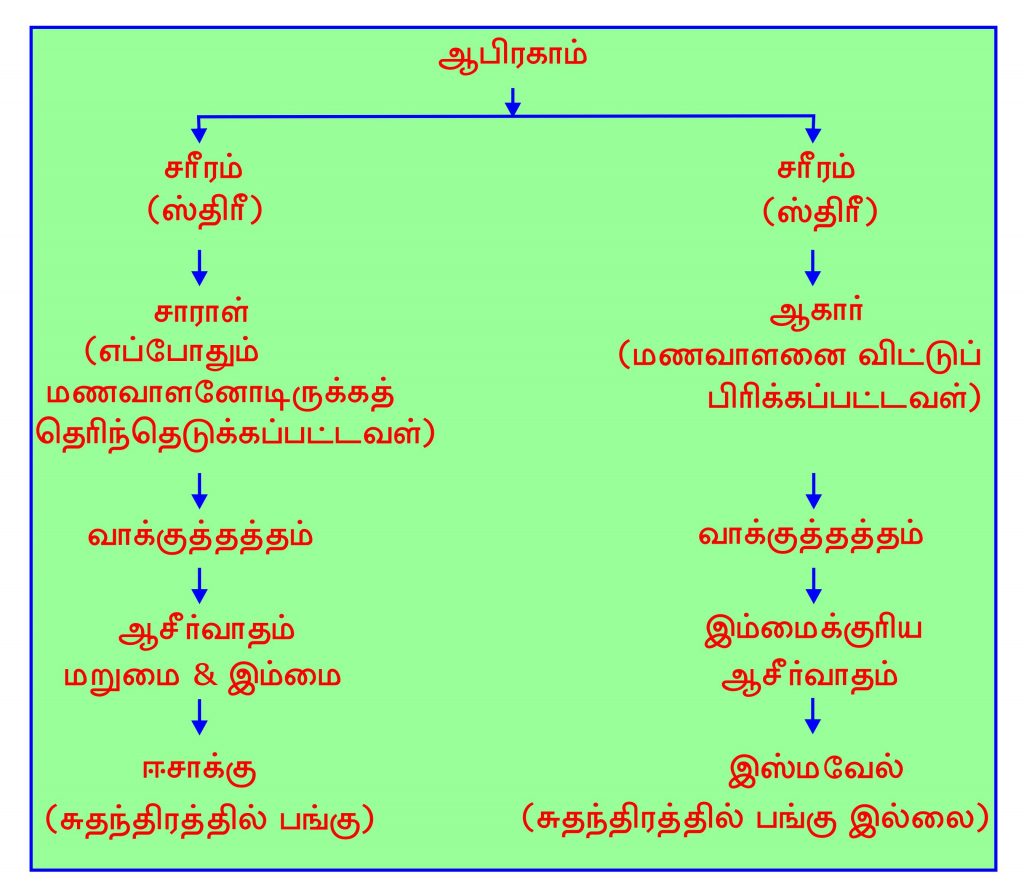
தண்ணீர் என்பது வார்த்தை. அது ஆபிரகாமிற்குக் கொடுக்கப்பட்டது. ஆபிரகாமால் கொடுத்து அனுப்பப்பட்ட தண்ணீர் தீர்ந்துபோனதால், தூதன் வேறொரு துரவினை அங்கே காட்டுகின்றான். தூதன் காட்டிய அந்தத் துரவிலிருந்து எடுக்கப்பட்ட தண்ணீர் என்பது இம்மைக்குரிய ஆசீர்வாதங்களைக் கொடுக்கக் கட்டளையிடப்பட்ட வாக்குத்தத்தத்தின் வார்த்தை. அந்தத் தண்ணீரை ஆகார் தன் பிள்ளைக்குக் கொடுத்தாள். அவன் வளர்ந்தான், பெரியவனானான். அவனைப் பெரிய ஜாதியாக்குவேன் என்று கூறப்பட்ட வாக்குத்தத்தத்தின்படியாக இன்று பெரிய ஜாதியாகி இருக்கின்றான். மாமிசத்திற்குரிய அந்த ஆசீர்வாதத்தினைப் பெற்றவன் வனாந்திரத்தில் குடியிருந்தான் என்று வேதத்தில் வாசிக்கின்றோம்.
ஆதி. 21: 20-ல் இவ்விதமாகக் கூறப்பட்டுள்ளது:
"தேவன் பிள்ளையுடனே இருந்தார்; அவன் வளர்ந்து வனாந்தரத்திலே குடியிருந்து, வில்வித்தையிலே வல்லவனானான்."
ஆபிரகாம் குடித்த தண்ணீர் துருத்தியில் இருந்து சிலகாலம் இஸ்மவேலைப் போஷித்தது. ஆபிரகாம் உட்கொண்ட அந்த ஜீவனுக்குரிய வார்த்தை இஸ்மவேலின் மாமிச சரீரத்தோடு நிறைவடைந்தது.
இஸ்மவேலினைப் பெற்றெடுக்கத் தெரிந்தெடுக்கப்பட்ட மாமிச சரீரம் ஆகாருடையது. சரீரம் என்பது ஸ்திரீயினைக் குறிக்கும். ஸ்திரீ என்பது சபையாகும். இங்கே இரண்டு சபைகளைக் குறித்துக் கூறப்பட்டுள்ளது.
1. வாக்குத்தத்தம் பெற்ற சாராள்
2. இன்னொன்று இஸ்மவேலைப் பெற்ற ஆகார்.
ஆபிரகாமிடமிருந்து இரண்டு பிரிவு ஜனங்கள் வருகின்றார்கள் அவர்கள் இரண்டு சரீரமாகிய ஸ்திரீகள் மூலம் பெருகுகின்றார்கள். ஒரு சரீரம் சாராள். இன்னொரு சரிரம் ஆகார். இரண்டு சரீரங்களுமே வாக்குத்தத்தம் பெற்றவர்களை பெற்றெடுத்தார்கள். ஒரு வாக்குத்தத்தம் இம்மைக்குரியது; மற்றொன்று இம்மையையும் மறுமையையும் தன்னகத்தே கொண்டது.
ஒருபுறம், கிருபை பெற்ற சாராள் மூலமாக ஆபிரகாமுக்குக் கொடுக்கப்பட்ட வாக்குத்தத்தமானது தண்ணீராக ஈசாக்கிற்கு வருகின்றது. மற்றொருபுறம் ஆகார் மூலமாக ஆபிரகாமின் வாக்குத்தத்தமானது தண்ணீராக இஸ்மவேலுக்கு வருகின்றது. ஆகார் மணவாளனை விட்டுப் பிரிந்துபோனவள்; மணவாளனை விட்டுப் பிரிக்கப்பட்டவள். ஆபிரகாமோடு தொடர்ந்து ஆகார் இருக்கவில்லை. ஏனென்றால், அவளுக்கு அந்தக் கிருபை கொடுக்கப்படவில்லை. குழந்தையினைப் பெற்றாள்; அதாவது வம்சத்தினை உருவாக்கக்கூடிய அதிகாரத்தினைப் பெற்றாள். ஜாதிகளுக்குத் தாயாக இருக்கக்கூடிய கிருபையினைப் பெற்றாள். ஆனால், மணவாளனோடு இசைந்திருக்கக்கூடிய கிருபையினைப் பெறவில்லை. சாராள் தன் ஆண்டவனோடே இருந்தாள். ஆனால், ஆகார் அப்படியாக இல்லை. ஆகார் மணவாளனைவிட்டுப் பிரிந்தவள்.
ஆபிரகாம் குடித்த துரவின் தண்ணீரை சாராள் மூலமாக ஈசாக்கு குடித்தான். அது தொடர்ந்து அவனுக்குக் கட்டளையிடப்பட்டது. ஆனால், அந்தக் கிருபை ஆகாருடைய பிள்ளைக்கு சிலகாலம் மாத்திரம் கிடைத்தது. அந்தக் கிருபையானது தொடர்ந்து அவனுக்குக் கொடுக்கப்படவில்லை.
ஆபிரகாம் மரித்தபின்னர் ஈசாக்கு தன் தகப்பனின் நாட்களில் வெட்டிய துரவுகளில் தண்ணீர் குடித்தான்.
ஆதி. 26: 18-ல் இவ்விதமாகக் கூறப்பட்டுள்ளது:
"தன் தகப்பனாகிய ஆபிரகாமின் நாட்களில் வெட்டினவைகளும், ஆபிரகாம் மரித்தபின் பெலிஸ்தர் தூர்த்துப்போட்டவைகளுமான துரவுகளை மறுபடியும் தோண்டி, தன் தகப்பன் அவைகளுக்கு இட்டிருந்த பேர்களின்படியே அவைகளுக்குப் பேரிட்டான்."
தூர்ந்துபோன தன் தகப்பன் வெட்டிய துரவினை செப்பனிட்டு அதின் நீரைப் பானம்பண்ணினான். அவனுக்கு அந்தக் கிருபை கட்டளையிடப்பட்டது. ஆபிரகாமிடமிருந்து அந்தக் கிருபை பூரணமாக ஈசாக்கிற்கு கட்டளையிடப்பட்டது.
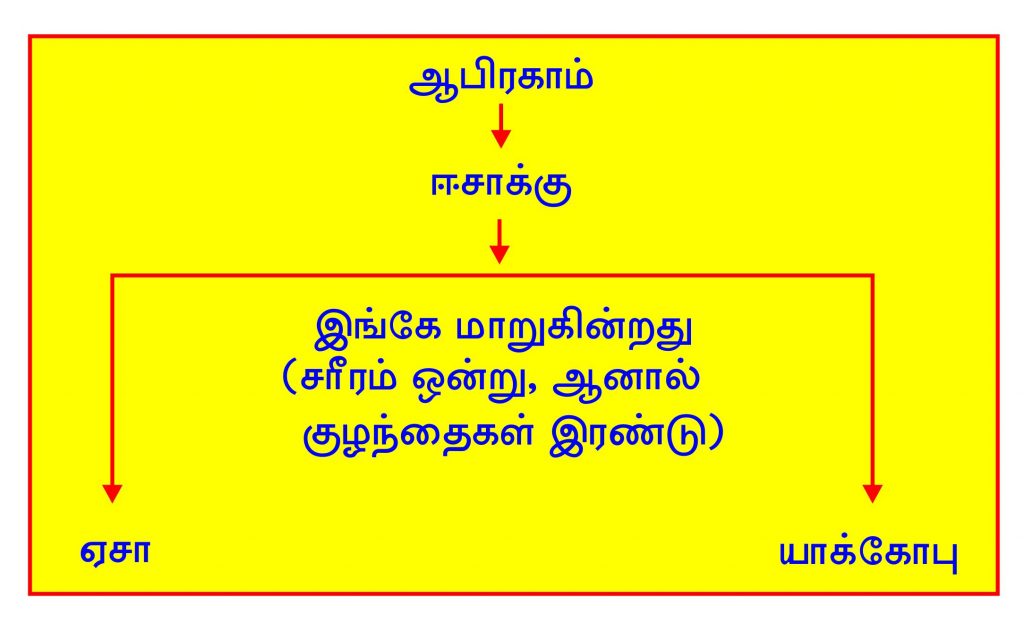
ஈசாக்கிடமிருந்து அந்த சரீரம் இரண்டாகப் பிரிகின்றது. அது:
1. ஏசா,
2. யாக்கோபு.
துரவு என்பது கிணறாகும். துரவு என்பது சொற்ப ஜனமாக இருந்தபோது கொடுக்கப்பட்ட ஆசீர்வாதமாகும். அந்த ஜனம் கொஞ்சமாக அப்போது இருந்தது. ஆபிரகாம், ஆபிரகாமின் குமாரன் ஈசாக்கு மற்றும் இஸ்மவேல்; ஏசா மற்றும் யாக்கோபு என சொற்ப ஜனமாக இருந்தபோது துரவின் தண்ணீர் கொடுக்கப்பட்டது. ஜனங்கள் பெருகியபோது அந்தத் துரவின் தண்ணீர் போதாததால், அது ஆற்று நீரானது. துரவின் தண்ணீர் போதுமானதாக இல்லாதபோது, ஆற்று நீர் அங்கே கட்டளையிடப்பட்டது.
ஈசாக்கு தன்னுடைய தகப்பன் வெட்டிய துரவிலிருந்த தண்ணீரைக் குடித்தான்; அந்த வார்த்தையினைத் தொடர்ந்து உட்கொண்டான். ஆபிரகாமின் மரணத்திற்குப்பின்னரும், ஈசாக்கு வார்த்தையில் உறுதியாய் இருந்தான். ஆபிரகாமின் மரணத்திற்குப்பின்னரும், கர்த்தர் தன் தகப்பனுக்குக் கட்டளையிட்ட வார்த்தையின்மீது உறுதியாய் இருந்தான். அந்த உறுதி அவனுக்கு ஆசீர்வாதமாக அமைந்தது. ஏனென்றால், அவன் ஆசீர்வதிக்கத் தெரிந்தெடுக்கப்பட்டவன்.
ஆபிரகாம், ஈசாக்கு மற்றும் யாக்கோபு வரையிலும் அது சிறு கூட்டமாகவே இருந்தது. எனவே துரவின் தண்ணீர் கட்டளையிடப்பட்டது. அதன்பின்னர் பெருந்திரளாக இஸ்ரவேலர்கள் பெருகியபோது துரவு நீர் போதாமையினால் அங்கே ஆற்று நீர் கட்டளையிடப்பட்டது.
ஆதி. 2: 10-14-ல் இவ்விதமாகக் கூறப்பட்டுள்ளது:
"தோட்டத்துக்குத் தண்ணீர் பாயும்படி ஏதேனிலிருந்து ஒரு நதி ஓடி, அங்கேயிருந்து பிரிந்து நாலு பெரிய ஆறுகளாயிற்று.
முதலாம் ஆற்றுக்குப் பைசோன் என்று பேர், அது ஆவிலா தேசம் முழுவதையும் சுற்றி ஓடும்; அவ்விடத்திலே பொன் விளையும்.
அந்தத் தேசத்தின் பொன் நல்லது. அவ்விடத்திலே பிதோலாகும், கோமேதகக்கல்லும் உண்டு.
இரண்டாம் ஆற்றுக்குக் கீகோன் என்று பேர், அது எத்தியோப்பியா தேசம் முழுவதையும் சுற்றி ஓடும்.
மூன்றாம் ஆற்றுக்கு இதெக்கேல் என்று பேர், அது அசீரியாவுக்குக் கிழக்கே ஓடும். நாலாம் ஆற்றுக்கு ஐபிராத்து என்று பேர்."
துரவிலிருந்து எடுக்கப்பட்ட நீர் கொஞ்ச ஜனத்திற்காகவும், ஆற்றின் தண்ணீர் அநேகருக்காகவும் கட்டளையிடப்பட்டது. இங்கே ஒரு ஆறு உருவாகின்றது. அது கர்த்தர் தெரிந்தெடுத்த இடத்தில் உருவாகின்றது.
இஸ்லாமியருக்கு இறைதூதன் மூலமாக ஆசீர்வாதம் கட்டளையிடப்பட்டுள்ளது. தூதன் மூலமாகத்தான் தண்ணீரான ஆசீர்வாதம் ஆகாரின் பிள்ளைக்குக் கொடுக்கப்பட்டது. ஆகாரின் பிள்ளைக்கு வார்த்தையினைக் கொண்டு, ஆசீர்வாதத்தினைக் கட்டளையிட அனுப்பப்பட்டவன் ஒரு தூதன். அந்தத் தூதன்தான், துரவின் தண்ணீரை எடுத்து உன் பிள்ளைக்குக் கொடு என்று கூறித் துரவைக் காட்டினான்.
அந்த வாக்குத்தத்தமும், ஆசீர்வாதமும் ஆபிரகாமின்பொருட்டு, ஆகார் என்ற மாமிச சரீரத்தின் மூலமாகக் கொடுக்கப்பட்டது. அது இஸ்மவேலுக்கும், அவன் சந்ததிகளுக்கும் கட்டளையிடப்பட்டது.
இன்னொரு புறம் பார்த்தோமானால், அந்த ஆசீர்வாதம் ஈசாக்கிற்கு சாராள் மூலமாகக் கொடுக்கப்பட்டது. சாராள் எப்போதுமே மணவாளனோடு இருக்கத் தெரிந்தெடுக்கப்பட்டவள். சாராளுக்கும், ஆகாருக்கும் உள்ள வேறுபாட்டினை நன்றாகக் கவனியுங்கள். சாராள் எப்போதும் மணவாளனோடு இருக்கத் தெரிந்தெடுக்கப்பட்டவள். ஆகார் ஒரு குறிப்பிட்ட வாக்குத்தத்தத்தினைச் சுதந்தரிப்பதற்காக மாத்திரம் இணைக்கப்பட்டவள். அவள் மூலமாக ஒரு சந்ததி உருவாக வேண்டும் என்பதற்காக மாத்திரமே அமர்த்தப்பட்டவள். இங்கே ஆகாருடைய கிரியைகளும் நற்கிரியைகளாகவே இருந்துள்ளது. இஸ்மவேலுக்குப்பின்னர் ஆகார் வேறு பிள்ளைகள் பெறவில்லை. அதற்குப்பின்னர் அவள் வேறொரு கணவரை மணமுடிக்கவுமில்லை. அவள் தன்னுடைய கணவனுக்கு உண்மையாகவே இருந்தாள். ஆனால், அவள் தெரிந்தெடுக்கப்பட்ட நோக்கம் பூரணமுள்ள மணவாட்டியாக இருக்கவேண்டும் என்பதற்காக அல்ல.
தன்னுடைய கர்ப்பம் அடைக்கப்பட்டிருக்கின்றது; அவள் மூலமாகச் சந்ததி வரட்டும் என்பதற்காகத்தான் ஆகார் இணைக்கப்பட்டாள். அந்தக் காரியம் நிறைவேறிய பின்னர் ஆபிரகாமிடமிருந்து தனியே அனுப்பப்படுகின்றாள். ஆனால், இஸ்மவேலுக்குக் கொடுக்கப்பட்ட ஆசீர்வாதம் அவன் சந்ததிகளுக்குக் கொடுக்கப்படவில்லை. மறுமைக்குரிய ஆசீர்வாதம் அவன் சந்ததிகளுக்குக் கட்டளையிடப்படவில்லை.
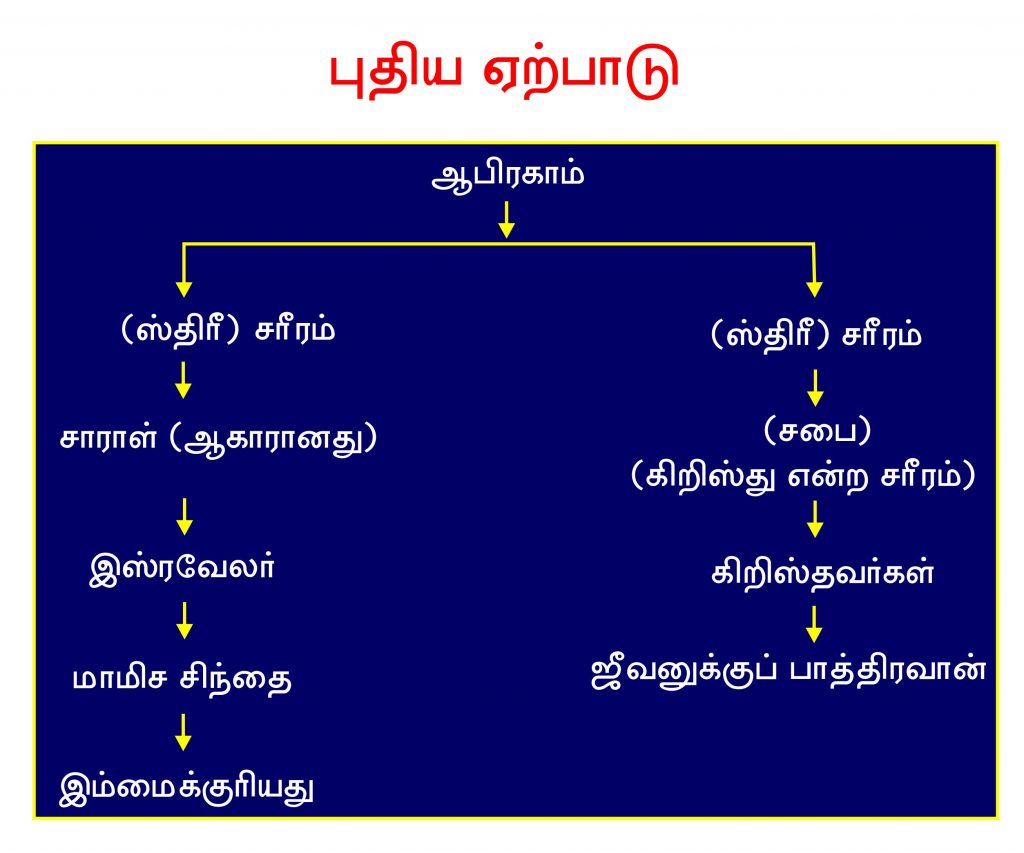
அப்போஸ்தலனாகிய பவுலும் சாராள் என்றும், ஆகார் என்றும் இரண்டு பிரிவாகப் பிரித்துக் கூறுகின்றார். சாராள் ஈசாக்கிற்குத் தாய்; ஆகார் இஸ்மவேலுக்குத் தாய். இந்த இருவரையும் பற்றிக் கூறும்போது, ஆகார் என்பவள் சீனாய் மலை என்றும், அது அடிமைத்தனம் என்றும், சாராள் புதிய எருசலேம் என்றும் கூறியுள்ளார்.
அதுபோலவே கிறிஸ்தவத்திற்குள்ளாகவும் இரண்டு ஸ்திரீகளாக வாக்குத்தத்தம் பெற்றவர்களின் நிலையும் காணப்படுகின்றது.
ஆபிரகாமின் மாமிச சரிரங்கள்: 1. சாராள், 2. ஆகார். ஆகாரை வழிநடத்த வந்த தூதன் ஆகாரின் சந்ததியினை வழிநடத்தினான். எனவே, ஆகாருடைய வம்சம் ஆசீர்வதிக்கப்பட்டது. சாராளுடைய பிள்ளையாகிய ஈசாக்கு ஆபிரகாமின் துரவண்டையிலிருந்தவனாய் தன் தகப்பனுக்கு உண்டான எல்லாவற்றையும் சுதந்தரித்துக்கொண்டவன். ஏனென்றால், அவன் மணவாட்டியாய் முத்திரிக்கப்பட்ட சாராளின் பிள்ளை. மணவாட்டி பெற்றெடுத்த சுதந்திரவாளி. எனவே அதற்குரிய எல்லா ஆசீர்வாதங்களையும் பெற்றான். சாராளின் சந்ததியாக ஈசாக்கிடமிருந்து இஸ்ரவேலர்கள் பெருக ஆரம்பித்தார்கள்; இஸ்ரவேலர்கள் ஆசீர்வாதத்தினைப் பெற்றுக்கொண்டார்கள். இது பழைய ஏற்பாடு.
புதிய ஏற்பாடு ஆரம்பித்தபோது, முதலாவது சபை தூதனான பவுல் இப்படியாகச் சாட்சியிடுகின்றார்.
கலா. 4: 22-26-ல் இவ்விதமாகக் கூறப்பட்டுள்ளது:
"ஆபிரகாமுக்கு இரண்டு குமாரர் இருந்தார்கள் என்று எழுதியிருக்கிறது; ஒருவன் அடிமையானவளிடத்தில் பிறந்தவன், ஒருவன் சுயாதீனமுள்ளவளிடத்தில் பிறந்தவன்.
அடிமையானவளிடத்தில் பிறந்தவன் மாம்சத்தின்படி பிறந்தான், சுயாதீனமுள்ளவளிடத்தில் பிறந்தவன் வாக்குத்தத்தத்தின்படி பிறந்தான்.
இவைகள் ஞான அர்த்தமுள்ளவைகள்; அந்த ஸ்திரீகள் இரண்டு ஏற்பாடுகளாம்; ஒன்று சீனாய்மலையிலுண்டான ஏற்பாடு, அது அடிமைத்தனத்திற்குள்ளாகப் பிள்ளை பெறுகிறது, அது ஆகார் என்பவள்தானே.
ஆகார் என்பது அரபிதேசத்திலுள்ள சீனாய்மலை; அந்த ஆகார் இப்பொழுதிருக்கிற எருசலேமுக்குச் சரி இவள் தன் பிள்ளைகளோடே அடிமைப்பட்டிருக்கிறாளே.
மேலான எருசலேமோ சுயாதீனமுள்ளவள், அவளே நம்மெல்லாருக்கும் தாயானவள்."
இங்கே பவுல்: சாராள் ஆகாராக மாறிவிட்டாள் என்று சாட்சியிட்டுள்ளார். இஸ்ரவேலர்கள், வாக்குத்தத்தத்தினைப் பெற்ற சாராளின் பிள்ளைகள். ஆனால் அப்போது வாக்குத்தத்தத்தினை இழந்துபோய்விட்டார்கள்; அவர்கள் மாமிசத்திற்குரியவர்களாக மாறியிருந்தார்கள்; எனவே ஆகாருடைய சந்ததியாக சாட்சியிடப்படுகின்றார்கள். சபைக்காலங்கள் ஆரம்பமானபோது சாராளுடைய சந்ததிகள் முதலாவது சபையில் இருந்தார்கள். அந்த சபை ஸ்திரீ என்று வேதம் கூறுகின்றது. இந்த சபைக்குத் தலை கிறிஸ்து. கிறிஸ்து என்ற அந்த சரீரம் மூலமாகத்தான் ஆசீர்வாதமானது புறஜாதிகளிடம் வந்தது. எப்படியாக ஈசாக்கிற்கு சாராள் என்ற சரீரம் மூலமாக ஆசீர்வாதம் வந்ததோ, அதுபோல கிறிஸ்து என்ற மணவாளனின் மணவாட்டியான சபை என்ற சரீரம் மூலமாக ஆசீர்வாதமும், ஜீவனுக்குரிய வார்த்தையும் கிறிஸ்தவர்களுக்குக் கொடுக்கப்பட்டது.
பழைய ஏற்பாட்டின் காலத்தில் இஸ்ரவேலர்களுக்குள்ளாக ஒரு ஆறு பாய்ந்தது. அந்த ஆற்றிற்கு யோர்தான் என்று பெயர். அந்த யோர்தானில் உடன்படிக்கைப் பெட்டியினைத் தூக்கிச் சென்றபோது, தண்ணீர் எதிர்திசையில் திரள ஆரம்பித்தது. அப்படியான அற்புதங்களையெல்லாம் கண்ட யோர்தான் பாவத்தினைக் கழுவுவதற்கு உபயோகப்படுத்தக்கூடிய தண்ணீர் கொண்டதாக மாறியது. சாட்சியான கிரியைகளைச் செய்த ஆறு பாவத்தினைக் கழுவுவதற்குப் பயன்படுத்தக்கூடிய தண்ணீரைக் கொடுப்பதாக மாறியது; அந்தத் தண்ணீரை அப்படியாக மாற்றியது யோவான்ஸ்நானன். இது புதிய ஏற்பாடு.
பழைய ஏற்பாட்டுக் காலத்தில் யோர்தான் சாட்சியாக இருந்தது. சாட்சியாக அமைந்த யோர்தான், பின்னர் பாவத்தினைக் கழுவக்கூடிய ஒரு காரணியாக மாற்றப்பட்டது.
இப்போது கடைசி ஏற்பாட்டுக்குள்ளாக வருகின்றோம்.
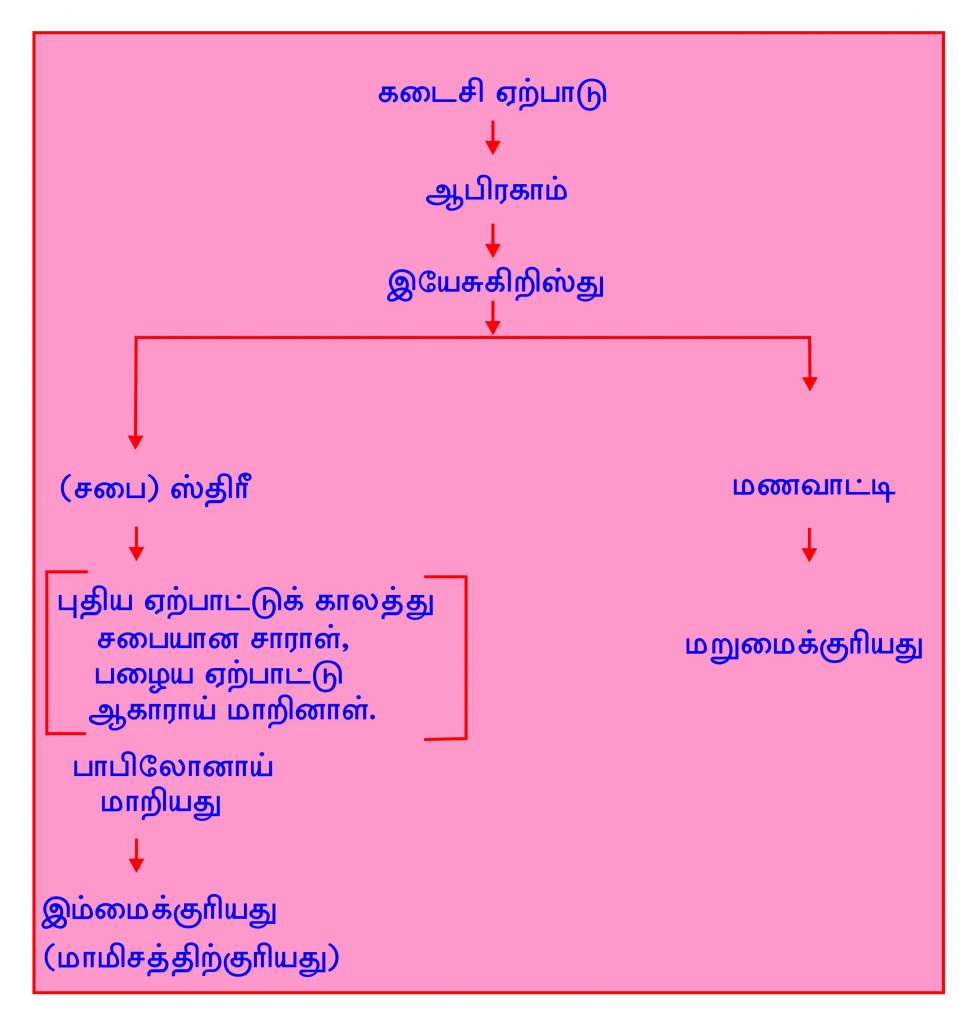
கிருபையும் வாக்குத்தத்தமும் தகப்பனாகிய ஆபிரகாம் மூலமாகவே கட்டளையிடப்பட்டுள்ளது. நாம் இயேசுகிறிஸ்து மூலமாக ஆபிரகாமின் பிள்ளைகளாக்கப்பட்டுள்ளோம்.
முன்னே கூறியபடி, ஆபிரகாமோடே இணைக்கப்பட்ட இரண்டு மாமிச சரீரங்களாவன:
1.மணவாட்டி - "சாராள்",
2.ஒரு குறிப்பிட்ட காரியத்திற்காக இணைக்கப்பட்டு இம்மைக்குரிய ஆசீர்வாதத்தினை மாத்திரம் பெற்றுக்கொள்வதற்காக இணைக்கப்பட்ட "ஆகார்".
ஆகாருக்காக இம்மைக்குரிய ஆசீர்வாதத்தினைக் கொடுப்பதற்கு ஒரு தூதன் அனுப்பப்பட்டான். அந்தத் தூதனுடைய வார்த்தையின்படி நடந்த யாவரும் ஆசீர்வாதத்தினைப் பெற்றுக்கொண்டார்கள். அந்தத் தூதன் கி.பி. 5-ம் நூற்றாண்டு வரையிலும் இஸ்மவேலின் சந்ததியாரை வழிநடத்தினார். கி.பி. 5-ம் நூற்றாண்டிற்குப் பின்னர் வேறு ஒரு தூதன் அனுப்பப்பட்டார். அந்தத் தூதன், இஸ்மவேலின் மாமிச சந்ததியாருக்கு மட்டுமல்ல, இஸ்மவேலின் தேவன்மீது யாரெல்லாம் விசுவாசம் வைத்தார்களோ, அவர்களெல்லாம் அந்த ஆசீர்வாதத்தினைப் பெற்றுக்கொள்ளும்படியாக வழிநடத்தினார். பூமியின் கடைசி பரியந்தமும் ஆகாருடைய சந்ததியும், சாராளுடைய சந்ததியும் இந்தப் பூமியில் இருப்பார்கள். இது ஆபிரகாமிற்குக் கர்த்தர் கொடுத்த வாக்குத்தத்தம். அது நிறைவேறியே தீரும்.
கொடுக்கப்பட்ட வாக்குத்தத்தத்தில் ஜீவனுக்குரிய காரியம் மட்டும் ஒரு பிரிவினருக்கு மட்டுமே கொடுக்கப்பட்டுள்ளது. ஜீவனுக்குரிய ஆசீர்வாதம் ஆபிரகாமிற்குக் கொடுக்கப்பட்டது. ஆபிரகாம் பெற்றுக்கொண்ட அந்த ஆசீர்வாதம் சாராள் மூலமாய் ஈசாக்கிற்குக் கொடுக்கப்பட்டது. ஈசாக்கு பெற்ற அந்த ஆசீர்வாதம் ரெபெக்காள் மூலம் யாக்கோபிற்கு வருகின்றது. யாக்கோபு அதனைப் பெற்றுக்கொண்டான். யாக்கோபிற்கு சகோதரனான ஏசா தன்னுடைய கிரியைகளில் உதாசீனம் பண்ணக்கூடிய ஒரு சூழல் வந்ததால், அதனை அவன் இழந்துபோனான். எனவே யாக்கோபின் சந்ததி மாத்திரம் அங்கே தெரிந்தெடுக்கப்பட்டது. யாக்கோபின் சந்ததியார் இஸ்ரவேலர்கள். இஸ்ரவேலர்களிலிருந்து யூதா கோத்திரம் பிரிக்கப்பட்டது. அதன்பின்னர் இயேசுகிறிஸ்து அனுப்பப்பட்டார். ஆகார், சாராள் என இரு பிரிவுகளாகப் பிரிக்கப்பட்டுள்ளதை அப்போஸ்தலனாகிய பவுலும் சாட்சியிட்டுள்ளார்.
ஏசா மாமிசத்திற்குரியவனாய் பிரிக்கப்பட்டான். மாமிசத்திற்குரியவர்கள் ஆகாரின் சந்ததி.
புதிய ஏற்பாட்டு காலம் ஆரம்பமானபோது, மாமிசத்தின்படி சாராளுடைய சந்ததியாராய் இருந்த இஸ்ரவேலர்கள் ஆவியின் சரீரத்திற்குள்ளாக ஆகாருடைய சந்ததியாக மாறினார்கள். எப்போதுமே ஸ்திரீயினை மையமாகக்கொண்டே இந்த நிகழ்வுகள் யாவும் நிகழ்த்தப்பட்டுள்ளது. புதிய ஏற்பாட்டுக் கால ஆரம்பத்தில் சபை என்ற அந்த ஸ்திரீக்குப் பெயர் சாராள். வாக்குத்தத்தம் பெற்ற சாராள் கிறிஸ்தவர்களுக்குத் தாயானாள். கிறிஸ்தவர்கள் யாவரும் சாராளின் சந்ததியானார்கள். ஜீவனுக்குரிய ஆசீர்வாதம் கிறிஸ்தவர்களிடமும், மாமிசத்திற்குரிய ஆசீர்வாதம் மாத்திரம் ஜீவனை இழந்துபோன ஆகாருடைய சந்ததியாக சாட்சியிடப்பட்டுள்ள இஸ்ரவேலருக்கும் கட்டளையிடப்பட்டது. இதுவே புதிய ஏற்பாடு. இந்த நிகழ்வுகள் புதிய ஏற்பாட்டுக் காலத்தின் நிறைவில் மாற்றியமைக்கப்படும். இப்படியாக ஒவ்வொரு காலத்திலும் சாராளின் தன்மையும், ஆகாரின் தன்மையும் காணப்பட்டது. அதேபோலொத்த நிலை புதிய ஏற்பாட்டின் நிறைவிலும் உருவாகும். இயேசுகிறிஸ்து மூலமாக கிருபையினைப் பெற்று கிறிஸ்தவர்களாக மாறியுள்ள புறஜாதிகளும் இருபிரிவாக பிரிக்கப்பட்டுள்ளார்கள். அது ஒன்று சாராளின் சந்ததி, மற்றொன்று ஆகாரின் சந்ததி. பாபிலோன் என்று சாட்சியிடப்பட்டுள்ள இந்த ஸ்திரீ கடைசி ஏற்பாட்டின் காலத்தில் அடிமைப்பெண்ணாகிய ஆகாரின் தன்மை கொண்டதாக சாட்சியிடப்படும்.
பழைய ஏற்பாட்டுக் காலத்து ஆகாரைப்போல, புதிய ஏற்பாட்டுக்காலத்து சபை என்ற தன்மையிலிருக்கும் சாராள் என்ற ஸ்திரீயும் மாமிசத்திற்குரியவளாய் மாறக்கூடிய ஒரு நிலை உருவாகும். வாக்குத்தத்தம் பண்ணப்பட்டவளாகக் காணப்பட்ட சபை என்ற ஸ்தீரியும் தன் நிலையிலிருந்து மாறுவாள். சபைக்குத் தலை கிறிஸ்து என்று பார்த்தோம். கடைசி ஏற்பாட்டில் சபை என்ற அந்த ஸ்திரீ ஆகாரின் தன்மை கொண்ட பாபிலோனாக மாறிவிடுகின்றாள். இந்த பாபிலோன் என்பது அடிமைத்தனம் ஆகும். அடிமைப்பட்டவள் ஆகார். புதிய ஏற்பாட்டின் நிறைவில் கிறிஸ்தவர்களுக்குத் தாயாகவும் சுயாதீனமுள்ளவளாகவும் குறிப்பிடப்பட்ட ஸ்திரீயானவளும் ஆகாரின் தன்மையில் மாறிவிடுகின்றாள். கடைசி ஏற்பாட்டுக்குள்ளாக வரும்போது சபைகள் யாவும் அடிமைத்தனத்திற்குள்ளாகும்.
இம்மைக்குரிய ஆசீர்வாதத்தினை மாத்திரம் பெற்றுக்கொண்டவள் ஆகார். அவளுக்கு சுயாதீனத்தில் பங்கு இல்லை. அந்தப் பங்கு பரலோக சுதந்திரமாகும். அதனைப் பெற்றுக்கொள்ள இயலாததால் அவள் மாமிசத்திற்குரியவளாகின்றாள். பழைய ஏற்பாட்டுக் காலத்தில் இஸ்ரவேலருக்குச் சுயாதீனத்தினைக் கொடுத்த சாராள் புதிய ஏற்பாட்டுக் காலத்தில் ஆகாரின் தன்மையில் மாறிவிடுகின்றாள். புதிய ஏற்பாட்டுக் காலத்தில் சபைகளாக இந்த ஸ்திரீ எழும்பினாள். இவள் சுயாதீனமுள்ளவள். எனவே அவள் சாராள் என்று சாட்சியிடப்பட்டாள். கடைசி ஏற்பாட்டுக் காலத்தில் சபை என்ற இந்த ஸ்திரீயும் சுயாதீனம் இழந்துவிடுவாள். அவளும் ஆகாரின் தன்மைக்கொண்ட அடிமைத்தனத்திற்குரிய ஸ்தீரியாகிறாள்.
ஒவ்வொரு ஏற்பாட்டின் காலத்திலும் இப்படியாகத்தான் நிகழ்ந்துகொண்டு வருகின்றது. பழைய ஏற்பாட்டுக் காலத்தில் ஆகார், இஸ்மவேலின் தாய். புதிய ஏற்பாட்டுக் காலத்தில் ஆகார், இஸ்ரவேலர்களின் சபை. கடைசி ஏற்பாட்டுக் காலத்தில் அது கிறிஸ்தவர்களின் சபைகளாக மாறிவிடும். வெறும் மாமிசத்திற்குரிய நன்மைகளுக்குள்ளாவதால், அது ஆகாராகின்றது. கடைசி ஏற்பாட்டுக் காலத்தில் சபைகள் மாமிசத்திற்குரியதாக மாறும். அது சுதந்தரவாளிகளைப் பெற இயலாத ஆகாரின் தன்மையைப் போலவே இருக்கும்.
கடைசி ஏற்பாட்டில், சபைகள் மாமிசத்திற்குரியதாக மாறி ஆகாரின் சந்ததியாகின்றது. சபை என்ற ஸ்திரீ வெறும் மாமிசத்திற்குரியவளாக மாத்திரம் செயல்படுவாள். எனவே அவள் மணவாட்டிக்கு எதிர்த்து நிற்பாள்.
மணவாட்டியின் தன்மை, எப்போதும் கணவனோடு இணைந்திருக்கக்கூடிய தன்மையாகும். சாராள் ஆபிரகாமோடு இறுதிவரை இணைந்திருந்தாள். ஆனால் ஆகார் மணவாளனை விட்டுப் பிரித்து அனுப்பப்படுகின்றாள். மணவாட்டியான சாராள் ஜீவனுக்குரியவள். மணவாட்டியின் கிரியைகள் தேவனால் அங்கீகரிக்கப்படும் கிரியைகள்.
முதலில் பார்த்தோம், துரவில் எடுக்கப்பட்ட தண்ணீர் இரண்டு தன்மையில் இருந்தது. 1. இம்மைக்குரியது, 2. மறுமைக்குரியது. அதேபோலவே ஆறும் இருதன்மை கொண்டதாகப் பிரிக்கப்படுகின்றது. ஒன்று இம்மைக்குரியது. இன்னொன்று மறுமைக்குரியது. இந்த மறுமை என்பது ஜீவன்; இம்மை என்பது மரணம். இம்மைக்குரியவள் ஆகார் என்று பார்த்தோம். சாராள் ஜீவனுக்குரியவள்; ஜீவனைக் கொண்ட சுதந்திரவாளிகளைக் கொண்ட மணவாட்டி.
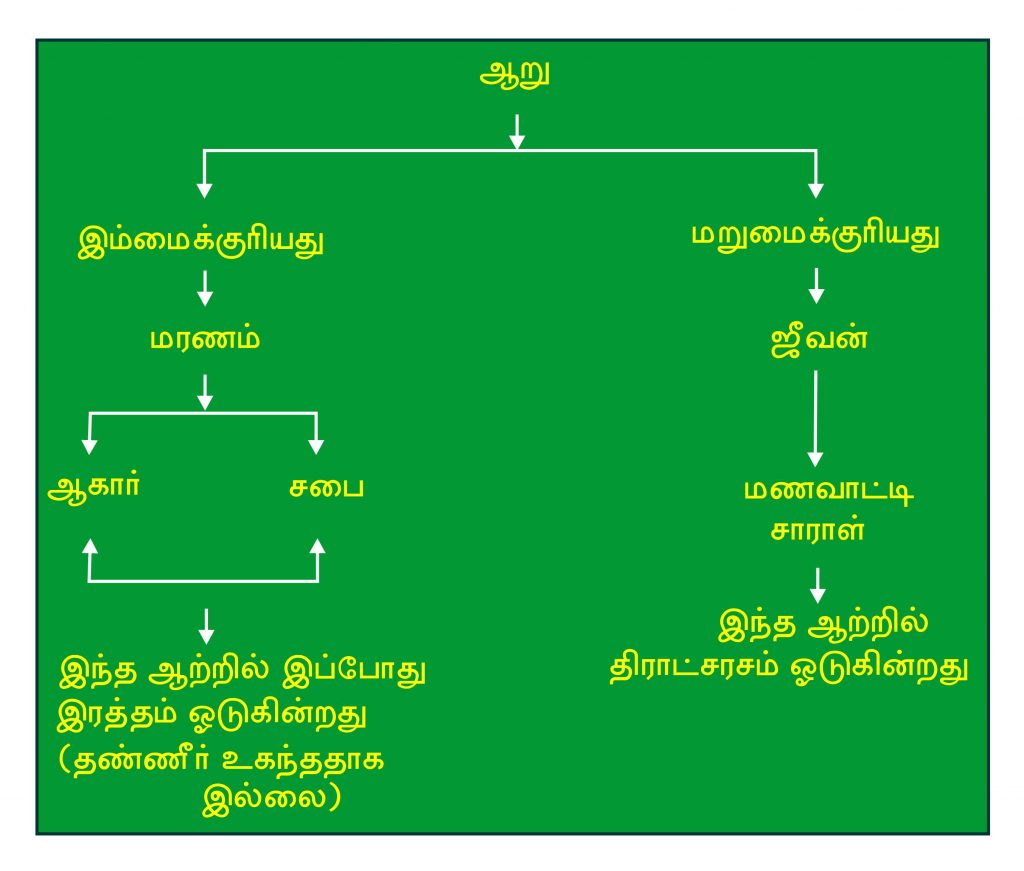
இந்த ஆறு ஜீவனுக்குரியவனான ஆதாம் குடியமர்த்தப்பட்ட ஏதேன் தொடங்கி இரண்டு பிரிவாக சாட்சியிடப்படுகின்றது. ஒன்று இம்மைக்குரியது என்றும், மற்றொன்று மறுமைக்குரியது என்றும் பிரிந்து வருகின்றது. இம்மைக்குரிய இந்த ஆறு மாத்திரம் ஜீவனை இழந்துபோன நிலையில் சபைகளுக்குள்ளாக ஓடும். கடைசி ஏற்பாட்டில் இம்மைக்குரியவர்கள் பானம்பண்ணும் ஆற்று நீர் இரத்தமாக ஓடும். மறுமைக்குரியவர்களாக முன்குறிக்கப்பட்டவர்கள் பானம்பண்ணுகின்ற ஆற்றில் திராட்சரசம் ஓடிக்கொண்டிருக்கும். மாமிசத்திற்குரிய ஆகாரின் சந்ததி பானம் பண்ணும் ஆற்றின் தண்ணீர் இரத்தமாக மாறிவிடும். இந்தத் தண்ணீர் ஜீவனுக்கு உகந்ததாகாது.
கடைசி ஏற்பாட்டுக் காலத்தில் இந்த ஆற்றினருகே ஒரு ஆட்டுக்கடா நிற்கக்கூடிய நிலை சாட்சியிடப்படும்.
தானி. 8: 3 - 7-ல் இவ்விதமாகக் கூறப்பட்டுள்ளது:
"நான் என் கண்களை ஏறெடுத்துப் பார்த்தேன்; இதோ, இரண்டு கொம்புகளுள்ள ஒரு ஆட்டுக்கடா ஆற்றிற்கு முன்பாக நின்றது; அதின் இரண்டு கொம்புகளும் உயர்ந்தவைகளாயிருந்தது; ஆகிலும் அவைகளில் ஒன்று மற்றதைப்பார்க்கிலும் உயர்ந்திருந்தது; உயர்ந்தகொம்பு பிந்தி முளைத்தெழும்பிற்று.
அந்த ஆட்டுக்கடா மேற்கும் வடக்கும் தெற்கும் பாய்கிறதைக் கண்டேன்; ஒரு மிருகமும் அதின் முன்னே நிற்கக்கூடாதிருந்தது; அதின் கைக்குத் தப்புவிப்பாருமில்லை; அது தன் இஷ்டப்படியே செய்து வல்லமைகொண்டது.
நான் அதைக் கவனித்துக்கொண்டிருக்கையில், இதோ, மேற்கேயிருந்து ஒரு வெள்ளாட்டுக்கடா நிலத்திலே கால் பாவாமல் தேசத்தின்மீதெங்கும் சென்றது; அந்த வெள்ளாட்டுக்கடாவின் கண்களுக்கு நடுவே விசேஷித்த ஒரு கொம்பு இருந்தது.
நான் ஆற்றின் முன்பாக நிற்கக்கண்ட இரண்டு கொம்புகளுள்ள ஆட்டுக்கடாவினிடமட்டும் அது வந்து, தன் பலத்தின் உக்கிரத்தோடே அதற்கு எதிராகப் பாய்ந்தது.
அது ஆட்டுக்கடாவின் கிட்டச் சேரக்கண்டேன்; அது ஆட்டுக்கடாவின்மேல் கடுங்கோபங்கொண்டு, அதை முட்டி, அதின் இரண்டு கொம்புகளையும் முறித்துப்போட்டது; அதின் முன் நிற்க ஆட்டுக்கடாவுக்குப் பலமில்லாமையால், வெள்ளாட்டுக்கடா அதைத் தரையிலே தள்ளி மிதித்துப்போட்டது; அதின் கைக்கு ஆட்டுக்கடாவைத் தப்புவிப்பார் இல்லை."
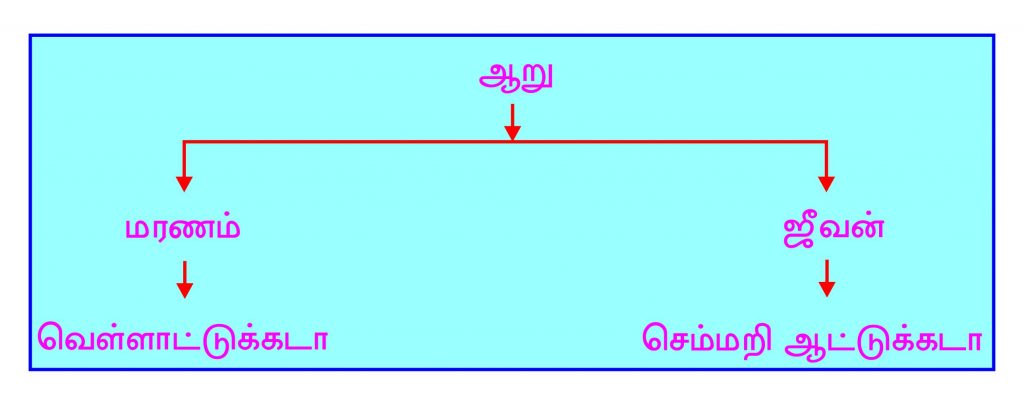
இந்த ஆறு இரண்டு பிரிவாக பிரிக்கப்படுகின்றது. அது இரண்டு தன்மையுள்ளதான தண்ணீரைக் கொடுக்கத்தக்க விதமாய் வேறுபிரிக்கப்படுகின்றது. ஒன்று ஜீவன், மற்றொன்று மரணம். இந்த ஆற்றிற்கு முன்பாக ஆட்டுக்கடா ஒன்று நிற்கின்றது. அதற்கு இரண்டு கொம்புகள் இருந்தது. இங்கே நின்றுகொண்டிருக்கும் செம்மறி ஆடு சாராள் என்றும், வெள்ளாடு ஆகார் என்றும் சாட்சியிடப்படுகின்றது.
தானி. 8: 8 - 12-ல் இவ்விதமாகக் கூறப்பட்டுள்ளது:
"அப்பொழுது வெள்ளாட்டுக்கடா மிகுதியும் வல்லமைகொண்டது; அது பலங்கொண்டிருக்கையில், அந்தப் பெரிய கொம்பு முறிந்துபோயிற்று; அதற்குப் பதிலாக ஆகாயத்தின் நாலு திசைகளுக்கும் எதிராய் விசேஷித்த நாலுகொம்புகள் முளைந்தெழும்பினது.
அவைகளில் ஒன்றிலிருந்து சின்னதான ஒரு கொம்பு புறப்பட்டு, தெற்குக்கும், கிழக்குக்கும் எதிராகவும், சிங்காரமான தேசத்துக்கு நேராகவும் மிகவும் பெரியதாயிற்று.
அது வானத்தின் சேனைபரியந்தம் வளர்ந்து, அதின் சேனையாகிய நட்சத்திரங்களில் சிலவற்றைப் பூமியிலே விழப்பண்ணி, அவைகளை மிதித்தது.
அது சேனையினுடைய அதிபதி பரியந்தமும் தன்னை உயர்த்தி, அவரிடத்திலிருந்து அன்றாட பலியை நீக்கிற்று; அவருடைய பரிசுத்த ஸ்தானம் தள்ளுண்டது.
பாதகத்தினிமித்தம் அன்றாட பலியோடுங்கூடச் சேனையும் அதற்கு ஒப்புக்கொடுக்கப்பட்டது; அது சத்தியத்தைத் தரையிலே தள்ளிற்று; அது கிரியைசெய்து அநுகூலமடைந்தது."
இந்த வெள்ளாட்டுக்கடாவிற்கு விசேஷித்த கொம்புகள் முளைக்கின்றது. இந்த வெள்ளாட்டுக்கடாவானது அன்றாட பலியினை நீக்கிற்று. அது சத்தியத்தினைத் தரையில் தள்ளி, செம்மறி ஆட்டுக்கடாவை மிதித்துப்போட்டது. மேலும் அதின் ராஜ்யமானது பெலப்பட்டது. அது சத்தியத்தினைத் தரையில் தள்ளிவிடும். தரை என்பது பூமிக்குரிய காரியமாகும். அது சத்தியத்தினை மாமிசத்திற்குரிய, அதாவது மண்ணுக்குரிய சிந்தையோடு அறிவதாகும். பூமிக்குரிய காரியத்தோடு ஆவிக்குரிய நிகழ்வுகள் ஒப்புக்கொடுக்கப்படும் என்பது இதன் பொருளாகும்.
கிறிதவர்களாகிய நாம் தேவசமூகத்தில் வைக்கக்கூடிய விண்ணப்பங்கள் யாவையும் நம்முடைய மாமிச தேவைகளுக்காக மாத்திரம் வைக்கக்கூடிய ஜெபமாக ஏறெடுத்துக் கொண்டிருக்கின்றோம். அது தேவசித்தத்தை மறந்த ஒரு நிலையாகும்; அது ஆகாரின் நிலை. ஆகார் பூமிக்குரியவள், இம்மைக்குரியவள். சாராள் மறுமைக்குரியவள், ஜீவனுக்குரியவள். அவள் பெற்றெடுத்த பிள்ளைகள் ஜீவனுக்குரியவர்கள்; அவர்களே வாக்குத்தத்தத்தினை சுதந்தரிப்பார்கள். நித்திய ஜீவனைக் கொடுப்பேன் என்பதே அவர் நமக்குக் கொடுத்த வாக்குத்தத்தமாகும். அதுவே புதிய உடன்படிக்கையாகும்.
சபைகளெல்லாம் வேசிகளின் கூடாரங்களாக மாறவேண்டும் என்பதே தீர்க்கதரிசனமாகும். பாபிலோன் திரளான தண்ணீர்களுக்குமேல் அமர்ந்திருக்கக்கூடிய வேசி என்று வேதம் சாட்சியிடுகின்றது (வெளி. 18: 4).
கடைசி ஏற்பாட்டின் காலத்தில் மணவாட்டி அந்த வேசியின் கூடாரத்தில் இருந்து வெளியேறி வரவேண்டும். அவைகள் சுவிசேஷமாக அறிவிக்கப்படும். கர்த்தர் நியமித்திருக்கின்ற வாதைகளுக்கு உள்ளாகாமல் இருக்க, நீ வெளியேறி வா என்று வார்த்தை அழைக்கும். அவருடைய மணவாட்டி அவரின் வார்த்தைக்குச் செவிகொடுப்பாள்.
அவருடைய மந்தையின் ஆடாகிய செம்மறி ஆடு அவளைவிட்டு வெளியேறி வரும். வெள்ளாடு அவளை விட்டு வெளியேறாது. வெள்ளாடு சத்தியத்திற்குக் கீழ்ப்படியாது. செம்மறி ஆடு சத்தியத்திற்குக் கீழ்ப்படியும். வெள்ளாடு இடப்புறத்தில் கூட்டப்படுகின்ற மந்தை. செம்மறி ஆடு வலப்புறத்தில் கூட்டப்படுகின்ற மந்தை.
இரண்டும் ஆட்டு மந்தைகள்தான். ஏசாவும், யாக்கோபும் ஈசாக்கின் பிள்ளைகள்தான். ஆகாருடைய வம்சத்தில் பிறந்த இஸ்மவேலும், சாராளுடைய வயிற்றில் பிறந்த ஈசாக்கும் ஆபிரகாமின் பிள்ளைகள்தான். கிறிஸ்தவர்கள் யாவரும் கர்த்தத்துவத்தில் ஆபிரகாமின் பிள்ளைகளாகின்றோம். ஆனால், அவர்களுக்குள்ளாக ஜீவனுக்குரியவன் வலப்புறமாகவும், மரணத்திற்குரியவன் இடதுபுறமாகவும் பிரிக்கப்படுகின்றான். ஜீவனுக்குரியவன் எப்போதும் மணவாளனோடே இருக்கத் தெரிந்தெடுக்கப்பட்ட மணவாட்டியாவாள். மணவாட்டி வனாந்திரத்திற்கு ஓடி வருகின்றாள். காரணம், வார்த்தை வனாந்திரத்திலிருந்து வெளிப்படும்.
சுதந்தரவாளிகள் அவளைவிட்டு வெளியேறி வனாந்திரத்திற்கு வருவார்கள். ஆகார் மாமிசத்தின்படி வேசி அல்ல. அவள் ஆபிரகாமிற்கு உத்தமியாகவே காணப்பட்டாள். அதுபோல பாபிலோனாக எழும்பும் சபைகளும் மாமிசத்தின்படியாக வேசித்தனம் செய்பவர்கள் அல்ல. ஆனால், அவர்கள் ஆவியின்படி வேசிகளாய் சாட்சியிடப்படுவார்கள்.
வெளி. 12: 6-ல் இவ்விதமாகக் கூறப்பட்டுள்ளது:
"ஸ்திரீயானவள் வனாந்திரத்திற்கு ஓடிப்போனாள்; அங்கே ஆயிரத்திருநூற்றறுபது நாளளவும் அவளைப் போஷிப்பதற்காகத் தேவனால் ஆயத்தமாக்கப்பட்ட இடம் அவளுக்கு உண்டாயிருந்தது."
1260 நாட்கள், 3 ½ வருஷம்; 3 ½ தலைமுறைகள் சாராள் வனாந்திரத்தில் இருக்கவேண்டும். ஏனென்றால், அதுதான் தீர்மானம். வாக்குத்தத்தம் பண்ணப்பட்டவள் தன்னுடைய பிள்ளையினை பெற்றெடுப்பதற்காக வனாந்திரத்தில் இருக்கின்றாள். வனாந்திரத்தில் அவள் பெற்றெடுக்கப்போகின்ற பிள்ளைகள் வாக்குத்தத்தத்தினை சுதந்தரிக்கப்போகும் பிள்ளைகள். ஸ்தாபனங்களுக்குள்ளாகவும், சபைகளுக்குள்ளாகவும், கூடார மகிமையினுக்குள்ளாகவும் பெற்றெடுக்கப்படும் பிள்ளைகள் மாமிசத்தின்படியான வாக்குத்தத்தத்தினை மாத்திரம் சுதந்தரிப்பவர்களாகக் காணப்படுவார்கள். ஜீவனுக்குரிய வாக்குத்தத்தத்தினை சுதந்தரிக்கின்றவர்களாய் வார்த்தையைக் கொண்டு செல்கின்றவர்களாகச் செயல்பட கர்த்தர்தாமே நமக்கு கிருபையினைக் கட்டளையிடுவாராக.
ஆமென்! ஆமென்!! ஆமென்!!!