


(Date of Announcement: 26.10.2014)
In Mark chapter 13: verse 14 it is said like this:
“But when ye shall see the abomination of desolation, spoken of by Daniel the prophet, standing where it ought not, (let him that readeth understand,) then let them that be in Judaea flee to the mountains:”
Prophet Daniel prophesied in advance about the abomination of desolation. It is said that when this abomination of desolation stands in a place, where it ought not to grace again goes back to them who are in Judea. Then, those who are in Judea must flee to the mountains. As said before, this abomination of desolation must enter into the holy place. The Lord has prophesied by His spirit that the abomination of desolation would enter into the holy place. When the grace given to the gentiles becomes full, the desolator must stand in a place where he ought not to. Thus, his standing must be announced as a witness. Thus, when the abomination of desolation stands in the place, where he ought not to, they who belong to life, in Judea must flee to the mountains. These have been prophesied, before these events take place. When these things occur, they who are in Judea must flee to the commanded mountains in order to save themselves for salvation. Then the identity of abomination of desolation will be shown among them.
In Revelation 18: 1, 2 it is said like this:
“And after these things I saw another angel come down from heaven, having great power; and the earth was lightened with his glory.
And he cried mightily with a strong voice, saying, Babylon the great is fallen, is fallen, and is become the habitation of devils, and the hold of every foul spirit, and a cage of every unclean and hateful bird.”
The entering of the desolator into the holy place must be announced not only to the Christians but also among the Israelites. When it will be announced as a witness that the desolator has entered into the holy place, it should be witnessed as, “Glory of Babylon is fallen.”
In Isaiah 21: 9 it is said like this:
“And, behold, here cometh a chariot of men, with a couple of horsemen. And he answered and said, Babylon is fallen, is fallen; and all the graven images of her gods he hath broken unto the ground.”
As prophesied by the prophet Isaiah, a charioteer riding a chariot would come. He would witness, “Babylon is fallen, is fallen.” Then Babylon must fall down. It must be announced as a witness as soon as it fell down. One man will be sent to announce the coming of abomination of desolation into the holy place. He will come in a chariot fastened with a pair of horses. Thus the man coming in the chariot will say, “Babylon is fallen, is fallen.” Two horses refer to two Testaments. It is announced as a prophecy that at the time of merging of two testaments, a man will come riding on a chariot fastened with two horses, namely, two testaments and say, “Babylon is fallen, is fallen.”
Next to that,
In Revelation 18: 1, 2 it is said like this:
“And after these things I saw another angel come down from heaven, having great power; and the earth was lightened with his glory.
And he cried mightily with a strong voice, saying, Babylon the great is fallen, is fallen, and is become the habitation of devils, and the hold of every foul spirit, and a cage of every unclean and hateful bird.”
At first it is said 'man'. But here it is said 'angel'. The Lord sends a word through the man who is mentioned as 'an angel'. It is announcing “Great Babylon is fallen, is fallen. Not only that, he must shout that Babylon has become a dwelling place of demons, a prison for every foul spirit, and a cage for every unclean and hateful bird. As foretold by the prophet Daniel, abomination of desolation must come into the holy place. Thus the coming of the desolator into the holy place must be announced. A man is sent to announce that happening, he will come on a chariot fastened with pair of horses. These two horses are the two testaments.
In 2 Kings 2: 2, 4, 11, 12 it is said like this:
“And Elijah said unto Elisha, Tarry here, I pray thee; for the LORD hath sent me to Bethel. And Elisha said unto him, As the LORD liveth, and as thy soul liveth, I will not leave thee. So they went down to Bethel.
And Elijah said unto him, Elisha, tarry here, I pray thee; for the LORD hath sent me to Jericho. And he said, As the LORD liveth, and as thy soul liveth, I will not leave thee. So they came to Jericho.
And it came to pass, as they still went on, and talked, that, behold, there appeared a chariot of fire, and horses of fire, and parted them both asunder; and Elijah went up by a whirlwind into heaven.
And Elisha saw it, and he cried, My father, my father, the chariot of Israel, and the horsemen thereof. And he saw him no more: and he took hold of his own clothes, and rent them in two pieces.”
Here, we should observe the thing carefully mentioned as prophecy. Prophet Isaiah said one person would come in a chariot fastened with a pair of horses. It is that he would say, “Babylon is fallen”. Here, what is said about the chariot is said about Elijah. It has already been announced that the angel mentioned in Revelation 18: 1 had the spirit of Elijah. There is a pair of horses. The one who is riding the chariot is the angel who has the spirit of Elijah. He must announce that Babylon is fallen and what kind of spirit works there. When these events will happen? It will be at the time, when the chariot fastened with two horses goes.
When John the Baptist, who had the spirit and power of Elijah, was sent, these events have happened.
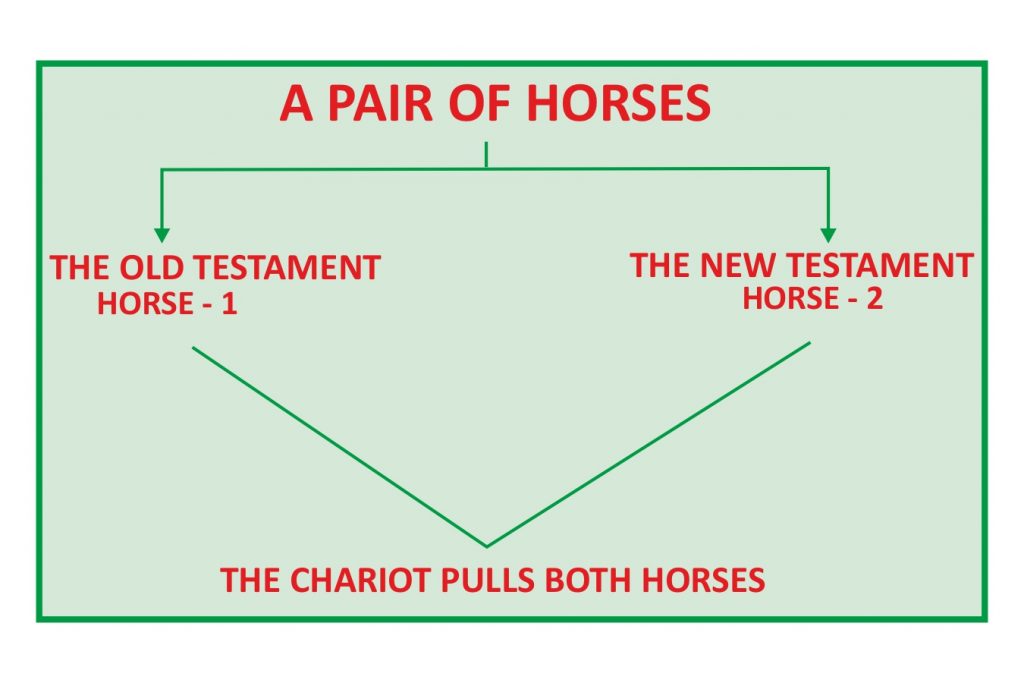
The two horses must together pull the chariot. Likewise, when Babylon falls down, the two Testaments must merge together. Formerly, it was John the Baptist, who came riding on the chariot fastened with two horses. These events are already mentioned as prophecy in the book of the prophet Malachi.
In Malachi 4: 5, 6 it is said like this:
“Behold, I will send you Elijah the prophet before the coming of the great and dreadful day of the LORD:
And he shall turn the heart of the fathers to the children, and the heart of the children to their fathers, lest I come and smite the earth with a curse.”
Here, it was John the Baptist, who had the spirit of Elijah, who came riding on the chariot. Formerly, he was the chariot of Israel. He was the horseman of Israel. After that, John the Baptist, the horseman who had the power of the spirit of Elijah, was sent. Those two horses that were at that time were the Old and the New Testaments.
John the Baptist was sent riding the chariot fastened with two horses, namely the Old Testament and the New Testament. That man proclaimed, “Jerusalem is fallen, is fallen”. John the Baptist did not enter into the temple of Jerusalem. He was in the wilderness. This event is a confluence of the Old and the New Testaments. A similar journey would arise again. Then that angel would again come as man and would announce, “Babylon is fallen, is fallen.” Formerly, when it came into John the Baptist, there was that time, that it was a chariot pulled by two horses namely the Old Testament and the New Testament. At such a time of the confluence of those two testaments, one should announce about Babylon. Because, then Babylon will have become a dwelling place of demons.
That man mentioned in the book of the prophet Isaiah is the angel announced in Revelation 18: 1. As John the Baptist came before, riding the chariot fastened with a pair of horses, again a man must be sent. After the mysteries of the Church are announced, these will take place.
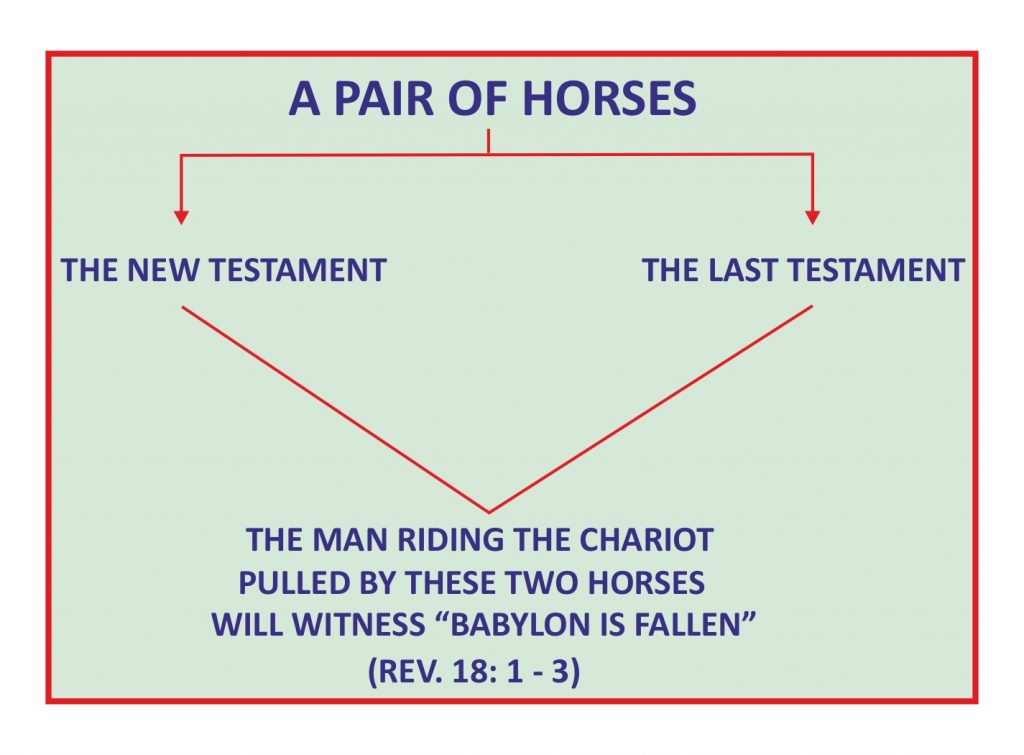
Just as John the Baptist came riding the chariot fastened with two horses, namely, the Old Testament and the New Testament, again the same kind of event must happen. Now, the two horses, namely, the New Testament and the Last Testament must jointly pull together the chariot. These events will take place at the time, when these two testaments merge together.
At that time of the confluence of these two testaments, the man who came riding the chariot must witness “Babylon is fallen, is fallen”.
In Revelation 18: 2 it is said like this:
And he cried mightily with a strong voice, saying, Babylon the great is fallen, is fallen, and is become the habitation of devils, and the hold of every foul spirit, and a cage of every unclean and hateful bird.”
The one who has seated himself on the chariot fastened with a pair of horses, must say, “Babylon the great is fallen, and has become the dwelling place of demons, a prison for every foul spirit and a cage for every unclean and hateful bird.” Prophet Daniel has said, “When you see the abomination of desolation stand in the holy place.” That man will be sent to announce that desolator has entered into the holy place. Then a word will be sent there. The bringer of that word will announce that word and witness to that word. When all these events take place merging together, that man will come seated on the horse and say these. He will say that Babylon has become a habitation of the devils. He must proclaim, as the prophet Daniel had said, those standing on a place where it ought not to. He must announce that the works of the Churches are fornicative.
In Revelation 18: 3 it is like this:
“For all nations have drunk of the wine of the wrath of her fornication, and the kings of the earth have committed fornication with her, and the merchants of the earth are waxed rich through the abundance of her delicacies.”
That angel must announce that
1. Babylon has become a habitation of devils
2. All her works are fornicative.
These must be announced by the angel who had the authority. He will be sent only for announcing these events. Horses are the actions of the Lord. The one who is sent on that horse will be sent only for the actions of the Lord. Here, there is no importance to the fleshy body on which the angel was seated. There was not any kind of carnal hatred for John the Baptist against the priests in Jerusalem. Then why did he not come into the temple but wander in the wilderness? Why did he say to the people who followed the Law, “You come and receive baptism?” Did John the Baptist gain any benefits through the baptism from the Israelites? Did he say to them, “you who receive baptism must give your tithe to me?” No, he did not say. His work was a service oriented run. Similarly, in the time of the Last Testament within that man, the angel with the spirit of Elijah will be sent to witness.
The man who will come on the chariot fastened with the horses will be seen as having known her works of harlotry. Other people could not identify her fornication. Her works may be seen as holy to others. They may be seen as righteous. Just as those things were not seen righteous to the spiritual John the Baptist, so too they will be seen to that angel who will be sent. John the Baptist never went to the temple of Jerusalem and offered sacrifice. Standing in the wilderness, he was witnessing. He said, “I am not that Light. I am a witness to that Light”. If so, where was that Light? That Light was not there then in the Jerusalem temple. There was darkness in the Jerusalem temple. Darkness belongs to the devil. So, John the Baptist did not go into the temple of Jerusalem. Jerusalem temple had turned into a place of devil. It was turned into a place of darkness. That temple did not accept the Light. Chief Priest did not accept the Light. Who was that Light? It was Jesus Christ who was the true Light that quickens everyman. Jerusalem did not accept Him. The priests delivered that true Light to be crucified. Reason; they were those who were belonging to the darkness in the temple. John the Baptist, who belonged to Light did not enter into that darkness. Because, he was the one who had known that Light. The believers of the temple did not know that true Light. Their eyes were hidden to it there.
Only the fire lit in the candlestick was seen as light to them. Burning candlestick was seen as light to them. The light lit in the candlestick of the temple was seen as light to them. But it was not so to John the Baptist. John the Baptist saw the temple of Jerusalem full of darkness. He saw the Light of Jerusalem walking on the bank of the river Jordan and witnessed it. Likewise, the darkness and the fornication of Babylon must be brought out. The one who comes on the chariot fastened with a pair of horses will witness. He must show out the identity of the fornication of Babylon. As soon as the fornication of Babylon was shown out, another voice will be heard.
In Revelation 18: 4 it is said like this:
“And I heard another voice from heaven, saying, Come out of her, my people, that ye be not partakers of her sins, and that ye receive not of her plagues.”
After it was shown out, that Babylon had become a harlot and has become a habitation of devils, a voice must be made from heaven. That voice was not made from him who came riding on a chariot fastened with horses. That voice came from heaven. That voice would come witnessing a word to His name. Word is Light. Voice to the Word is ministry.
After the fornication of Babylon was shown, another voice from heaven must be made. It will witness asking them to leave Babylon, namely the Churches that become a harlot. Before these events take place identify of the presence of abomination of desolation in the holy place of the Churches must be shown out. After the abomination and fornication of Babylon are shown out, that voice will come out. That voice will reverberate as word.
Beloved in Christ, abomination seen in Babylon, the works of the foul spirits dwelling there and the things that changed into the habitation of the demons – all these must be witnessed. After all these are witnessed, voice of the word will come out. It will convoke, “You come out of her.”
It is said, “And I heard another voice from heaven, saying: my people”.
Those people are the people, of possession of Him who gives word from the heaven. It is not the people of him who comes riding on the horse. He who comes riding on the horse must announce this. It is his work. Voice from the heaven says, “Come out of her, my people that ye be not partakers of her sins and that ye receive not of her plagues.”
Only the people of the possession of Him, who has sat in the heavens, will hear that voice and come out of Babylon. They who are not His people will not come out of Babylon.
Many went to John the Baptist to receive baptism from him. If sins are to be forgiven according to the law, goat or bull or young pigeons must be sacrificed. But, without all these an easy method of forgiving sins was introduced by John the Baptist. Many came into this new way and received baptism. All they who received baptism did not turn to be the disciples of John. They came to be cleansed of their sins, to immerse in the Jordan according to the custom of baptism. The baptism which John the Baptist gave, was given in order to accept the one who comes after him. Among the many who had received the baptism and heard this word that was given to believe Him who came later, they separated themselves and left John the Baptist. People of Jerusalem went to receive baptism. The Bible says, “But they who conceived to hurt themselves did not go to him.” All who received baptism did not become his disciples.
When John the Baptist gave the baptism, did they, who were in the temple of Jerusalem, appreciate the baptism which he gave? No it was not. Because, they did not completely accept John the Baptist as a prophet. Believers of the Jerusalem temple and the priests of the temple did not believe John the Baptist as a prophet. People believed him as a prophet. But they did not confirm it in their works. They who showed it in their deeds became the disciples of John. Those who were the disciples of John the Baptist also became the disciples of Jesus Christ.
A challenge is placed here, “Come out of her, my people, that ye be not partakers of her sins, and that ye receive not of her plagues.”
A voice from the heaven will be made, that His people should not be partakers of her plagues and that His people should be saved. It will not come as a voice that all people can hear in order not to partake of Babylon's works. It will not be a voice that all can hear from heaven. The voice from heaven will be proclaimed as a witness by the sent one. Before this earth will be set on fire, the Son of Man will come openly with fullness of His glory. It is the publicly open coming. Then this earth will be burnt with fire. The Lord will give tribulation to Babylon. She will be thrown into the sea of fire burning with brimstone. If they have fellowship with her, the same impact will affect His own people. So that voice cries “You come out of her.”
John said this as, “And I heard another voice from heaven, saying my people…”
Apostle John saw that voice made from heaven. John heard that voice. The Word was there within that voice. That voice witnessed three things. The angel who came riding the horse knew that voice which John had heard. He would announce them as a witness.
No prophecy of Scripture is of any private interpretation. Did all the Jews accept Jesus Christ as the King of the Jews when He came in flesh? If it had been that, all of them who had not accepted Him would become pillar of salt, many would have accepted Him with fear. But it was not God's plan. They who accept Him with whole heartedness will inherit heritage of heaven. Accepting the Word of that day as preached is faith.
We the Christians do have the thought that we will go to heaven, by doing the good works of the flesh. We have the wrong thought that the Lord would pull us out by holding our hands from the Churches, if the Lord had not been on the Churches. That is not so. The Lord sends His chosen one to witness His word. The Bible says that he who is to be sent will bear witness as, “…. Thou shalt speak my words unto them, whether they will hear or whether they will forbear: for they are most rebellious.
Apostle John heard that voice. The word was there within that voice. The name belonging to it was the name not announced to anyone else at that time. Other apostles also did not proclaim that name, that is 'Word' namely 'the name of God'. Apostle Paul was the angel sent to the first Church. But these things were not let known to anyone except John.
That voice was heard by John. It witnessed that “His name is the Word of God.”
In the portion of the gospel also, only John has witnessed about this name. It is written, “In the beginning was the word”. Only the apostle John heard that voice. He knows him who was seated on the chariot fastened with horses. He also knows Him who shouted from heaven. Only through him it was proclaimed as a prophecy that “the name of God is Word”. John was the most loved disciple by the Lord.
In the gospel and in the epistles which the apostle John has written it is mentioned as 'Word'. In John 1: 14 it is said, “And the Word was made flesh.” it was he who declared. The name 'Word' was there already before the works of creation. Before the name 'God' was declared, the name that was already there was Word.
In Revelation 18: 4 it is said like this:
“And I heard another voice from heaven, saying, Come out of her, my people, that ye be not partakers of her sins, and that ye receive not of her plagues.”
Apostle John heard this voice, from heaven.
In Revelation 19: 12, 13 it is said like this:
“His eyes were as a flame of fire, and on his head were many crowns; and he had a name written, that no man knew, but he himself.
And he was clothed with a vesture dipped in blood: and his name is called The Word of God.”
A name that no one knew except Himself was revealed to the apostle John. The Lord Jesus Christ has given us the grace of proclaiming that name declared to the apostle John that day. That day except John, no one knew that name. Two thousand years have gone since that prophecy was written. But only in this Last Testament the Lord has revealed this name of Him. That name, namely 'Word' is a name having all the mysteries. Since all the mysteries are revealed because of His name, this name has been declared as the voice of the last thunder. This name of God was known to John the Baptist. He knew that the one who had come was the Lamb. Because he came riding on the chariot fastened with a pair of horses.
In Revelation 18: 20, it is said like this:
“Rejoice over her, thou heaven, and ye holy apostles and prophets; for God hath avenged you on her.”
Since Babylon has fallen down, the holy people must rejoice over her. Babylon is a harlot. Babylon has become a place of abomination of desolation. Babylon has become a hold of every foul spirit. It has become a habitation of devils. When people say this Babylon which is thus seen has fallen down, they who are in heaven, holy apostles and all prophets will rejoice. But, then another crowd will weep and mourn.
In Revelation 18: 13, 16, 19, it is said like this:
“And cinnamon, and odours, and ointments, and frankincense, and wine, and oil, and fine flour, and wheat, and beasts, and sheep, and horses, and chariots, and slaves, and souls of men.
And saying, Alas, alas, that great city, that was clothed in fine linen, and purple, and scarlet, and decked with gold, and precious stones, and pearls!
And they cast dust on their heads, and cried, weeping and wailing, saying, Alas, alas, that great city, wherein were made rich all that had ships in the sea by reason of her costliness! for in one hour is she made desolate.”
One crowd wept and wailed. Another crowd rejoiced. When it was said, “Babylon is fallen”, one crowd wept and another rejoiced. When Jesus Christ was crucified, one crowd rejoiced. In the Last Testament also, when the Olive trees are cut down, a crowd will rejoice. Here, as the harlot, alias Babylon was shown her identity and it was said she had fallen, a crowd would rejoice. The whole heaven rejoices. Because, to them who live in heaven, her fornication, her abomination all these things were painful. Therefore, when Babylon fell down, they rejoiced and were happy.
The works of the Churches that were as Jerusalem now have turned into Babylon will utterly become carnal and fleshy. Then her abominations will be shown out. To whom the Lord is willing to show these as abomination, to them it will appear as abomination. To others, her fornication will not be seen as abomination.
Since Babylon falls down, all they who are in heaven, apostles, prophets will rejoice. Because the prophet has written what will happen later. When Isaiah proclaimed this prophecy he knew that he was belonging to the eternal life and that he had a heritage in the land of the living. He knew that one man would come riding on the chariot fastened with a pair of horses and say 'Babylon is fallen; is fallen'. He knew what the meaning of that prophecy was, how that prophecy was written; and why that was written like that. Likewise, Apostle John also knew these things that 'Babylon is fallen; is fallen'. He knew the meaning of that prophecy. Those two olive trees to be sent as the prophets also knew the matters of Babylon. These things are revealed to those two and are informed to them.
No prophecy of Scripture is of any private interpretation (2 Peter 1: 20). It was revealed and given to the apostle John that the number was 666. The apostle John knew what that number meant. Let him who has understanding calculate the number, says the Bible in Revelation 13: 18. “What understanding is that? It is not the understanding got by doing research and getting doctorate degree.” When John wrote it, what wisdom was given to him, except that same wisdom was given, one cannot calculate that number. They will say it is www.com. They will say it is chip. These are carnal things. The Bible was not written for that. The Bible was not written for the things of carnality. The Bible says what it has from within, only a link beginning from Adam. Adam was created a first man by the dominion. In the event of falling of Babylon, they who feel happy are those who belong to heaven. Apostles and prophets who are in heaven will rejoice. When Babylon falls down only they who belong to heaven can rejoice. Those who do not belong to heaven will weep and wail.
Word witnesses. The voice from heaven says: “My people, you do not be partaker of her plagues”. Babylon has become a dwelling place of demons. The Lord calls His people, my people, you do not be entangled in the tribulation which will be given to her. They who are in heaven will hear this voice and rejoice. Others will not rejoice.
What a great joy will there be when it is said, Babylon is fallen! We must feel joy just as the apostles felt joy. We must feel happy just as the prophets felt happy. We must rejoice as the dwellers of heaven rejoice. These are all spiritual things; these are not carnal things.
In Isaiah 21: 9 it is said like this:
“And, behold, here cometh a chariot of men, with a couple of horsemen. And he answered and said, Babylon is fallen, is fallen; and all the graven images of her gods he hath broken unto the ground.”
That man must say “Babylon is fallen”. Not only he must say “Babylon is fallen,” he must also declare, “my people, leave her and come out”. These are commanded as the law of that day. They who follow the Law will rejoice.
When the man coming on the chariot fastened with two horses rises, Babylon will fall. About the fallen Babylon, it will be said, it is fallen. The Bible says that, that day is the Lord's day
What does it mean 'The Lord's day'?
In Joel 2: 1, 3 it is said like this:
“Blow ye the trumpet in Zion, and sound an alarm in my holy mountain: let all the inhabitants of the land tremble: for the day of the LORD cometh, for it is nigh at hand;
A fire devoureth before them; and behind them a flame burneth: the land is as the garden of Eden before them, and behind them a desolate wilderness; yea, and nothing shall escape them.”
When the man who came on the chariot fastened with a pair of horses, announced these events, a law will be commanded there. He who gives that law is the Lord who revealed Himself as God Almighty! Moses did not give you manna; Moses did not give you the Law. When Jesus Christ was revealed in flesh, He witnessed, “Only my Father gave you” (John 6: 32, 33). He who comes on the chariot fastened with a pair of horses does not give the Law. The Lord will send the Law through him. “Come out of her” is that Law.
The Lord's Day is the day predestined by the Lord. After that predestined day, a great event must occur. A dark age must begin. “The Lord's Day is the end of a deed.”
In the Bible, the Lord's Day is mentioned in two divisions.
In Malachi 4: 5, 6 it is said like this:
“Behold, I will send you Elijah the prophet before the coming of the great and dreadful day of the LORD:
And he shall turn the heart of the fathers to the children, and the heart of the children to their fathers, lest I come and smite the earth with a curse.”
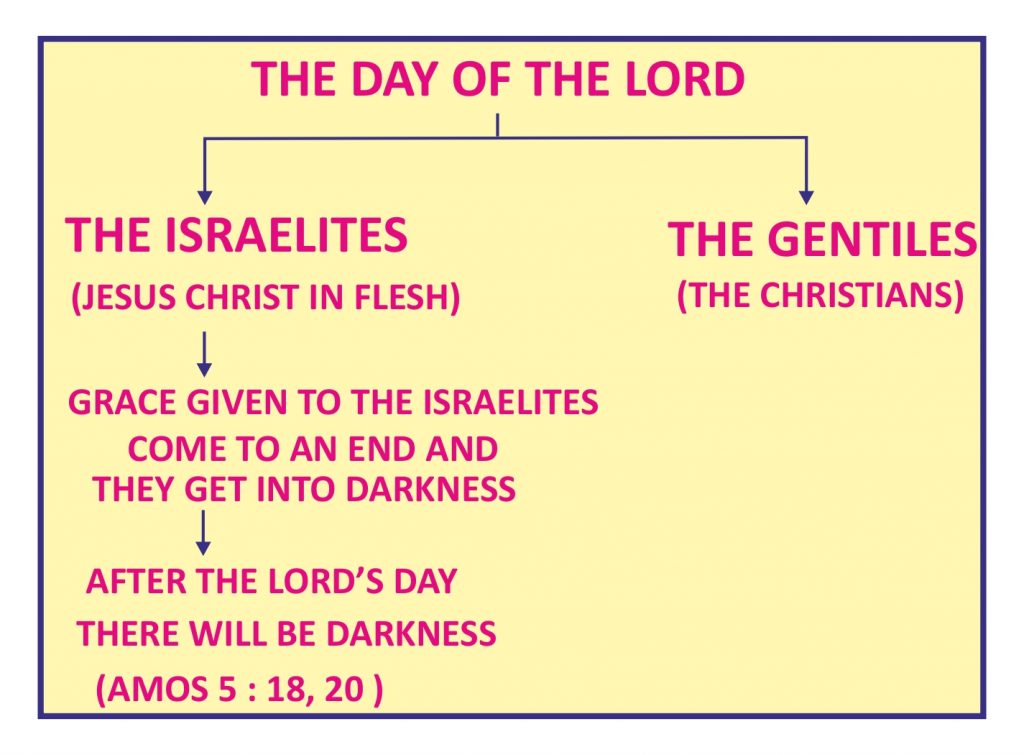
The Day of the Lord is divided into two categories. The first category is to the Israelites and the second one is to the Christians. At the first time, on the Day of the Lord, Lord Jesus Christ was revealed in flesh.
When the Lord's Day came, it was the prophecy that the heart of the fathers should turn to the children. The fathers, that is, the heart of our forefathers – Abraham, Isaac and Jacob must turn to the children, that is, to the children of the fathers (by flesh). Whoever has got the heart, like that of fathers their hearts were turned to the Lord on the Day of the Lord. On the Day of the Lord, the heart of the children, whose heart is like the heart of the fathers, was turned. These events took place when Jesus Christ was revealed in flesh. That was the fullness of the grace to the Israelites.
Another one to the Gentiles, that is to the Christians.
In Ezekiel 30: 3 it is said like this:
“For the day is near, even the day of the LORD is near, a cloudy day; it shall be the time of the heathen.”
The Gentiles put their faith on His name and became His children. According to John 1: 12, all they, who believe in His name, are His children. It is said so. We are His children because we believe in His name. Only these children are christened as Christians. The heart of the Christians should be turned towards the fathers. Who are these fathers? Abraham, Isaac and Jacob are the forefathers. They paid heed to the words of the Lord as it is. Abraham believed the Lord. It was imputed to him for righteousness. What word had the Lord commanded, Abraham believed that word. The heart of the children must change as their heart. The Christians, who change like that, belong to the eternal life.
The Lord was revealed in flesh on the day of the Lord given to the Israelites. The Lord commanded fullness to the grace given to the Israelites on that day. After that, there were dark ages among the Israelites. Darkness among the Israelites. Till today, the kingdom of Israel is in darkness. That means, it is in a state of not going into the land of the living. That is the end. The Bible witnesses the boundary of that end as “the Day of the Lord”.
In Amos 5: 18, 20 it is said like this:
“Woe unto you that desire the day of the LORD! to what end is it for you? the day of the LORD is darkness, and not light.
Shall not the day of the LORD be darkness, and not light? even very dark, and no brightness in it?”
The day of the Lord shall be dark and not light. It will be very dark. There will be darkness after the Lord had predestined that day. When Jesus Christ was crucified, from the sixth hour there was darkness all over the earth to the ninth hour (Matt. 27: 45). After He was glorified, the Holy Spirit was sent in the name of Jesus Christ. We, the Gentiles, have got grace.
In Amos 5: 25 – 27 it is said like this:
“Have ye offered unto me sacrifices and offerings in the wilderness forty years, O house of Israel?
But ye have borne the tabernacle of your Moloch and Chiun your images, the star of your god, which ye made to yourselves.
Therefore will I cause you to go into captivity beyond Damascus, saith the LORD, whose name is The God of hosts.”
“The day of the Lord” mentioned here as prophesy by Prophet Amos belongs to Israelites. Likewise, there is a day of the Lord for Gentiles too.
In Acts 7: 42, 43 it is said like this:
“Then God turned, and gave them up to worship the host of heaven; as it is written in the book of the prophets, O ye house of Israel, have ye offered to me slain beasts and sacrifices by the space of forty years in the wilderness?
Yea, ye took up the tabernacle of Moloch, and the star of your god Remphan, figures which ye made to worship them: and I will carry you away beyond Babylon.”
When that day prophesied by the prophet Amos was revealed, they were witnessed by Stephen. Stephen witnessed about the fulfillment of the Lord's Day among the Israelites. He witnessed that, what was prophesied by the prophets, was fulfilled.
The man, who came on the chariot fastened with a pair of horses, also witnessed the Day of the Lord on that day.
In John 1: 23 it is said like this:
“He said, I am the voice of one crying in the wilderness, Make straight the way of the Lord, as said the prophet Esaias.”
That day, that voice sounded in the wilderness. It witnessed that he was not that word; he was the voice of that word; he was the voice crying in the wilderness. He witnessed that he came to make straight the way of the Lord and that he was not that light but he was sent to witness about that light. He witnessed that he was not that word; he was the voice of that Word. All these happenings occurred on that day of the Lord.
Likewise, in the time of the Last Testament, an incident similar to that will take place in “the day of the Lord”.
In 1 Thessalonians 5: 2 it is said like this:
“For yourselves know perfectly that the day of the Lord so cometh as a thief in the night.”
The Word witnesses the day of the Lord comes in the night. Witness is given that the Day of the Lord is divided into two parts.
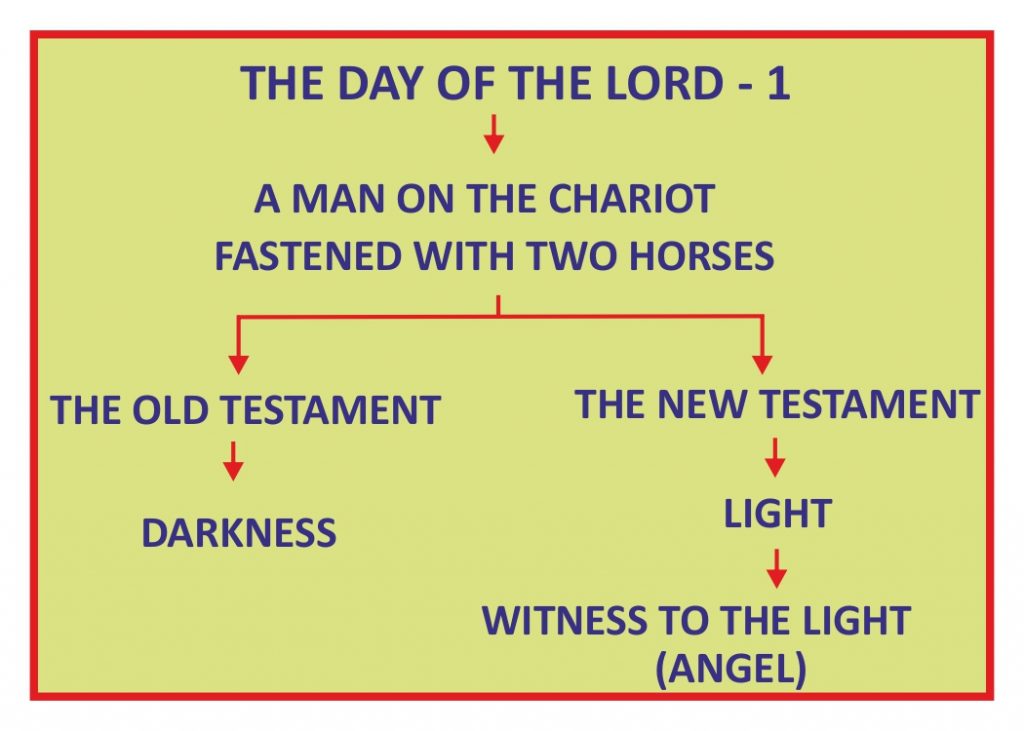
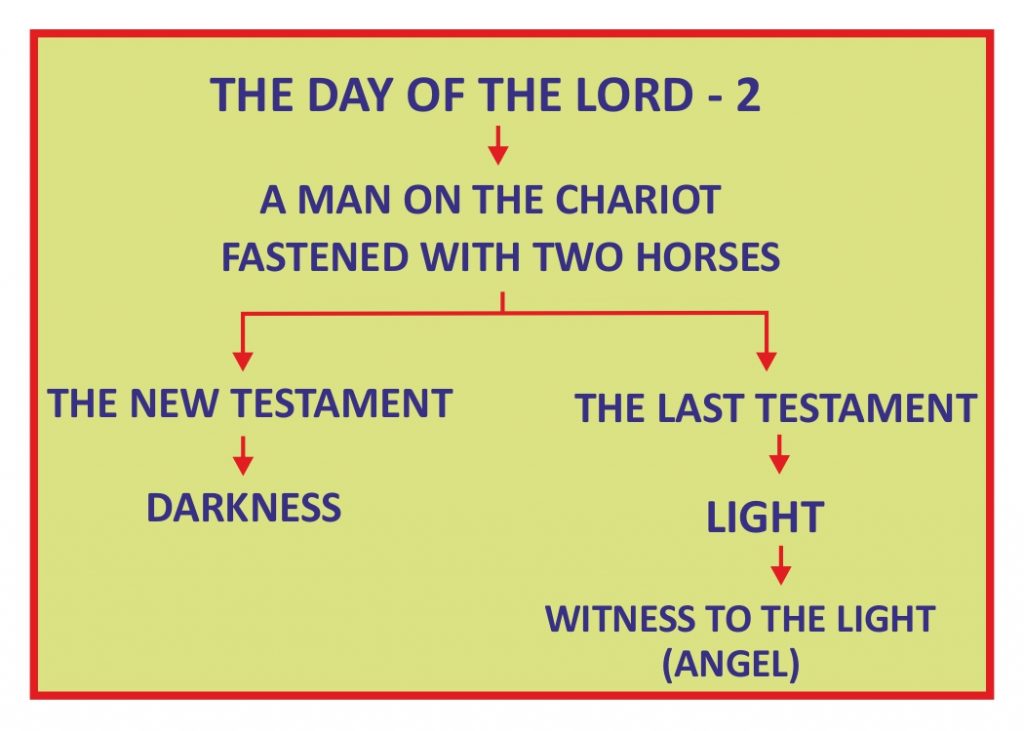
The day of the Lord is the end of the brightness of the day. The Lord's Day is the day of the end of fullness of light. After that, only darkness will be full. The Lord's Day is the end of the boundary. That is an end to light. That is the beginning of darkness.
In 1 Thessalonians 5: 5-8 it is said like this:
“Ye are all the children of light, and the children of the day: we are not of the night, nor of darkness.
Therefore let us not sleep, as do others; but let us watch and be sober.
For they that sleep sleep in the night; and they that be drunken are drunken in the night.
But let us, who are of the day, be sober, putting on the breastplate of faith and love; and for an helmet, the hope of salvation.”
Apostle Paul witnesses that we are not of the darkness; we are of the light. After the Lord's Day passes off, darkness will grab.
In Joel 2: 1, 2 it is said like this:
“Blow ye the trumpet in Zion, and sound an alarm in my holy mountain: let all the inhabitants of the land tremble: for the day of the LORD cometh, for it is nigh at hand;
A day of darkness and of gloominess, a day of clouds and of thick darkness, as the morning spread upon the mountains: a great people and a strong; there hath not been ever the like, neither shall be any more after it, even to the years of many generations.”
The Lord's Day is the day of darkness and the day of gloominess. The Lord's Day is an end. At the end of the Lord's Day there will be darkness. The Lord's Day is the end of brightness. A throng of people will rise up in light on the day of the Lord. Prophet Joel says only this as a prophecy. These will happen at the time of the Last Testament. Joel has said, “As the morning spread upon the mountains; a great people and a strong; there hath not been ever the like, neither shall be any more after it, even to the years of many generations.”
Who are this strong people? That is the people of light. Only the people of light, knows what darkness is. Only people who have sight can see the light. That is the sight made by the spirit.
A strong people will rise up. That strong people are the people who know the light. They are of the light. Only they can identify Babylon which is in darkness. Only they can know what Babylon's fornication is. That is not the fornication of the flesh. That is spiritual fornication. Only with the spiritual eyes one can see them.
In John 1: 7, 8 it is said like this:
“The same came for a witness, to bear witness of the Light, that all men through him might believe.
He was not that Light, but was sent to bear witness of that Light.”
After the day of the Lord, darkness will cover completely. That is a final line. That day, that line was marked among the Israelites. Nonetheless, grace has been given to them for later harvest. There is no later harvest for us, the Gentiles. The day of the Lord was witnessed to the Israelites, and so to the Gentiles also, the day of the Lord must be witnessed. When this day of the Lord is fulfilled, it will be declared. How should the day of the Lord be proclaimed? To proclaim the Lord's Day, two horses are needed. A chariot fastened with two horses is also needed. On the chariot, one must come riding. Then a voice from heaven will be revealed.
In the time of the Last Testament a strong (nation) people will rise up to witness the light. A great deal of grace will be given more in the time of the Last Testament than the grace ordered in the times of the Churches. On the Lord's Day, the Law will be made easier. Reason – that is final. More people must be sent and enabled to win the special exam. Like that, here the Law is made easy.
The law is made easy on the Lord's Day. The law was made easy on the Lord's Day of the Israelites. Then, the law given to the Israelites was to believe Jesus as the Lord, as the Messiah, as Christ. He was the Messiah, He was the one who was sent and He was the one who had brought the Father's name and to believe that, was the law of that day. This creed of faith of the Lord's Day was made easy more than the works of the law.
Jesus Christ said to the thief on the right side, who must be killed according to the law, “Today, you will be with me in paradise”. Reason; He accepted Jesus as the 'Son of God'. He accepted the Word that was sent and was revealed in flesh. Although, he did not fulfill the works of the law, he inherited the kingdom of heaven by his work of faith.
Likewise, in the time of Last Testament law will be lightened. Believing the voice rising from heaven and acting according to it is witnessed as the work of eternal life.
'On the Day of the Lord' of the New Testament Word became flesh.
On the Day of the Lord of the Last Testament, the Word of the Lord will reveal itself as His name. It will reveal the name of the Lord.
On the day of the Lord that rose up at first, the Lord revealed Himself in flesh. On the day of the Lord that rose up second time, the Lord will reveal Himself as “Word, the name of God”.
On the day of the Lord in the Last Testament too, a man must sit on the chariot fastened with two horses and proclaim that name. These must be announced through a man by an angel. He who comes on the chariot fastened with a pair of horses must yell “Babylon is fallen, is fallen”. He must witness about the Word that will be sent in the Last Testament. He must witness about the name of the Lord.
At the time of his witnessing thus, a strong people will rise up. That is a people of light as mentioned in the book of the Prophet Joel. What is the light for that strong people? What is darkness? They know them. Darkness is devil. Light is the Lord. Only by knowing the Lord, one can identify the devil. That people is the people who comprehended light. Likewise, the fornication of Babylon must be identified and shown. The name of the Lord, which is the Word of the name of the Lord, will show the identity of Babylon and the Devil.
Amen! Amen!! Amen!!!
(அறிவிக்கப்பட்ட நாள்: 26.10.2014)
மாற். 13: 14-ல் இவ்விதமாகக் கூறப்பட்டுள்ளது:
"மேலும் பாழாக்குகிற அருவருப்பைக்குறித்துத் தானியேல் தீர்க்கதரிசி சொல்லியிருக்கிறானே; வாசிக்கிறவன் சிந்திக்கக்கடவன்; அது நிற்கத்தகாத இடத்திலே நீங்கள் அதை நிற்கக் காணும்போது, யூதேயாவில் இருக்கிறவர்கள் மலைகளுக்கு ஓடிப்போகக்கடவர்கள்."
பாழாக்குகின்ற அருவருப்பினைக்குறித்துத் தானியேல் தீர்க்கதரிசி தீர்க்கதரிசனமாக முன் அறிவித்துள்ளார்; இந்தப் பாழாக்குகின்ற அருவருப்பு நிற்கத்தகாத இடத்தில் நிற்கும்போது, யூதேயாவில் இருப்பவர்களுக்குள் மீண்டும் கிருபை செல்கின்றது என்றும், அப்போது, யூதேயாவில் இருப்பவர்கள் மலைகளுக்கு ஓடிப்போக வேண்டும் என்றும் கூறப்பட்டுள்ளது. முன் அறிவிக்கப்பட்டதுபோல இந்த பாழாக்குகின்ற அருவருப்பு பரிசுத்த ஸ்தலத்திற்குள் நுழையவேண்டும். பாழாக்குகின்ற அருவருப்பு பரிசுத்த ஸ்தலத்திற்குள் நுழைய இருப்பதைக் கர்த்தர் தம்முடைய ஆவியின் மூலம் தீர்க்கதரிசனமாக அறிவித்திருக்கின்றார். புறஜாதிகளுக்குக் கொடுக்கப்பட்ட கிருபை முழுமை பெறும்போது, பாழாக்குபவன் நிற்கத்தகாத இடத்தில் நிற்கவேண்டும். அப்படியாக அவன் நிற்பதை சாட்சியாக அறிவிக்க வேண்டும். அப்படியாக நிற்கத்தகாத இடத்தில் பாழாக்குகின்ற அருவருப்பு நிற்கும்போது, யூதேயாவில் இருக்கக்கூடிய ஜீவனுக்குரியவர்கள் மலைகளுக்கு ஓடிப்போக வேண்டும். இந்த நிகழ்வுகள் சம்பவிக்கின்றதற்கு முன்பாகவே இவைகள் தீர்க்கதரிசனமாக அறிவிக்கப்பட்டிருக்கின்றது. இந்தக் காரியங்கள் சம்பவிக்கும்போது, யூதேயாவில் உள்ளவர்கள் தங்களுடைய இரட்சிப்பிற்காகக் கட்டளையிடப்பட்டுள்ள மலையினிடத்திற்குச் செல்லவேண்டும். அப்போது பாழாக்குகின்ற அருவருப்பு அவர்கள் மத்தியில் அடையாளம் காட்டப்படும்.
வெளி. 18: 1, 2-ல் இவ்விதமாகக் கூறப்பட்டுள்ளது:
"இவைகளுக்குப்பின்பு, வேறொரு தூதன் மிகுந்த அதிகாரமுடையவனாய், வானத்திலிருந்து இறங்கிவரக்கண்டேன்; அவனுடைய மகிமையினால் பூமி பிரகாசமாயிற்று.
அவன் பலத்த சத்தமிட்டு: மகா பாபிலோன் விழுந்தது! விழுந்தது! அது பேய்களுடைய குடியிருப்பும், சகலவித அசுத்தஆவிகளுடைய காவல்வீடும், அசுத்தமும் அருவருப்புமுள்ள சகலவித பறவைகளுடைய கூடுமாயிற்று."
பாழாக்குகின்றவன் பரிசுத்த ஸ்தலத்திற்குள் நுழைந்திருப்பது கிறிஸ்தவர்களுக்கு மாத்திரமல்ல, இஸ்ரவேல் ஜனங்கள் மத்தியிலும் அறிவிக்கப்பட வேண்டும். அப்படியாகப் பாழாக்குகின்றவன் பரிசுத்த ஸ்தலத்திற்குள் நுழைந்திருப்பது சாட்சியாக அறிவிக்கப்படும்போது, "பாபிலோனின் மகிமை விழுந்தது" என்று சாட்சியிடப்பட வேண்டும்.
ஏசா. 21: 9-ல் இவ்விதமாகக் கூறப்பட்டுள்ளது:
"இதோ, ஒரு ஜோடு குதிரை பூண்ட இரதத்தின்மேல் ஏறியிருக்கிற ஒரு மனுஷன் வருகிறான்; பாபிலோன் விழுந்தது, விழுந்தது; அதின் விக்கிரக தேவர்களையெல்லாம் தரையோடே மோதி உடைத்தார் என்று பிரதியுத்தரம் சொல்லுகிறான்."
ஏசாயா தீர்க்கதரிசி மூலமாகத் தீர்க்கதரிசனமாகக் கூறப்பட்டபடி, இரதத்தின்மேல் ஏறியிருக்கின்ற ஒரு மனுஷன் வருவான்; அவன் பாபிலோன் விழுந்தது, விழுந்தது என்று சாட்சியிடுவான். அப்போது, பாபிலோன் விழவேண்டும்; அவ்வாறாக அது விழுந்ததும் சாட்சியாய் அறிவிக்கப்பட வேண்டும். பாழாக்குகின்ற அருவருப்பு பரிசுத்த ஸ்தலத்திற்குள் வந்துவிட்டதை அறிவிப்பதற்காக ஒரு மனுஷன் அனுப்பப்படுவான்; அவன் ஒரு ஜோடு குதிரைபூண்ட இரதத்தின் மேல் ஏறிவருவான். அதாவது இரண்டு குதிரை பூட்டப்பட்ட ஒரு இரதத்தின்மேல் ஏறிவருவான். அப்படியாக இரதத்தின்மேல் ஏறிவருகின்ற மனுஷன், பாபிலோன் விழுந்தது, விழுந்தது என்று கூறுவான். இங்கே கூறப்பட்டுள்ள இரண்டு குதிரைகள் என்பது இரண்டு ஏற்பாடுகளைக் குறிக்கும். அதாவது இரண்டு ஏற்பாடுகளும் ஒன்று சேரக்கூடிய வேளையில் இரண்டு ஏற்பாடுகளாகிய குதிரை பூட்டப்பட்ட இரதத்தின்மேலேறி ஒரு மனுஷன் வந்து, பாபிலோன் விழுந்தது, விழுந்தது என்று கூறுவான் என்பது தீர்க்கதரிசனமாக அறிவிக்கப்பட்டுள்ளது.
அதற்கு அடுத்ததாக,
வெளி. 18: 1, 2-ல் இவ்விதமாகக் கூறப்பட்டுள்ளது:
"இவைகளுக்குப்பின்பு, வேறொரு தூதன் மிகுந்த அதிகாரமுடையவனாய், வானத்திலிருந்து இறங்கிவரக்கண்டேன்; அவனுடைய மகிமையினால் பூமி பிரகாசமாயிற்று.
அவன் பலத்த சத்தமிட்டு: மகா பாபிலோன் விழுந்தது! விழுந்தது! அது பேய்களுடைய குடியிருப்பும், சகலவித அசுத்தஆவிகளுடைய காவல்வீடும், அசுத்தமும் அருவருப்புமுள்ள சகலவித பறவைகளுடைய கூடுமாயிற்று."
மனுஷன் என்று முதலில் கூறப்பட்டிருக்கின்றது; ஆனால், இங்கே தூதன் என்று கூறப்பட்டிருக்கின்றது. தூதனாகக் குறிப்பிடப்பட்ட அந்த மனுஷன் மூலம் கர்த்தர் ஒரு வார்த்தையினைக் கொடுத்து அனுப்புகின்றார்; அது மகா பாபிலோன் விழுந்தது, விழுந்தது என்று அறிவிப்பதாகும். அவன் அத்தோடு மாத்திரமல்ல, அது பேய்களுடைய குடியிருப்பும், சகலவித அசுத்தஆவிகளுடைய காவல்வீடும், அசுத்தமும் அருவருப்புமுள்ள சகலவித பறவைகளுடைய கூடுமாயிற்று என்றும் சத்தமிட வேண்டும். தானியேல் தீர்க்கதரிசி மூலம் முன் அறிவிக்கப்பட்டவாறு பாழாக்குகின்ற அருவருப்பு பரிசுத்த ஸ்தலத்திற்குள் வரவேண்டும். அப்படிப் பாழாக்குகின்றவன் பரிசுத்த ஸ்தலத்திற்குள் நுழைந்தது அறிவிக்கப்பட வேண்டும்; அப்படி அந்த நிகழ்வினை அறிவிப்பதற்காக ஒரு மனுஷன் அனுப்பப்படுவான். அவன் ஒரு ஜோடு குதிரை பூண்ட இரதத்தின்மேல் ஏறிவருவான். இந்த ஒரு ஜோடு குதிரை என்பது இரண்டு ஏற்பாடுகள் ஆகும்.
2 இரா. 2: 2, 4, 11, 12-ல் இவ்விதமாகக் கூறப்பட்டுள்ளது:
"எலியா எலிசாவை நோக்கி: நீ இங்கே இரு; கர்த்தர் என்னைப் பெத்தேல்மட்டும் போக அனுப்புகிறார் என்றான். அதற்கு எலிசா: நான் உம்மை விடுகிறதில்லை என்று கர்த்தரின் ஜீவனையும் உம்முடைய ஜீவனையும்கொண்டு சொல்லுகிறேன் என்றான்; அப்படியே இருவரும் பெத்தேலுக்குப் போனார்கள்.
பின்பு எலியா அவனை நோக்கி: எலிசாவே, நீ இங்கே இரு; கர்த்தர் என்னை எரிகோமட்டும் போக அனுப்புகிறார் என்றான். அதற்கு அவன்: நான் உம்மை விடுகிறதில்லை என்று கர்த்தருடைய ஜீவனையும் உம்முடைய ஜீவனையும்கொண்டு சொல்லுகிறேன் என்றான்; அப்படியே அவர்கள் எரிகோவுக்கு வந்தார்கள்.
அவர்கள் பேசிக்கொண்டு நடந்துபோகையில், இதோ, அக்கினி ரதமும் அக்கினிக் குதிரைகளும் அவர்கள் நடுவாக வந்து இருவரையும் பிரித்தது; எலியா சுழற்காற்றிலே பரலோகத்திற்கு ஏறிப்போனான்.
அதை எலிசா கண்டு: என் தகப்பனே, என் தகப்பனே, இஸ்ரவேலுக்கு இரதமும் குதிரைவீரருமாய் இருந்தவரே என்று புலம்பினான்; அவனை அப்புறம் காணாமல், தன் வஸ்திரத்தைப் பிடித்து இரண்டு துண்டாகக் கிழித்தான்."
தீர்க்கதரிசனமாக இங்கே கூறப்பட்ட காரியத்தினைக் கவனமாகப் பார்க்கவேண்டும். ஏசாயா தீர்க்கதரிசி தீர்க்கதரிசனமாக அறிவித்தது ஒரு ஜோடு குதிரை பூண்ட இரதத்தின்மேல் ஒருவர் ஏறிவருவார்; அவர் பாபிலோன் விழுந்தது என்று அறிவிப்பார் என்பதாகும். இங்கே இரதத்தினைக் குறித்துக் கூறப்பட்ட காரியம் எலியாவைக் குறித்ததான காரியமாகும். வெளி. 18: 1-ல் கூறப்பட்ட அந்த தூதன் எலியாவின் ஆவியினைக் கொண்டவன் என்று ஏற்கனவே அறிவிக்கப்பட்டுள்ளது. இரண்டு குதிரைகள் பூட்டப்பட்டுள்ள இந்த இரதத்தின்மேல் ஏறிவருபவன் எலியாவின் ஆவியினைக் கொண்டிருக்கக்கூடிய தூதன் ஆகும். அவன் பாபிலோன் விழுந்தது என்றும், அங்கு எத்தகைய ஆவி கிரியை செய்கின்றது என்றும் அறிவிக்க வேண்டும். இந்த நிகழ்வுகள் எப்போது சம்பவிக்கவேண்டும் என்றால், ஒரு ஜோடு குதிரை பூட்டி அந்த இரதம் செல்லக்கூடியக் காலமாகும்.
எலியாவின் ஆவியும் பெலமும் கொண்ட யோவான்ஸ்நானன் அனுப்பப்பட்டபோதும், இத்தகைய நிகழ்வுகள் நிகழ்ந்துள்ளது.
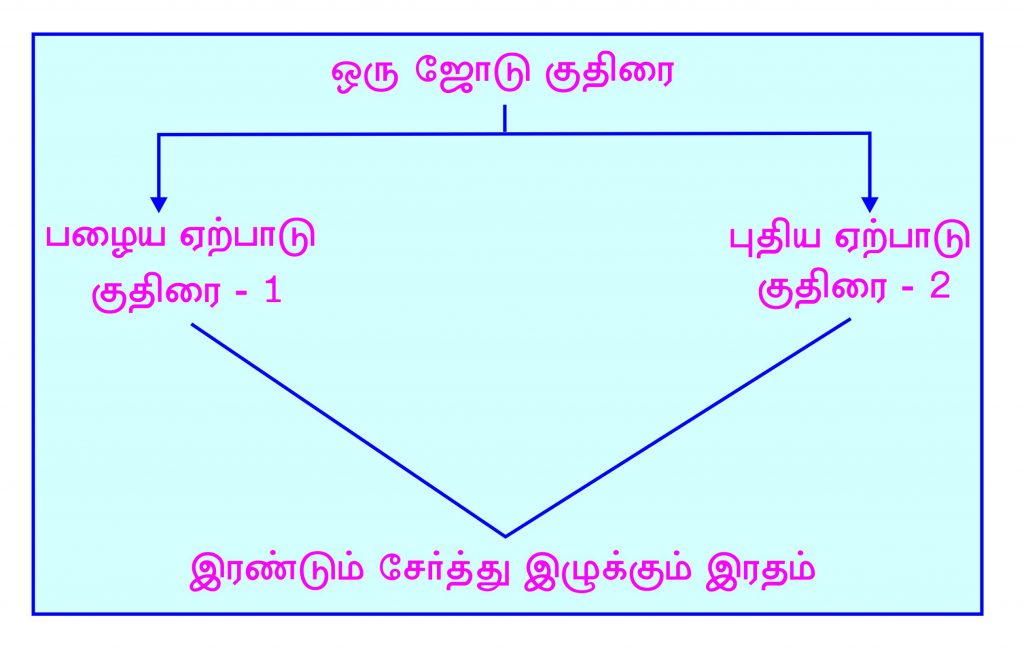
இரதத்தினை இழுத்துச் செல்வதற்கு இரண்டு குதிரைகளும் ஒன்று சேர்ந்து இழுக்க வேண்டும். அதுபோல பாபிலோன் விழும்போதும், இரண்டு ஏற்பாடுகளும் ஒன்று சேரவேண்டும்; முன்னர் இந்த ஒரு ஜோடு குதிரை பூண்ட இரதத்தில் ஏறிவந்தவன் யோவான்ஸ்நானன். இந்த நிகழ்வுகள் முன்கூட்டியே மல்கியா தீர்க்கதரிசியின் புத்தகத்தில் தீர்க்கதரிசனமாகக் கூறப்பட்டிருக்கின்றது.
மல். 4: 5, 6-ல் இவ்விதமாகக் கூறப்பட்டுள்ளது:
"இதோ, கர்த்தருடைய பெரிதும் பயங்கரமுமான நாள் வருகிறதற்கு முன்னே நான் உங்களிடத்திற்கு எலியா தீர்க்கதரிசியை அனுப்புகிறேன்.
நான் வந்து பூமியைச் சங்காரத்தால் அடிக்காதபடிக்கு, அவன் பிதாக்களுடைய இருதயத்தைப் பிள்ளைகளிடத்திற்கும், பிள்ளைகளுடைய இருதயத்தை அவர்கள் பிதாக்களிடத்திற்கும் திருப்புவான்."
இங்கே இரதத்தின்மேல் ஏறிவந்தவர் எலியாவின் ஆவி கொண்ட யோவான்ஸ்நானன். முன்னர் இஸ்ரவேலுக்கு இரதமாய் இருந்தவர்; இஸ்ரவேலுக்கு குதிரை வீரராய் இருந்தவர், அதன் பின்னர் எலியாவின் ஆவியின் பலத்தினைக் கொண்ட யோவான்ஸ்நானனாக அனுப்பப்பட்டான். அப்போதிருந்த ஒரு ஜோடு குதிரைகள் பழைய மற்றும் புதிய ஏற்பாடுகளாகும்.
பழைய ஏற்பாடு மற்றும் புதிய ஏற்பாடு என்ற இரண்டு குதிரைகள் பூண்ட இரதத்தின்மேலேறினவனாய் யோவான்ஸ்நானன் அனுப்பப்பட்டான். அந்த மனுஷன் எருசலேம் விழுந்தது, விழுந்தது என்று அறிவித்தான். யோவான்ஸ்நானன் எருசலேம் தேவாலயத்திற்குள் செல்லவில்லை; அவன் வனாந்திரத்தில் இருந்தான். இந்த நிகழ்வு பழைய மற்றும் புதிய ஏற்பாடுகளின் சங்கமமாகும். அதுபோன்றதொரு பயணம் மீண்டும் எழும்பும். அப்போது அந்த தூதன் மனுஷனாக மீண்டும் வந்து, பாபிலோன் விழுந்தது, விழுந்தது என்று அறிவிப்பான். முன்னர் யோவான்ஸ்நானனுக்குள் வந்தபோது, பழைய ஏற்பாடு என்று ஒரு குதிரையும், புதிய ஏற்பாடு என்று ஒரு குதிரையுமாக சேர்ந்திழுக்கக்கூடிய இரதமாக அந்தக் காலம் இருந்தது. அப்படியாக இரண்டு ஏற்பாடுகளும் சேர்ந்திருக்கக்கூடிய வேளையில் பாபிலோனைக் குறித்தும் அறிக்கையிட வேண்டும். ஏனென்றால், அப்போது பாபிலோன் பேய்களுடைய குடியிருப்பாக மாறியிருக்கும்.
ஏசாயா தீர்க்கதரிசியின் புத்தகத்தில் குறிப்பிடப்பட்ட அந்த மனுஷன்தான் வெளி. 18: 1-ல் தூதன் என்று அறிவிக்கப்பட்டுள்ளான். முன்னர் ஒரு ஜோடு குதிரை பூண்ட இரதத்தின்மேல் யோவான்ஸ்நானன் ஏறிவந்ததுபோல, மறுபடியும் ஒரு மனுஷன் அனுப்பப்படவேண்டும். சபைகளைக் குறித்த இரகசியங்கள் அறிவிக்கப்பட்ட பின்னர் இவைகள் சம்பவிக்கும்.
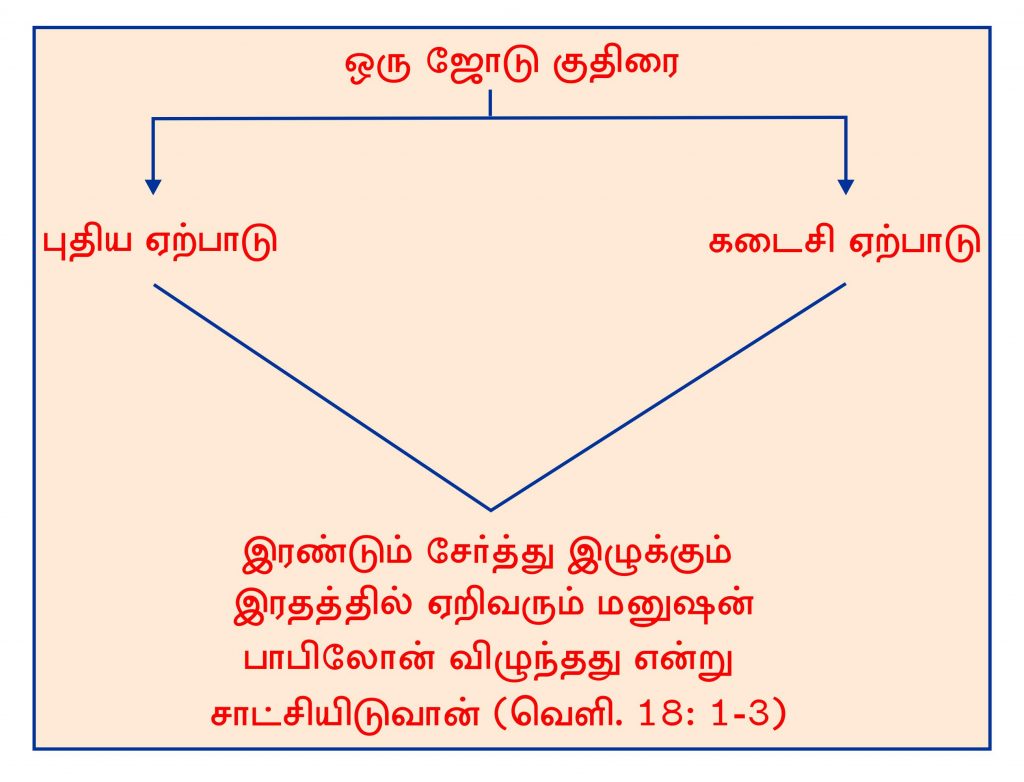
யோவான்ஸ்நானன் பழைய ஏற்பாடு மற்றும் புதிய ஏற்பாடு என்ற இரண்டு குதிரைகள் பூண்ட இரதத்தின்மீது ஏறிவந்ததுபோல, மறுபடியும் அதே விதமான சம்பவம் ஒன்று நிகழ வேண்டும். இப்போது புதிய ஏற்பாடு மற்றும் கடைசி ஏற்பாடு என்ற இரு குதிரைகள் ஒன்று சேர இரதத்தினை இழுக்க வேண்டும். இரு ஏற்பாடுகளும் ஒன்றுசேரும் காலத்தில் இந்த நிகழ்வுகள் ஏற்படும்.
இந்த இரண்டு ஏற்பாடுகளும் சேர்ந்திருக்கக்கூடிய காலத்தில் இரதத்தின்மீது ஏறி அமர்ந்த மனிதன், பாபிலோன் விழுந்தது, விழுந்தது என்று சாட்சியிட வேண்டும்.
வெளி. 18: 2-ல் இவ்விதமாகக் கூறப்பட்டுள்ளது:
"அவன் பலத்த சத்தமிட்டு: மகா பாபிலோன் விழுந்தது! விழுந்தது! அது பேய்களுடைய குடியிருப்பும், சகலவித அசுத்தஆவிகளுடைய காவல்வீடும், அசுத்தமும் அருவருப்புமுள்ள சகலவித பறவைகளுடைய கூடுமாயிற்று."
ஒரு ஜோடு குதிரை பூண்ட இரதத்தின்மீது ஏறியிருப்பவன்: மகா பாபிலோன் விழுந்தது! விழுந்தது! அது பேய்களுடைய குடியிருப்பும், சகலவித அசுத்தஆவிகளுடைய காவல்வீடும், அசுத்தமும் அருவருப்புமுள்ள சகலவித பறவைகளுடைய கூடுமாயிற்று என்று கூறவேண்டும். "பாழாக்குகின்ற அருவருப்பு பரிசுத்த ஸ்தலத்தில் வர நீங்கள் காணும்போது" என்று தானியேல் தீர்க்கதரிசி கூறியிருக்கின்றார். அந்த பாழாக்குபவன் பரிசுத்த ஸ்தலத்திற்குள் நுழைந்துள்ளதை அறிவிப்பதற்காக அந்த மனுஷன் அனுப்பப்படுவான், அப்போது அங்கே ஒரு வார்த்தை அனுப்பப்படும். அப்படி அனுப்பப்படும் அந்த வார்த்தையினைக் கொண்டுவருபவன் அதை அறிவித்து அந்த வார்த்தைக்குச் சாட்சியிடுவான். இந்த நிகழ்வுகள் யாவும் ஒன்றிணைந்து நிகழும்போதுதான், குதிரைமீது அந்த மனுஷன் வந்து இவைகளைக் கூறுவான். அவன், பாபிலோன் பேய்களுடைய குடியிருப்பாக மாறிவிட்டது என்று கூறுவான். தானியேல் தீர்க்கதரிசி கூறியதுபோன்று நிற்கத்தகாத இடத்தில் அவைகள் நிற்பதை அவன் பறைசாற்ற வேண்டும்; சபைகளின் கிரியைகள் வேசித்தனமானது என்பதையும் அவன் அறிவிக்க வேண்டும்.
வெளி. 18: 3-ல் இவ்விதமாகக் கூறப்பட்டுள்ளது:
"அவளுடைய வேசித்தனத்தின் உக்கிரமான மதுவை எல்லா ஜாதிகளும் குடித்தார்கள்; பூமியின் ராஜாக்கள் அவளோடே வேசித்தனம்பண்ணினார்கள்; பூமியின் வர்த்தகர் அவளுடைய செல்வச் செருக்கின் மிகுதியினால் ஐசுவரியவான்களானார்கள் என்று விளம்பினான்."
அந்த தூதன்,
1. பாபிலோன் பேய்களுடைய குடியிருப்பாக மாறி இருக்கின்றது என்றும்,
2. அவளுடைய கிரியைகளெல்லாம் வேசித்தனமானது என்றும் அறிவிக்க வேண்டும்.
இவைகள் அதிகாரம் கொண்ட அந்த தூதன் மூலம் அறிவிக்கப்பட வேண்டும். இந்த நிகழ்வுகளைக் குறித்து அறிக்கையிடுவதற்காகவே அவன் அனுப்பப்படுவான். குதிரைகள் கர்த்தருடைய காரியம்; அந்தக் குதிரையின்மீது அனுப்பப்படுபவனும் கர்த்தருடைய காரியமாக அனுப்பப்படுவான். இங்கே அந்த தூதன் வந்தமர்ந்த மாமிச சரீரத்திற்கு முக்கியத்துவம் கிடையாது. யோவான்ஸ்நானனுக்கு எருசலேமில் இருந்த ஆசாரியர்களிடம் எந்தவிதமான மாமிச விரோதமும் இல்லை. பின்னர் ஏன் அவன் தேவாலயத்திற்குள் வராமல், வனாந்தரத்தில் சுற்றித்திரிந்தான்? நியாயப்பிரமாணத்தினைப் பின்பற்றிய ஜனங்களை நோக்கி, நீங்கள் வந்து ஞானஸ்நானம் பெற்றுக்கொள்ளுங்கள் என்று ஏன் கூறினான்? யோவான்ஸ்நானன் அதன்மூலமாக இஸ்ரவேலரிடம் ஏதாவது ஆதாயம் பெற்றுக்கொண்டானா? ஞானஸ்நானம் பெற்றுக்கொள்ளும் நீங்கள் தசமபாகத்தினை என்னிடம்தான் கொடுக்க வேண்டும் என்று கூறினானா? இல்லையே! அது அவனுடைய பணிவிடை ஓட்டமாகவே இருந்தது. அதுபோலவே கடைசி ஏற்பாட்டின் காலத்திலும் அந்த மனுஷனுக்குள் எலியாவின் ஆவி கொண்ட தூதன் சாட்சியிட அனுப்பப்படுவான்.
வேசித்தனமான அவளுடைய கிரியைகளை குதிரைகள் பூட்டப்பட்ட இரதத்தின்மீது ஏறி வருபவன் அறிந்தவனாகக் காணப்படுவான். மற்றவர்கள் அவளது வேசித்தனத்தினை அடையாளம் காணமுடியாது. அவளது கிரியைகள் மற்றவர்களுக்கு பரிசுத்தமாகக் காணப்படலாம்; நீதியுள்ளவைகளாகக் கூடக் காணப்படலாம்; ஆனால் ஆவிக்குள்ளானவனான யோவான்ஸ்நானனுக்கு அந்தக் காரியம் நீதியுள்ளவைகளாகக் காணப்படாததுபோலவே அனுப்பப்படப்போகிற அந்தத் தூதனுக்கும் அவைகள் காணப்படும். யோவான்ஸ்நானன் எருசலேம் தேவாலயத்திற்குச் சென்று பலியிடவில்லை; வனாந்தரத்தில் நின்று சாட்சியிட்டுக் கொண்டேயிருந்தான். நான் அந்த ஒளி அல்ல; அந்த ஒளிக்குச் சாட்சி என்றான். அப்படியானால் அந்த ஒளி எங்கே இருந்தது? அந்த ஒளி அன்று எருசலேம் தேவாலயத்தில் இல்லை; எருசலேம் தேவாலயத்திற்குள் இருள் இருந்தது. இருள் பிசாசிற்குரியதாகும். எனவே எருசலேம் தேவாலயத்திற்குள் யோவான்ஸ்நானன் செல்லவில்லை. எருசலேம் தேவாலயம் பிசாசிற்குரிய இடமாக மாறி இருந்தது, இருளுக்குரிய இடமாக அது மாறி இருந்தது. ஒளியினை அந்தத் தேவாலயம் ஏற்றுக்கொள்ளவில்லை. ஒளியினைப் பிரதான ஆசாரியன் ஏற்றுக்கொள்ளவில்லை. யார் அந்த ஒளி? அது எந்த மனுஷனையும் உயிர்ப்பிக்கின்ற மெய்யான ஒளியாகிய இயேசுகிறிஸ்து; அவரை எருசலேம் ஏற்றுக்கொள்ளவில்லை. ஆசாரியர்கள் அந்த மெய்யான ஒளியினைச் சிலுவையில் அறைய ஒப்புக்கொடுத்தார்கள். காரணம், அவர்கள் தேவாலயத்தில் இருந்த இருளைச் சார்ந்தவர்களாக இருந்தார்கள். ஒளிக்குரியவனான யோவான்ஸ்நானன் அந்த இருளுக்குள் செல்லவில்லை. ஏனென்றால், அவன் அந்த ஒளியினை அறிந்தவனாக இருந்தான். தேவாலய விசுவாசிகள் மெய்யான ஒளியினை அறியவில்லை. அவர்களின் கண்கள் அங்கே மறைக்கப்பட்டிருந்தது.
குத்துவிளக்கில் ஏற்றப்பட்டிருக்கின்ற நெருப்பு மட்டுமே அவர்களுக்கு ஒளியாகத் தெரிந்தது; எரிந்துகொண்டிருக்கின்ற குத்துவிளக்கு அவர்களுக்கு ஒளியாகத் தெரிந்தது; தேவாலயத்தில் ஏற்றப்பட்டிருந்த விளக்குகளின் வெளிச்சம் அவர்களுக்கு ஒளியாகத் தெரிந்தது. ஆனால் யோவான்ஸ்நானனுக்கு அப்படியாக இல்லை. யோவான்ஸ்நானன், எருசலேம் தேவாலயம் இருளாக இருப்பதைக் கண்டான். எருசலேமின் ஒளி யோர்தான் நதிக்கரை ஓரமாக நடந்து வருவதைக் கண்டு சாட்சியிட்டான். அதுபோல, பாபிலோனின் இருளும் வேசித்தனமும் வெளிக்காட்டப்பட வேண்டும். அதைத்தான் ஒரு ஜோடு குதிரை பூண்ட இரதத்தின்மேல் ஏறி வருபவன் சாட்சியிடுவான். பாபிலோனின் வேசித்தனத்தினை அவன் அடையாளம் காட்டவேண்டும். பாபிலோனின் வேசித்தனம் அடையாளம் காட்டப்பட்டவுடன், வேறொரு சத்தம் உண்டாகும்.
வெளி. 18: 4-ல் இவ்விதமாகக் கூறப்பட்டுள்ளது:
"பின்பு, வேறொரு சத்தம் வானத்திலிருந்து உண்டாகக் கேட்டேன். அது: என் ஜனங்களே, நீங்கள் அவளுடைய பாவங்களுக்கு உடன்படாமலும், அவளுக்கு நேரிடும் வாதைகளில் அகப்படாமலும் இருக்கும்படிக்கு அவளைவிட்டு வெளியே வாருங்கள்."
பாபிலோன் வேசியாகவும், பேய்களுடைய குடியிருப்பாகவும் மாறிவிட்டது என்று வெளிக்காட்டப்பட்டதும், வானத்திலிருந்து சத்தம் உண்டாக வேண்டும். அந்த சத்தம் குதிரை பூட்டப்பட்ட இரதத்தின்மேலிருந்து வருகின்றவனிடத்தில் இருந்து உண்டாகவில்லை. அந்த சத்தம் வானத்திலிருந்து உண்டானது. அந்த சத்தம் வார்த்தையாக அவருடைய நாமத்திற்குச் சாட்சியிட்டு வெளிவரும். வார்த்தை ஒளி, வார்த்தைக்குச் சத்தம் ஊழியம்.
பாபிலோனின் வேசித்தனம் அடையாளம் காட்டப்பட்ட பின்னர், வானத்திலிருந்து வேறொரு சத்தம் உண்டாக வேண்டும். அது பாபிலோனை விட்டு, அதாவது வேசியாக மாறிவிட்ட சபைகளை விட்டு வெளியேறி வரும்படியாய் சாட்சியிடும். இந்த நிகழ்வுகளுக்கு முன்னதாக பாழாக்குகின்ற அருவருப்பு பரிசுத்த ஸ்தலமாகிய சபைகளில் இருப்பது அடையாளம் காட்டப்பட வேண்டும். பாபிலோனுடைய அருவருப்பும், வேசித்தனமும் வெளிக்காட்டப்பட்ட பின்னர், அந்த சத்தம் வெளிவரும். அந்த சத்தம் வார்த்தையாய் பிரதிபலிக்கும்.
கிறிஸ்துவுக்குள் அருமையானவர்களே, பாபிலோனுக்குள்ளாகக் காணப்படுகின்ற அருவருப்பு, அங்கே குடியிருக்கக்கூடிய அசுத்த ஆவிகளின் கிரியைகள் மற்றும் பேய்களுடைய குடியிருப்பாய் மாறிவிட்ட காரியங்கள் ஆகிய இவைகள் அனைத்தும் சாட்சியிடப்பட வேண்டும். இவைகளெல்லாம் சாட்சியாய் அறிவிக்கப்பட்ட பின்னர்தான், வார்த்தையின் சத்தம் வெளிவரும். அது: "நீ அவளை விட்டு வெளியே வா" என்று அழைக்கும்.
"பின்பு, வேறொரு சத்தம் வானத்திலிருந்து உண்டாகக் கேட்டேன். அது: என் ஜனங்களே…" என்று கூறப்பட்டுள்ளது. அந்த ஜனம் வானத்திலிருந்து வார்த்தையினைக் கொடுப்பவருடைய காணியாட்சிக்குரிய ஜனமாகும். அது, குதிரைமீது ஏறிவருகின்றவனுடைய ஜனம் அல்ல. குதிரைமீது ஏறிவருபவன் இதனை அறிவிக்க வேண்டும். அது அவனது பணி. வானத்திலிருந்து உண்டான சத்தம் கூறுகின்றது, "…என் ஜனங்களே, நீங்கள் அவளுடைய பாவங்களுக்கு உடன்படாமலும், அவளுக்கு நேரிடும் வாதைகளில் அகப்படாமலும் இருக்கும்படிக்கு அவளைவிட்டு வெளியே வாருங்கள்" என்று.
பரலோகத்தில் வீற்றிருக்கின்றவரின் காணியாட்சிக்குரிய ஜனமே அந்த சத்தத்தினைக் கேட்டு பாபிலோனுக்குள்ளிருந்து வெளியேறி வரும்; அவருடைய ஜனம் அல்லாதவர்கள் பாபிலோனை விட்டு வெளியேறி வரமாட்டார்கள்.
யோவான்ஸ்நானனிடம் ஞானஸ்நானம் பெறுவதற்காக அநேகர் சென்றார்கள். நியாயப்பிரமாணத்தின்படியாக பாவம் மன்னிக்கப்பட வேண்டுமானால், ஆடு அல்லது மாடு அல்லது புறாக்குஞ்சுகள் பலியிடப்பட வேண்டும். ஆனால் இவைகள் இல்லாமல் பாவம் மன்னிக்கப்பட இலகுவான ஒரு முறைமை யோவான்ஸ்நானனால் அறிமுகப்படுத்தப்பட்டது. இந்தப் புதிய மார்க்கத்திற்குள் அநேகர் வந்து ஞானஸ்நானம் பெற்றார்கள். ஞானஸ்நானம் பெற்றவர்கள் அனைவரும் யோவானின் சீஷர்களாக மாறவில்லை. ஞானஸ்நான முறைமையின்படி பாவங்கள் கழுவப்பட யோர்தானில் முழுக வேண்டும் என்பதற்காக வந்தார்கள். யோவான்ஸ்நானன் கொடுத்த ஞானஸ்நானம் அவருக்குப்பின் வருபவரை ஏற்றுக்கொள்ள வேண்டும் என்பதற்காகக் கொடுக்கப்பட்டது. ஞானஸ்நானம் பெற்றவர்களில் அநேகர், பின்வருபவரை விசுவாசிக்க வேண்டும் என்பதாய் கொடுக்கப்பட்ட இந்த வார்த்தையினைக் கேட்டதும், யோவான்ஸ்நானனை விட்டுப் பிரிந்துச் சென்றார்கள். எருசலேம் நகரத்தார் ஞானஸ்நானம் பெறச் சென்றார்கள்; ஆனால், தங்களுக்குக் கேடுண்டாக நினைத்தவர்கள் அவரிடம் செல்லவில்லை என்று வேதம் கூறுகின்றது. ஞானஸ்நானம் பெற்ற அனைவரும் அவரின் சீஷராகவில்லை.
யோவான்ஸ்நானன் ஞானஸ்நானம் கொடுத்தபோது, எருசலேம் தேவாலயத்தில் இருந்தவர்கள் அவர் கொடுத்த ஞானஸ்நானத்தினைப் பாராட்டினார்களா? இல்லையே! ஏனென்றால், யோவான்ஸ்நானனைத் தீர்க்கதரிசி என்று அவர்கள் முழுமையாய் ஏற்றுக்கொள்ளவில்லை. எருசலேம் தேவாலய விசுவாசிகளும், தேவாலயத்தின் ஆசாரியர்களும் யோவான்ஸ்நானனைத் தீர்க்கதரிசி என்று விசுவாசிக்கவில்லை. ஜனங்கள் அவரைத் தீர்க்கதரிசி என்று விசுவாசித்தார்கள்; ஆனால், அவர்கள் கிரியைகளில் அதனை உறுதி செய்யவில்லை; கிரியையில் காட்டியவர்கள் யோவானுக்குச் சீஷர்களாக மாறினார்கள்; அவருடைய சீஷர்களாக இருந்தவர்களும் இயேசுகிறிஸ்துவின் சீஷர்களாக மாறினார்கள்.
"…என் ஜனங்களே, நீங்கள் அவளுடைய பாவங்களுக்கு உடன்படாமலும், அவளுக்கு நேரிடும் வாதைகளில் அகப்படாமலும் இருக்கும்படிக்கு அவளைவிட்டு வெளியே வாருங்கள்" என்று இங்கே அறைகூவல் இடப்படுகின்றது. அவளுக்கு நேரிடப்போகின்ற வாதையினுக்கு உட்படாதபடிக்கு அவரது ஜனங்கள் காக்கப்பட வானத்திலிருந்து இந்தச் சத்தம் உண்டாகும். வானத்திலிருந்து ஒரு சத்தம் உண்டாகி, அது, பாபிலோனின் கிரியைகளுக்கு உடன்படக்கூடாது என்று அனைவரும் கேட்கும்படியான சத்தமாய் வராது. வானத்திலிருந்து யாவரும் கேட்கும்படியாக அந்த சத்தம் உண்டாகாது. வானத்திலிருந்து உண்டாகும் சத்தம் அனுப்பப்பட்டவன் மூலம் சாட்சியாய் அறிவிக்கப்படும். இந்தப் பூமி அக்கினியினால் சுட்டெரிக்கப்படுவதற்கு முன்னதாக மனுஷகுமாரனும் தனது மகிமை நிறைந்தவராய் வெளியரங்கமாய் வருவார். அதுதான் பகிரங்க வருகை. அப்போது இந்தப் பூமி அக்கினியினால் சுட்டெரிக்கப்படும். பாபிலோனுக்குக் கர்த்தர் உபத்திரவத்தினைக் கொடுக்கப்போகின்றார்; அவள் அக்கினியும், கந்தகமும் எரியக்கூடிய கடலில் தள்ளப்படப் போகின்றாள்; அவளோடு ஐக்கியப்பட்டிருந்தால், தனது ஜனத்திற்கும் அதே நிலை ஏற்படும் என்பதால், அவளைவிட்டு வெளியேறி வா என்று அந்த சத்தம் அழைக்கும்.
இதைத்தான் யோவான்: "பின்பு, வேறொரு சத்தம் வானத்திலிருந்து உண்டாகக் கேட்டேன்…" என்று கூறியுள்ளார். அப்போஸ்தலனாகிய யோவான் அந்த சத்தம் வானத்திலிருந்து உண்டாவதைக் கண்டார். யோவான் அந்த சத்தத்தினைக் கேட்டார்; அந்த சத்தத்திற்குள்ளாக வார்த்தை இருந்தது. அந்த வார்த்தை மூன்று காரியங்களைச் சாட்சியிட்டது. யோவான் கேட்ட அந்த சத்தத்தினை, குதிரையின்மேல் ஏறிவந்த தூதனும் அறிவான். அவன் அவைகளைச் சாட்சியாய் அறிவிப்பான்.
தீர்க்கதரிசனமானது சுயதோற்றமுடைய பொருளை உடையதாய் இராது. இயேசுகிறிஸ்து மாமிசத்தில் வந்தபோது, அவரை யூதருக்கு ராஜா என்று எல்லா யூதர்களும் ஏற்றுக்கொண்டார்களா? அப்போது அவரை ஏற்றுக்கொள்ளாதவர்கள் யாவரும் உப்புத்தூணாகியிருப்பார்கள் என்று இருந்தால், பயத்தோடு அநேகர் ஏற்றுக்கொண்டிருப்பார்கள். ஆனால் தேவதிட்டம் அது அல்ல. உள்ளான இருதயத்தோடு ஏற்றுக்கொள்பவர்கள் பரலோக சுதந்திரத்தினைப் பெறுவார்கள். அறிவிக்கப்படும் அன்றைக்குரிய வார்த்தையினை அறிவிக்கப்பட்டபடியே ஏற்றுக்கொள்வதுதான் விசுவாசம்.
கிறிஸ்தவர்களாகிய நாம் மாமிசத்தின்படியான நற்கிரியைகளைச் செய்யும்போது பரலோகராஜ்யம் சென்றடைவோம் என்ற எண்ணம் கொண்டவர்களாகவே இருக்கின்றோம்; சபைகளில் கர்த்தர் இல்லாதிருந்தால், அவர் நம் கரங்களைப் பிடித்து இழுத்து, அதைவிட்டு வெளியில் அழைத்து வந்துவிடுவார் என்பதாய் தவறான எண்ணம் கொண்டிருக்கின்றவர்களாகவே காணப்படுகின்றோம். அது அப்படியாக இல்லை. தமது வார்த்தையினைச் சாட்சியிட தாம் தெரிந்தெடுத்தவனையே அவர் அனுப்புவார். "கலகவீட்டாராகிய அவர்கள் கேட்டாலும் சரி, கேளாவிட்டாலும் சரி, நீ போய் அறிவி" என்பதாய் அனுப்பப்படப்போகிறவன் சாட்சிகொடுப்பான் என்றே வேதம் கூறுகின்றது.
அப்போஸ்தலனாகிய யோவான் அந்த சத்தத்தினைக் கேட்டார். அந்த சத்தத்திற்குள் வார்த்தை இருந்தது; அதற்குரிய நாமம் வேறு ஒருவருக்கும் அறிவிக்கப்படாத நாமமாகவே அப்போது இருந்தது. தேவனுடைய நாமமாகிய "வார்த்தை" என்ற அந்த நாமத்தினை மற்ற அப்போஸ்தலர்கள் அறிக்கையிடவில்லை. அப்போஸ்தலனாகிய பவுல் முதலாம் சபைக்கென்று அனுப்பப்பட்ட தூதன். ஆனால், இந்தக் காரியங்களெல்லாம் யோவானைத் தவிர வேறு ஒருவருக்கும் அறிவிக்கப்படவில்லை. அப்போஸ்தலனாகிய யோவானுக்கு அந்த சத்தம் கேட்டது. அது, "தேவனுடைய நாமம் வார்த்தை" என்று சாட்சியிட்டது. சுவிசேஷப் பகுதியிலும் யோவான் மாத்திரமே இந்த நாமத்தினைக் குறித்துச் சாட்சியிட்டுள்ளார். "ஆதியிலே வார்த்தை இருந்தது" என்று எழுதப்பட்டிருக்கின்றது. அப்போஸ்தலனாகிய யோவான்தான் அந்த சத்தத்தினைக் கேட்டார்; குதிரைகள் பூட்டப்பட்ட இரதத்தின்மேல் அமர்ந்தவனை அவருக்குத் தெரியும்; வானத்திலிருந்து சத்தமிட்டவர் யார் என்பதும் அவருக்குத் தெரியும். அவர் மூலமாகவே "தேவனுடைய நாமம் வார்த்தை" என்பது தீர்க்கதரிசனமாக அறிவிக்கப்பட்டது. யோவான் கர்த்தரால் அதிகமாக நேசிக்கப்பட்ட சீஷன்.
அப்போஸ்தலனாகிய யோவான் எழுதிய சுவிசேஷம் மற்றும் நிருபங்களில் "வார்த்தை" என்று கூறப்பட்டிருக்கின்றது. "அந்த வார்த்தை மாமிசமாகி" (யோவா. 1: 14). அவர்தான் அதனை அறிவித்தார். "வார்த்தை" என்னும் நாமம் சிருஷ்டிப்பின் கிரியைகளுக்கு முன்னதாகவே இருந்த நாமமாகும்; தேவன் என்னும் நாமம் அறிவிக்கப்படுவதற்கு முன்னதாக இருந்த நாமம் 'வார்த்தை' என்ற நாமமாகும்.
வெளி. 18: 4-ல் இவ்விதமாகக் கூறப்பட்டுள்ளது:
"பின்பு, வேறொரு சத்தம் வானத்திலிருந்து உண்டாகக் கேட்டேன். அது: என் ஜனங்களே, நீங்கள் அவளுடைய பாவங்களுக்கு உடன்படாமலும், அவளுக்கு நேரிடும் வாதைகளில் அகப்படாமலும் இருக்கும்படிக்கு அவளைவிட்டு வெளியே வாருங்கள்."
வானத்திலிருந்து உண்டான இந்த சத்தத்தினை அப்போஸ்தலனாகிய யோவான் கேட்டார்.
வெளி. 19: 12, 13-ல் இவ்விதமாகக் கூறுகின்றது:
"அவருடைய கண்கள் அக்கினிஜூவாலையைப்போலிருந்தன, அவருடைய சிரசின்மேல் அநேக கிரீடங்கள் இருந்தன; அவருக்கேயன்றி வேறொருவருக்குந் தெரியாத ஒரு நாமமும் எழுதியிருந்தது.
இரத்தத்தில் தோய்க்கப்பட்ட வஸ்திரத்தைத் தரித்திருந்தார்; அவருடைய நாமம் தேவனுடைய வார்த்தை என்பதே."
அவருக்கேயன்றி வேறொருவருக்கும் தெரியாத அந்த நாமம் அப்போஸ்தலனாகிய யோவானுக்கு வெளிப்படுத்தப்பட்டது. அன்று அப்போஸ்தலனாகிய யோவானுக்கு அறிவிக்கப்பட்ட அந்த நாமத்தினைப் பறைசாற்றக்கூடிய கிருபையினை கர்த்தராகிய இயேசுகிறிஸ்து நமக்குக் கொடுத்திருக்கின்றார். அது அன்று யோவான் தவிர வேறொருவருக்கும் தெரியாதிருந்த நாமம். இந்த தீர்க்கதரிசனம் எழுதப்பட்டு கிட்டத்தட்ட 2000 ஆண்டுகள் ஆகின்றது. ஆனால், இந்தக் கடைசி ஏற்பாட்டினில்தான் அவருடைய இந்த நாமத்தினைக் கர்த்தர் வெளிப்படுத்தியுள்ளார். வார்த்தை என்ற அந்த நாமம் எல்லா இரகசியங்களையும் கொண்டிருக்கக்கூடிய நாமமாகும். எல்லா இரகசியங்களையும் அவருடைய நாமத்தினிமித்தம் வெளிப்படுத்துவதால், இந்த நாமம் கடைசி இடிமுழக்கச் சத்தமாக அறிவிக்கப்பட்டுள்ளது. தேவனுடைய இந்த நாமம் யோவான்ஸ்நானனுக்குத் தெரிந்தது. வந்திருப்பவர் ஆட்டுக்குட்டி என்று அவருக்குத் தெரிந்தது. ஏனென்றால், அவர் ஒரு ஜோடு குதிரை பூட்டப்பட்ட இரதத்தின்மேல் ஏறி வந்தவர்.
வெளி. 18: 20-ல் இவ்விதமாகக் கூறப்பட்டுள்ளது:
"பரலோகமே! பரிசுத்தவான்களாகிய அப்போஸ்தலர்களே! தீர்க்கதரிசிகளே! அவளைக்குறித்துக் களிகூருங்கள். உங்கள் நிமித்தம் தேவன் அவளை நியாயந்தீர்த்தாரே! என்று தூதன் சொன்னான்."
பாபிலோன் விழுந்துபோனதினால் பரிசுத்தவான்கள் அவளைக்குறித்துக் களிகூர வேண்டும். பாபிலோன் வேசியாக இருக்கின்றாள்; பாபிலோன் பாழாக்குகின்ற அருவருப்புகளுடைய ஸ்தலமாக மாறிவிட்டது; பாபிலோன் சகலவித அசுத்த ஆவிகளுடைய காவல்வீடாக மாறிவிட்டது; அது பேய்களுடைய குடியிருப்பாக மாறிவிட்டது; இப்படியாய் காணப்படும் இந்தப் பாபிலோன் விழுந்து போயிற்று என்று கூறும்போது, பரலோகத்தில் இருப்பவர்கள், பரிசுத்தவான்களாகிய அப்போஸ்தலர்கள், தீர்க்கதரிசிகள் யாவரும் களிகூருவார்கள். ஆனால், அப்போது மற்றொரு கூட்டம் அழுது துக்கித்துக் கொண்டிருக்கும்.
வெளி. 18: 13, 16, 19-ல் இவ்விதமாகக் கூறப்பட்டுள்ளது:
"இலவங்கப்பட்டையையும், தூபவர்க்கங்களையும், தைலங்களையும், சாம்பிராணியையும், திராட்சரசத்தையும், எண்ணெயையும், மெல்லிய மாவையும், கோதுமையையும், மாடுகளையும், ஆடுகளையும், குதிரைகளையும், இரதங்களையும், அடிமைகளையும், மனுஷருடைய ஆத்துமாக்களையும் இனிக் கொள்வாரில்லாதபடியால், அவளுக்காக அழுது புலம்புவார்கள்.
ஐயையோ! சல்லாவும் இரத்தாம்பரமும் சிவப்பாடையும் தரித்து, பொன்னினாலும் இரத்திங்களினாலும் முத்துக்களினாலும் சிங்காரிக்கப்பட்டிருந்த மகா நகரமே! ஒரு நாழிகையிலே இவ்வளவு ஐசுவரியமும் அழிந்துபோயிற்றே! என்று சொல்லி, அழுது துக்கிப்பார்கள்.
தங்கள் தலைகள்மேல் புழுதியைப் போட்டுக்கொண்டு: ஐயையோ, மகா நகரமே! சமுத்திரத்திலே கப்பல்களையுடைய அனைவரும் இவளுடைய உச்சிதமான சம்பூரணத்தினால் ஐசுவரியவான்களானார்களே! ஒரு நாழிகையிலே இவள் பாழாய்ப்போனாளே! என்று அழுது துக்கித்து ஓலமிடுவார்கள்."
ஒரு கூட்டம் அழுது புலம்பியது; ஒரு கூட்டம் களிகூருகின்றது. பாபிலோன் விழுந்தது என்று கூறப்பட்டவுடன் ஒரு கூட்டம் அழுகின்றது; ஒரு கூட்டம் களிகூர்ந்தது. இயேசுகிறிஸ்துவைச் சிலுவையில் அறைந்ததினால் ஒரு கூட்டம் களிகூர்ந்தது. கடைசி ஏற்பாட்டிலும் ஒலிவ மரங்களை வீழ்த்தியபடியினால், ஒரு கூட்டம் களிகூரும். இங்கே பாபிலோன் என்ற வேசி அடையாளம் காட்டப்பட்டு, அவள் விழுந்துபோனாள் என்று கூறுவதினால், ஒரு கூட்டம் சந்தோஷப்படுகின்றது. பரலோகமே சந்தோஷப்படுகின்றது. ஏனென்றால், அவளுடைய வேசித்தனம், அவளுடைய அருவருப்பு, இதையெல்லாம் பார்த்து பரலோகத்தில் வாசம்பண்ணுகின்றவர்களுக்கு வேதனையாக இருந்தது. எனவே, பாபிலோன் விழுந்துபோனதும் அவர்கள் சந்தோஷப்பட்டார்கள், அவர்கள் களிகூருகின்றார்கள்.
எருசேலேமாக இருந்து பாபிலோனாக மாறிய சபைகளின் கிரியைகள் முழுக்க முழுக்க மாமிசத்திற்குரியதாகவே மாறவேண்டும். அப்போது அவளது அருவருப்புகள் வெளிக்காட்டப்படும். இவைகள் அருவருப்பு என்று கர்த்தர் யாருக்கு வெளிக்காட்டச் சித்தமாயிருக்கின்றாரோ, அவர்களுக்கு அது அருவருப்பாக தோன்றும். மற்றவர்களுக்கு அவளின் வேசித்தனம் அருவருப்பாகத் தோன்றாது.
பாபிலோன் விழுவதினால் பரலோகத்தில் உள்ளவர்கள், அப்போஸ்தலர்கள், தீர்க்கதரிசிகள் யாவரும் களிகூருவார்கள். ஏனென்றால், தீர்க்கதரிசி பின்னதாக சம்பவிக்கப்போவதை எழுதியிருக்கின்றார். தான் ஜீவனுக்குரியவன் என்றும், ஜீவனுள்ளோருடைய தேசத்தில் தனக்குப் பங்கு உண்டு என்பதும் ஏசாயாவிற்கு இந்தத் தீர்க்கதரிசனத்தினை அறிவித்தபோது தெரியும். ஒரு மனுஷன் ஒரு ஜோடு குதிரை பூண்ட இரதத்தின்மேல் ஏறி, பாபிலோன் விழுந்தது, விழுந்தது என்று கூறுவார் என்பதை அவர் அறிவார். இந்தத் தீர்க்கதரிசனத்தின் பொருள் என்ன என்பதும் அவருக்குத் தெரியும். அந்தத் தீர்க்கதரிசனம் எப்படி எழுதப்பட்டிருக்கின்றது, அது எதற்காக இப்படி எழுதப்பட்டிருக்கின்றது என்பவைகள் யாவும் அவருக்குத் தெரியும். அதுபோலவே, அப்போஸ்தலனாகிய யோவானும், பாபிலோன் விழுந்தது, விழுந்தது என்று கூறப்படும் இந்தக் காரியங்களை அறிவார். அவருக்கு அதனுடைய பொருள் என்னவென்று தெரியும். தீர்க்கதரிசிகளாய் அனுப்பப்படப்போகின்ற அந்த ஒலிவ மரங்கள் இரண்டும் பாபிலோனுடைய காரியங்களைக் குறித்து அறிவார்கள். இவைகள் அவர்கள் இருவருக்கும் வெளிப்படுத்தப்பட்டு, அவர்களுக்கு அறிவிக்கப்பட்டவைகள்.
தீர்க்கதரிசன வார்த்தைகள் சுயதோற்றமுள்ள பொருளை உடையதாய் இராது (2 பேது. 1: 20). அந்த இலக்கம் 666 என்று அப்போஸ்தலனாகிய யோவானுக்கு வெளிப்படுத்திக் கொடுக்கப்பட்டது. அந்த இலக்கம் என்னவென்று அப்போஸ்தலனாகிய யோவானுக்குத் தெரியும்; புத்தியுள்ளவன் கணக்குப்பார்க்கக்கடவன் என்று வார்த்தை கூறுகின்றது (வெளி. 13: 18). அது எந்தப் புத்தி? ஆராய்ச்சி செய்து டாக்டர் பட்டம் பெற்ற புத்தி அது அல்ல; யோவானுக்கு அதை எழுதும்போது என்ன ஞானம் கொடுக்கப்பட்டதோ, அதே ஞானம் கொடுக்கப்பட்டாலன்றி, அந்த இலக்கத்தினைக் கணக்குப் பார்க்க முடியாது. அந்தக் காரியம் www.com என்று கூறிவிடுவார்கள்; அந்தக் காரியம் chip என்றும் கூறுவார்கள். இவைகள் மாமிசத்திற்குரியவைகள். இதற்காக எழுதப்பட்டது வேதாகமம் அல்ல. மாமிசத்திற்குரிய காரியங்களுக்காக எழுதப்பட்டது வேதாகமம் அல்ல. ஆதாமிலிருந்து ஆரம்பமான ஒரு இணைப்பினை மட்டும்தான் வேதாகமம் தன்னகத்தே எடுத்துக் கூறுகின்றது. ஆதாம் கர்த்தத்துவத்தினால் உருவான முதல் மனிதன்.
பாபிலோன் விழுந்தால் சந்தோஷப்படுபவர்கள் பரலோகத்திற்குரியவர்கள்; பரலோகத்தில் இருப்பவர்களாகிய அப்போஸ்தலர்களும் தீர்க்கதரிசிகளும் களிகூறுவார்கள். பாபிலோன் விழும்போது பரலோகத்திற்குரியவர்களாக இருப்பவர்களால் மட்டுமே களிகூரமுடியும்; பரலோகத்திற்குரியவர்களாக இல்லாதவர்கள், அழுது புலம்புவார்கள்.
வார்த்தை சாட்சியிடுகின்றது, வானத்திலிருந்து உண்டான சத்தம் கூறுகின்றது: என் ஜனங்களே, நீ அவளுடைய வாதைக்கு உடன்படாதே; அது பேய்களுடைய குடியிருப்பாக மாறிவிட்டது. அவளுக்குக் கொடுக்கப்படப்போகின்ற உபாதையில், என் ஜனமே நீ அகப்படக்கூடாது- என்று தமது ஜனத்தினைக் கர்த்தர் அழைக்கின்றார். இந்தச் சத்தத்தினைக் கேட்டுக் களிகூருபவர்கள் பரலோகத்திற்குரியவர்கள்; மற்றவர்கள் களிகூரமாட்டார்கள்.
பாபிலோன் விழுந்தது என்று கூறும்போது, எப்படியான ஒரு சந்தோஷம் உண்டாயிருக்கும்? அப்போஸ்தலர்கள் சந்தோஷப்படுவதுபோல சந்தோஷப்பட வேண்டும்; தீர்க்கதரிசிகள் சந்தோஷப்படுவதுபோல சந்தோஷப்பட வேண்டும்; பரலோகவாசிகள் சந்தோஷப்படுவதுபோல சந்தோஷப்பட வேண்டும். இவைகள் ஆவிக்குரிய காரியங்களாகும்; அது மாமிசத்திற்குரியவைகள் அல்ல.
ஏசா. 21: 9-ல் இவ்விதமாகக் கூறப்பட்டுள்ளது:
"இதோ, ஒரு ஜோடு குதிரை பூண்ட இரதத்தின்மேல் ஏறியிருக்கிற ஒரு மனுஷன் வருகிறான்; பாபிலோன் விழுந்தது, விழுந்தது; அதின் விக்கிரக தேவர்களையெல்லாம் தரையோடே மோதி உடைத்தார் என்று பிரதியுத்தரம் சொல்லுகிறான்."
பாபிலோன் விழுந்தது என்று அந்த மனுஷன் கூறவேண்டும். பாபிலோன் விழுந்தது என்று கூறுவது மாத்திரமல்ல; என் ஜனங்களே, அவளை விட்டு வெளியே வாருங்கள் என்றும் அறிவிக்கப்பட வேண்டும். இவைகள் அந்த நாளுக்குரிய பிரமாணமாகக் கட்டளையிடப்பட்டுள்ளது. பிரமாணத்தினைப் பின்பற்றுபவர்கள் களிகூருவார்கள்.
இரண்டு குதிரைகள் பூட்டப்பட்ட இரதத்தின்மீது ஏறிவரும் மனிதன் எழும்பும் போது பாபிலோன் விழும். விழுந்த பாபிலோனைக் குறித்து அது விழுந்தது என்றும் கூறப்படும். அந்த நாளினைத்தான் வேதம் கர்த்தருடைய நாள் என்று கூறுகின்றது.
கர்த்தருடைய நாள் என்றால் என்ன?
யோவே. 2: 1, 3-ல் இவ்விதமாகக் கூறப்பட்டுள்ளது:
"சீயோனிலே எக்காளம் ஊதுங்கள், என் பரிசுத்த பர்வதத்திலே எச்சரிப்பின் சத்தமிடுங்கள்; தேசத்தின் குடிகள் எல்லாம் தத்தளிக்கக்கடவர்கள்; ஏனெனில் கர்த்தருடைய நாள் வருகிறது, அது சமீபமாயிருக்கிறது.
அவைகளுக்கு முன்னாக அக்கினி பட்சிக்கும், அவைகளுக்குப் பின்னாக ஜூவாலை எரிக்கும்; அவைகளுக்கு முன்னாகத் தேசம் ஏதேன் தோட்டத்தைப்போலவும், அவைகளுக்குப் பின்னாகப் பாழான வனாந்தரத்தைப்போலவும் இருக்கும்; அவைகளுக்கு ஒன்றும் தப்பிப்போவதில்லை."
ஒரு ஜோடு குதிரை பூண்ட இரதத்தின்மீது வந்த மனுஷன் இந்த நிகழ்வுகளை அறிவிக்கும்போது, ஒரு பிரமாணம் அங்கே கட்டளையிடப்படும். அந்தப் பிரமாணத்தினைக் கொடுப்பவர் சர்வவல்லமையுள்ள தேவனாய் தன்னை வெளிப்படுத்திய கர்த்தர். மோசே உங்களுக்கு மன்னாவைக் கொடுக்கவில்லை, மோசே உங்களுக்குப் பிரமாணத்தினைக் கொடுக்கவில்லை; என் பிதாவே உங்களுக்குக் கொடுத்தார் என்று இயேசுகிறிஸ்து மாமிசத்தில் வெளிப்பட்டபோது சாட்சியிட்டார் (யோவா. 6: 32, 33). பிரமாணத்தினை ஒரு ஜோடு குதிரை பூண்ட இரதத்தின்மீது ஏறிவருபவன் கொடுப்பதில்லை. கர்த்தர் அவன் மூலம் அந்தப் பிரமாணத்தினைக் கொடுத்து அனுப்புவார். "அவளைவிட்டு வெளியே வா என்பதுதான் அந்தப் பிரமாணமாகும்".
கர்த்தருடைய நாள் என்பது கர்த்தர் முன்குறித்த ஒரு நாளாகும். அந்த முன்குறிக்கப்பட்ட நாளுக்குப் பின்னர் ஒரு பெரும் நிகழ்வு நிகழவேண்டும், ஒரு இருண்ட காலம் ஆரம்பமாகவேண்டும். "கர்த்தருடைய நாள் என்பது ஒரு கிரியையின் முடிவாகும்". கர்த்தருடைய நாள் இரண்டு பிரிவாக வேதாகமத்தில் கூறப்பட்டுள்ளது.
மல். 4: 5, 6-ல் இவ்விதமாகக் கூறப்பட்டுள்ளது:
"இதோ, கர்த்தருடைய பெரிதும் பயங்கரமுமான நாள் வருகிறதற்கு முன்னே நான் உங்களிடத்திற்கு எலியா தீர்க்கதரிசியை அனுப்புகிறேன்.
நான் வந்து பூமியைச் சங்காரத்தால் அடிக்காதபடிக்கு, அவன் பிதாக்களுடைய இருதயத்தைப் பிள்ளைகளிடத்திற்கும், பிள்ளைகளுடைய இருதயத்தை அவர்கள் பிதாக்களிடத்திற்கும் திருப்புவான்."
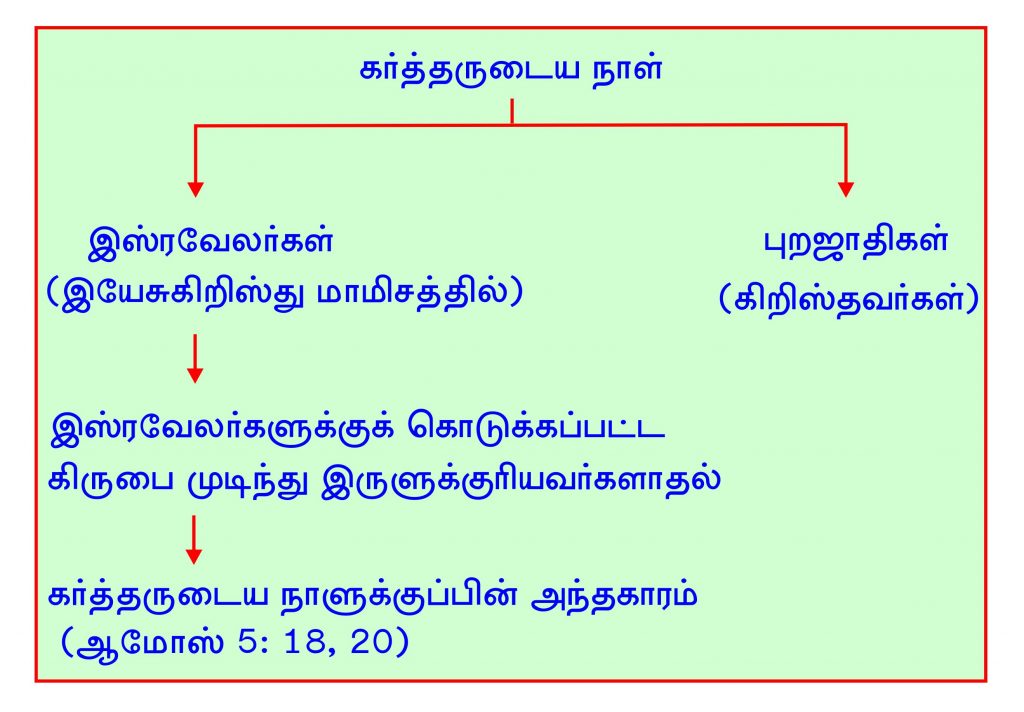
கர்த்தருடைய நாள் இங்கே இரண்டு பகுதியாகப் பிரிக்கப்பட்டுள்ளது. முதற்பகுதி இஸ்ரவேலர்களுக்கும், இரண்டாம் பகுதி கிறிஸ்தவர்களுக்கும் உரியதாகும். முதல் முறை கர்த்தருடைய நாளில் கர்த்தராகிய இயேசுகிறிஸ்து மாமிசத்தில் வெளிப்பட்டார்.
கர்த்தருடைய நாள் வந்தபோது, பிதாக்களுடைய இருதயம் பிள்ளைகளிடத்திற்குத் திருப்பப்பட வேண்டும் என்பது தீர்க்கதரிசனம். பிதாக்கள் அதாவது முற்பிதாக்களாகிய ஆபிரகாம், ஈசாக்கு, யாக்கோபு இவர்களுடைய இருதயம் பிள்ளைகளிடத்திற்கு அதாவது பிதாக்களுடைய (மாமிசத்தின்படி) பிள்ளைகளிடத்திற்குத் திரும்ப வேண்டும். பிதாக்களின் இருதயம் போன்ற இருதயம் யாரிடத்தில் இருக்கின்றதோ, அவர்களுடைய இருதயம் கர்த்தரிடத்தில் கர்த்தருடைய நாளில் திருப்பப்பட்டது. கர்த்தருடைய நாளில் பிதாக்களுடைய இருதயத்தினைப்போன்று இருக்கக்கூடிய பிள்ளைகளுடைய இருதயம் கர்த்தரிடத்தில் திருப்பப்பட்டது. இவைகள் இயேசுகிறிஸ்து மாமிசத்தில் வெளிப்பட்டபோது நிகழ்ந்த நிகழ்வாகும். அது இஸ்ரவேலர்களின் கிருபையின் நிறைவாகும்.
மற்றொன்று புறஜாதிகளுக்கு, அதாவது கிறிஸ்தவர்களுக்கு உரியதாகும்.
எசே. 30: 3-ல் இவ்விதமாகக் கூறப்பட்டுள்ளது:
"நாள் சமீபமாயிருக்கிறது; ஆம், கர்த்தருடைய நாள் சமீபமாயிருக்கிறது; அது மந்தாரமான நாள், அது புறஜாதிகளுக்கு வரும் காலம்."
புறஜாதிகள் அவரது நாமத்தின்மேல் விசுவாசம் வைத்து அவரது பிள்ளைகளானவர்கள். யோவா. 1: 12-ன்படி, அவருடைய நாமத்தின்மேல் விசுவாசம் வைத்திருக்கின்ற யாவரும் அவரது பிள்ளைகள் என்று கூறப்பட்டுள்ளது. நாம் அவருடைய நாமத்தின்மீது விசுவாசம் வைத்ததினால் பிள்ளைகளானோம். இந்தப் பிள்ளைகளுக்குத்தான் கிறிஸ்தவர்கள் என்ற பெயர் சூட்டப்பட்டது. கிறிஸ்தவர்களுடைய இருதயம் பிதாக்களுக்கு நேராகத் திருப்பப்பட வேண்டும். யார் இந்தப் பிதாக்கள்? ஆபிரகாம், ஈசாக்கு, யாக்கோபு இவர்கள்தான் முற்பிதாக்கள்; கர்த்தரது வார்த்தைக்கு அவர்கள் அப்படியே செவிகொடுத்தவர்கள். ஆபிரகாம் கர்த்தரை விசுவாசித்தான்; அதுவே நீதியாக எண்ணப்பட்டது. கர்த்தர் எந்த வார்த்தையினைக் கட்டளையிட்டாரோ, அந்த வார்த்தையினை ஆபிரகாம் விசுவாசித்தான். அவர்களின் இருதயத்தினைப்போல் பிள்ளைகளின் இருதயமும் மாறவேண்டும். அப்படி மாறக்கூடிய கிறிஸ்தவர்கள் ஜீவனுக்குரியவர்கள்.
இஸ்ரவேலருக்குள் கொடுக்கப்பட்ட கர்த்தருடைய நாளில் கர்த்தர் மாமிசத்தில் வெளிப்பட்டார்; அந்த நாளில் இஸ்ரவேலருக்குக் கொடுக்கப்பட்ட கிருபைக்கு நிறைவைக் கட்டளையிட்டார். அதற்குப்பின்னர் இஸ்ரவேலருக்குள் இருண்ட காலம், இஸ்ரவேலருக்குள் இருள். இன்றுவரையிலும் இஸ்ரவேலுடைய ராஜ்யம் இருளுக்குள் இருக்கின்றது; அதாவது ஜீவனுள்ளோருடைய தேசத்திற்குள் செல்லமுடியாத ஒரு நிலையில்தான் இருக்கின்றது. அதுதான் முடிவு. அந்த முடிவு எல்லையினைத்தான் வேதம் "கர்த்தருடைய நாள்" என்று சாட்சி கொடுக்கின்றது.
ஆமோ. 5: 18, 20-ல் இவ்விதமாகக் கூறப்பட்டுள்ளது:
"கர்த்தருடைய நாளை விரும்புகிறவர்களுக்கு ஐயோ! அதினால் உங்களுக்கு என்ன உண்டு? கர்த்தருடைய நாள் வெளிச்சமாயிராமல் அந்தகாரமாயிருக்கும்.
கர்த்தருடைய நாள் வெளிச்சமாயிராமல், இருளும் பிரகாசமற்ற அந்தகாரமுமாயிருக்குமல்லவோ?"
கர்த்தருடைய நாள் வெளிச்சமாயிராமல் அந்தகாரமாயிருக்கும், அது இருளாக இருக்கும். கர்த்தர் முன்குறித்த அந்த நாளுக்குப் பின்னர் ஒரு இருள். இயேசுகிறிஸ்துவைச் சிலுவையில் அறைந்தபோது, ஆறாம் மணிநேரம் முதல் ஒன்பதாம் மணிநேரம் வரையிலும் பூமியெங்கும் அந்தகாரம் உண்டாயிற்று (மத். 27: 45) என்று வேதம் கூறுகின்றது. அவர் மகிமைப்பட்ட பின்னர் பரிசுத்த ஆவியானவர் கர்த்தராகிய இயேசுகிறிஸ்து என்னும் நாமத்தில் அனுப்பப்பட்டார்; புறஜாதிகளாகிய நமக்கு கிருபை கிடைத்துள்ளது.
ஆமோ. 5: 25-27-ல் இவ்விதமாகக் கூறப்பட்டுள்ளது:
"இஸ்ரவேல் வம்சத்தாரே, நீங்கள் வனாந்தரத்திலே இருந்த நாற்பது வருஷம்வரையில் பலிகளையும் காணிக்கைகளையும் எனக்குச் செலுத்தினீர்களோ?
நீங்கள் உங்களுக்கு உண்டாக்கின மோளோகுடைய கூடாரத்தையும், உங்கள் தேவர்களின் நட்சத்திரராசியாகிய உங்கள் சொரூபங்களின் சப்பரத்தையும் சுமந்துகொண்டுவந்தீர்களே.
ஆகையால் உங்களைத் தமஸ்குவுக்கு அப்பாலே குடியோட்டுவேன் என்று சேனைகளுடைய தேவன் என்னும் நாமமுள்ள கர்த்தர் சொல்லுகிறார்."
ஆமோஸ் தீர்க்கதரிசி தீர்க்கதரிசனமாய் குறிப்பிட்ட இந்த "கர்த்தருடைய நாள்" இஸ்ரவேலருக்குரியதாகும். அதுபோல புறஜாதிகளுக்கும் கர்த்தருடைய நாள் ஒன்று இருக்கின்றது.
அப். 7: 42, 43-ல் இவ்விதமாகக் கூறப்பட்டுள்ளது:
"அப்பொழுது தேவன் அவர்களை விட்டு விலகி, வானசேனைக்கு ஆராதனைசெய்ய அவர்களை ஒப்புக்கொடுத்தார். அதைக்குறித்து: இஸ்ரவேல் வம்சத்தாரே, நீங்கள் வனாந்தரத்திலிருந்த நாற்பது வருஷம்வரையில் காணிக்கைகளையும் பலிகளையும் எனக்குச் செலுத்தினீர்களோ என்றும்,
பணிந்துகொள்ளும்படி நீங்கள் உண்டாக்கின சொரூபங்களாகிய மோளோகினுடைய கூடாரத்தையும், உங்கள் தேவனாகிய ரெம்பான் என்னும் நட்சத்திர சொரூபத்தையும் சுமந்தீர்களே; ஆகையால் உங்களைப் பாபிலோனுக்கு அப்புறத்திலே குடிபோகப்பண்ணுவேன் என்றும், தீர்க்கதரிசிகளின் புஸ்தகத்தில் எழுதியிருக்கிறதே."
ஆமோஸ் தீர்க்கதரிசியின் மூலமாகத் தீர்க்கதரிசனமாகக் கூறப்பட்ட அந்த நாள் வெளிப்படும்போது, ஸ்தேவான் மூலம் இவைகள் சாட்சியிடப்பட்டது. கர்த்தருடைய நாள் இஸ்ரவேலர்களுக்குள்ளாக நிறைவேறியது குறித்து ஸ்தேவான் சாட்சியிட்டார். தீர்க்கதரிசிகள் மூலமாகக் கூறப்பட்டவை நிறைவடைந்தது என்று சாட்சியிட்டார்.
ஒரு ஜோடு குதிரை பூண்ட இரதத்தின்மேல் வந்த மனுஷனும் கர்த்தருடைய நாளை அன்று இஸ்ரவேலர்களுக்குச் சாட்சியிட்டான்.
யோவா. 1: 23-ல் இவ்விதமாகக் கூறப்பட்டுள்ளது:
"அதற்கு அவன்: கர்த்தருக்கு வழியைச் செவ்வைபண்ணுங்கள் என்று ஏசாயா தீர்க்கதரிசி சொன்னபடியே, நான் வனாந்தரத்திலே கூப்பிடுகிறவனுடைய சத்தமாயிருக்கிறேன் என்றான்."
அந்த சத்தம் அன்று வனாந்தரத்திலிருந்து ஒலித்தது. அது நான் அந்த வார்த்தை அல்ல; அந்த வார்த்தையின் சத்தம், நான் வனாந்தரத்திலே கூப்பிடுகின்றவனுடைய சத்தம் என்று சாட்சியிட்டது. கர்த்தருக்கு வழியினைச் செவ்வைபண்ண வந்தேன் என்றும், நான் அந்த ஒளி அல்ல என்றும், அந்த ஒளியினைக் குறித்து சாட்சியிட அனுப்பப்பட்டவன் என்றும், நான் அந்த வார்த்தை அல்ல, அந்த வார்த்தையின் சத்தம் என்றும் சாட்சியிட்டான். கர்த்தருடைய அந்த நாளில் இந்த நிகழ்வுகள் யாவும் சம்பவித்தது.
அதுபோல, கடைசி ஏற்பாட்டின் காலத்திலும் "கர்த்தருடைய நாளில்" இதுபோன்ற ஒரு நிகழ்வு சம்பவிக்கும்.
1 தெச. 5: 2-ல் இவ்விதமாகக் கூறப்பட்டுள்ளது:
"இரவிலே திருடன் வருகிறவிதமாய்க் கர்த்தருடைய நாள் வருமென்று நீங்களே நன்றாய் அறிந்திருக்கிறீர்கள்."
கர்த்தருடைய நாள் இரவில் வரும் என்று வார்த்தை சாட்சியிடுகின்றது. கர்த்தருடைய நாள் இருபிரிவாகப் பிரிக்கப்பட்டு சாட்சிகொடுக்கப்பட்டுள்ளது.
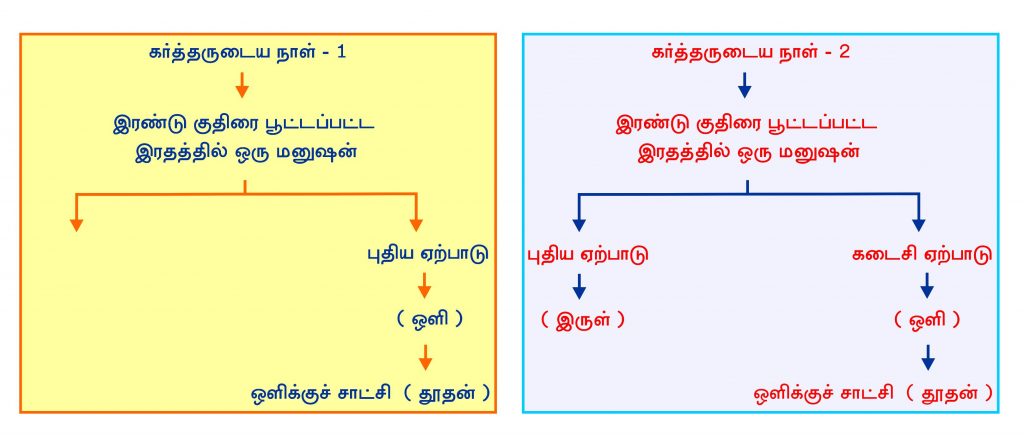
கர்த்தருடைய நாள் என்பது பிரகாசத்தின் முடிவின் நாள். கர்த்தருடைய நாள் என்பது ஒளியின் நிறைவின் நாள். அதற்குப்பின்னர் இருள் மட்டுமே நிறைந்திருக்கும். கர்த்தருடைய நாள் என்பது முடிவின் எல்லை. அது ஒளிக்கு முடிவு. இருளுக்கு ஆரம்பம்.
1 தெச. 5: 5, 8-ல் இவ்விதமாகக் கூறப்பட்டுள்ளது:
"நீங்களெல்லாரும் வெளிச்சத்தின் பிள்ளைகளும், பகலின் பிள்ளைகளுமாயிருக்கிறீர்கள்; நாம் இரவுக்கும் இருளுக்கும் உள்ளானவர்களல்லவே.
பகலுக்குரியவர்களாகிய நாமோ தெளிந்தவர்களாயிருந்து, விசுவாசம் அன்பு என்னும் மார்க்கவசத்தையும், இரட்சிப்பின் நம்பிக்கையென்னும் தலைச்சீராவையும் தரித்துக்கொண்டிருக்கக்கடவோம்."
நாம் இருளுக்குரியவர்கள் அல்ல; நாம் வெளிச்சத்திற்குரியவர்கள் என்று அப்போஸ்தலனாகிய பவுல் சாட்சி கொடுக்கின்றார். கர்த்தருடைய நாள் கடந்தபின்னர் இருள் பற்றிக்கொள்ளும்.
யோவே. 2: 1, 2-ல் இவ்விதமாகக் கூறப்பட்டுள்ளது:
"சீயோனிலே எக்காளம் ஊதுங்கள், என் பரிசுத்த பர்வதத்திலே எச்சரிப்பின் சத்தமிடுங்கள்; தேசத்தின் குடிகள் எல்லாம் தத்தளிக்கக்கடவர்கள்; ஏனெனில் கர்த்தருடைய நாள் வருகிறது, அது சமீபமாயிருக்கிறது.
அது இருளும் அந்தகாரமுமான நாள்; அது மப்பும் மந்தாரமுமான நாள்; விடியற்கால வெளுப்பு பர்வதங்களின்மேல் பரவுகிறதுபோல ஏராளமான பலத்த ஒரு ஜாதி தீவிரமாக வந்து பரவும்; அப்படிப்பட்டது முன் ஒருகாலத்திலும் உண்டானதுமில்லை, இனித் தலைமுறை தலைமுறையாக வரும் வருஷங்களிலும் உண்டாவதுமில்லை."
கர்த்தருடைய நாள் இருளும் அந்தகாரமுமான நாள். கர்த்தருடைய நாள் முடிவு. கர்த்தருடைய நாளின் முடிவில் இருள் ஏற்படும். கர்த்தருடைய நாள் வெளிச்சத்தின் நிறைவாகும். கர்த்தருடைய நாளில் வெளிச்சத்திற்குள்ளாகும் ஒரு கூட்டம் எழும்பும். அதைத்தான் யோவேல் தீர்க்கதரிசனமாகக் கூறுகின்றார். இவைகள் கடைசி ஏற்பாட்டில் சம்பவிக்கக்கூடிய காரியமாகும். "விடியற்கால வெளுப்பு பர்வதங்களின்மேல் பரவுகிறதுபோல ஏராளமான பலத்த ஒரு ஜாதி தீவிரமாக வந்து பரவும்; அப்படிப்பட்டது முன் ஒருகாலத்திலும் உண்டானதுமில்லை, இனித் தலைமுறை தலைமுறையாக வரும் வருஷங்களிலும் உண்டாவதுமில்லை" என்று கூறியுள்ளார். யார் இந்தப் பலத்த ஜாதி? அது வெளிச்சத்திற்குரிய ஜாதி. வெளிச்சத்திற்குரிய ஜாதிக்குத்தான் இருள் என்னவென்று தெரியும். வெளிச்சம் பார்வையுள்ளவர்களால் மட்டுமே காண இயலும். அது ஆவியினால் உண்டாகும் பார்வையாகும்.
ஒரு பலத்த ஜாதி எழும்பும். அந்தப் பலத்த ஜாதி வெளிச்சத்தினை அறிந்த ஜாதியாகும், அவர்கள் வெளிச்சத்திற்குரியவர்கள்; அவர்களுக்குத்தான் இருளில் இருக்கும் பாபிலோனை அடையாளம் காண இயலும். அவர்களுக்குத்தான் பாபிலோனுடைய வேசித்தனம் என்னவென்று தெரியும். அது மாமிசத்திற்குரிய வேசித்தனம் அல்ல. அது ஆவியின் வேசித்தனம். அவைகளை ஆவிக்குரிய கண்களினால்மாத்திரமே காண இயலும்.
யோவா. 1: 7, 8-ல் இவ்விதமாகக் கூறப்பட்டுள்ளது:
"அவன் தன்னால் எல்லாரும் விசுவாசிக்கும்படி அந்த ஒளியைக்குறித்துச் சாட்சிகொடுக்க சாட்சியாக வந்தான்.
அவன் அந்த ஒளியல்ல, அந்த ஒளியைக்குறித்துச் சாட்சிகொடுக்க வந்தவனாயிருந்தான்."
கர்த்தருடைய நாளின் பின்னர் இருள் முற்றிலுமாய் மூடும். அது ஒரு இறுதிக்கோடு. அன்று இஸ்ரவேலர்களுக்குள்ளாக அந்தக் கோடு போடப்பட்டது; ஆனாலும் பின்பறிப்பிற்கென்று கிருபை அவர்களுக்குக் கொடுக்கப்பட்டிருக்கின்றது. புறஜாதிகளாகிய நமக்குப் பின்பறிப்பு கிடையாது. இஸ்ரவேலருக்கு "கர்த்தருடைய நாள்" சாட்சியிடப்பட்டதுபோல, புறஜாதிகளுக்கும் "கர்த்தருடைய நாள்" இருப்பதை சாட்சியிடவேண்டும். இந்தக் கர்த்தருடைய நாள் அது நிறைவேறும்போது அறிவிக்கப்படும். கர்த்தருடைய நாள் எப்படிப் பறைசாற்றப்பட வேண்டும்? கர்த்தருடைய நாளினைப் பறைசாற்றுவதற்கு இரண்டு குதிரைகள் வேண்டும்; இரண்டு குதிரைகள் பூட்டப்படக்கூடிய இரதமும் வேண்டும்; அந்த இரதத்தின்மேல் ஒருவர் ஏறிவர வேண்டும்; அப்போது வானத்திலிருந்து அந்த சத்தம் வெளிப்படும்.
கடைசி ஏற்பாட்டின் காலத்தில் ஒளியினைக் குறித்துச் சாட்சியிட ஒரு பலத்த ஜாதி எழும்பும். சபைக்காலங்களில் கட்டளையிடப்பட்ட கிருபையைவிட, கடைசி ஏற்பாட்டின் காலத்தில் மிகவும் அதிகமான கிருபை கொடுக்கப்படும். கர்த்தருடைய நாளில் பிரமாணம் மிகவும் இலகுபடுத்தப்படும். காரணம், அதுதான் கடைசி. அநேகரை வெற்றிபெறச் செய்து அனுப்பவேண்டும் என்பதற்காக சிறப்புத் தேர்வு நடத்துவதுபோன்று இங்கே பிரமாணம் இலகுபடுத்தப்படும்.
கர்த்தருடைய நாளில் பிரமாணம் இலகுபடுத்தப்படுகின்றது. இஸ்ரவேலர்களுக்குரிய கர்த்தருடைய நாளில் பிரமாணம் இலகுபடுத்தப்பட்டது. அன்று இஸ்ரவேலர்களுக்குக் கொடுக்கப்பட்ட பிரமாணம் இயேசுவே கர்த்தர் என்றும், மேசியா என்றும், கிறிஸ்து என்றும் விசுவாசிப்பதாகும். அவர்தான் மேசியா என்றும், அவர்தான் அனுப்பப்பட்டவர் என்றும், அவர்தான் பிதாவின் நாமத்தினைக் கொண்டுவந்திருப்பவர் என்றும் விசுவாசிப்பதே அன்றைக்குரிய பிரமாணமாக இருந்தது. நியாயப்பிரமாணத்தின் கிரியைகளைவிட கர்த்தருடைய நாளின் இந்த விசுவாசப்பிரமாணம் இலகுபடுத்தப்பட்டது.
நியாயப்பிரமாணத்தின்படி கொலை செய்யப்பட வேண்டிய வலதுபுறத்து கள்வனிடம் இன்றைக்கு நீ என்னுடனே கூட பரதீசியில் இருப்பாய் என்று இயேசுகிறிஸ்து கூறினார். காரணம், அவன் இயேசுவைத் தேவனுடைய குமாரன் என்று ஏற்றுக்கொண்டான். அனுப்பப்பட்டு மாமிசத்தில் வெளிப்பட்ட வார்த்தையினை ஏற்றுக்கொண்டான். நியாயப்பிரமாணத்தின் கிரியைகளை அவன் நிறைவேற்றாதபோதிலும், விசுவாசக் கிரியையினால் பரலோகஇராஜ்யத்தினைச் சுதந்தரிக்கின்றவனானான்.
அதுபோலவே கடைசி ஏற்பாட்டின் காலத்திலும் பிரமாணம் இலகுபடுத்தப்படும். வானத்திலிருந்து எழும் சத்தத்தினை விசுவாசித்து அதன்படி செயல்படுவதே ஜீவனுக்குரிய கிரியையாக சாட்சியிடப்பட்டுள்ளது.
புதிய ஏற்பாட்டின் "கர்த்தருடைய நாளில்" வார்த்தை மாமிசமானது.
கடைசி ஏற்பாட்டின் "கர்த்தருடைய நாளில்" கர்த்தருடைய வார்த்தை தன்னை அவரின் நாமமாய் வெளிப்படுத்தும்; கர்த்தருடைய நாமத்தினை அது வெளிப்படுத்தும்.
முதலில் எழுந்த கர்த்தருடைய நாளில், கர்த்தர் மாமிசத்தில் தன்னை வெளிப்படுத்தினார்; இரண்டாவதாக எழும்பும் கர்த்தருடைய நாளில், கர்த்தர் தம்மை தேவனின் நாமம் வார்த்தை என்று வெளிப்படுத்துவார்.
கடைசி ஏற்பாட்டின் கர்த்தருடைய நாளிலும் ஒரு ஜோடு குதிரை பூண்ட இரதத்தின்மீது ஒரு மனுஷன் அமர்ந்து அந்த நாமத்தினைப் பறைசாற்ற வேண்டும். ஒரு தூதன் மூலம் இவைகள் அந்த மனிதனைக் கொண்டுஅறிவிக்கப்பட வேண்டும். ஒரு ஜோடு குதிரை பூண்ட இரதத்தின்மீது வருபவன் பாபிலோன் விழுந்தது, விழுந்தது என்று சத்தமிட வேண்டும். கடைசி ஏற்பாட்டில் அனுப்பப்படும் வார்த்தையினைக் குறித்து அவன் சாட்சியிட வேண்டும், தேவனின் நாமத்தினைக் குறித்து அவன் சாட்சியிட வேண்டும். அப்படி அவன் சாட்சியிடக்கூடிய வேளையில், ஒரு பலத்த ஜாதி எழும்பும். அது யோவேல் தீர்க்கதரிசியின் புத்தகத்தில் கூறப்பட்டபடி ஒளிக்குரியவர்களாகும். அந்தப் பலத்த ஜாதிக்கு வெளிச்சம் எது? இருள் எது? என்று தெரியும். இருள் பிசாசு; வெளிச்சம் கர்த்தர். கர்த்தரை அறிவதால் மட்டுமே பிசாசினை நாம் அடையாளம் காண முடியும். அந்த ஜாதி ஒளியைப் பற்றிக்கொண்ட ஜாதியாகும். அதுபோல பாபிலோனின் வேசித்தனம் அடையாளம் காட்டப்பட வேண்டும்; பிசாசினையும் பாபிலோனையும் அடையாளம் காட்டும் தேவனின் நாமம் அது தேவனின் நாமமாகிய வார்த்தையாகும்.
ஆமென்! ஆமென்!! ஆமென்!!!